<p>Parenthood is often likened to a delicate art—requiring balance, patience, and intentionality. However, when the foundations of parenting falter, the consequences extend far beyond the household, creating long-term societal challenges. Poor parenting, whether through neglect, abuse, or lack of guidance, seeds issues that society may grapple with for generations.</p><p><br></p><p>Children are a reflection of their upbringing, and their behaviors and values are shaped largely within the family. When children grow up in environments lacking love, discipline, or moral direction, they are more likely to develop behavioral issues, struggle with forming relationships, and make poor life decisions. These individual struggles eventually ripple out, affecting communities and, by extension, society at large.</p><p><br></p><p>The long-term effects of poor parenting are both alarming and multifaceted. For one, it contributes significantly to rising crime rates. Children raised without proper discipline or emotional support are more susceptible to developing antisocial behavior. This often manifests as criminal activity, creating a cycle of incarceration that strains judicial systems and damages community safety.</p><p><br></p><p>Economically, the impact is equally devastating. Poorly parented children are less likely to succeed academically or professionally, leading to higher unemployment rates and increased dependence on social welfare systems. This not only stifles individual growth but also places a significant financial burden on society.</p><p><br></p><p>Furthermore, the psychological scars of neglect or abuse during childhood often result in long-term mental health issues, including anxiety, depression, and violent tendencies. The societal cost of addressing these challenges is immense, as resources are poured into mental health systems to address problems that could have been mitigated through proper parenting.</p><p><br></p><p>Poor parenting also perpetuates cycles of dysfunction, as children who grow up in unstable homes often struggle to form healthy relationships or become effective parents themselves. This cycle of brokenness compounds societal problems over generations, making it increasingly difficult to break free from the grip of systemic challenges.</p><p><br></p><p><br></p><p>The family unit is the cornerstone of society, and its dysfunction can trigger a cascade of challenges that reverberate through generations. Poor parenting is not just a personal failing—it is a societal time bomb with far-reaching consequences. Acknowledging these dangers is the first step in creating awareness of its impact and reinforcing the need for intentional, responsible parenting in shaping a better future for all.</p>
At the end of the month, we give out prizes in 3 categories: Best Content, Top Engagers and
Most Engaged Content.
Best Content
Top Engagers
Most Engaged Content
Best Content
We give out cash prizes to 7 people with the best insights in the past month. The 7 winners are picked
by an in-house selection process.
The winners are NOT picked from the leaderboards/rankings, we choose winners based on the quality, originality
and insightfulness of their content.
Top Engagers
For the Top Engagers Track, we award the top 3 people who engage the most with other user's content via
comments.
The winners are picked using the "Top Monthly Engagers" tab on the rankings page.
Most Engaged Content
The Most Engaged Content recognizes users whose content received the most engagement during the month.
We pick the top 3.
The winners are picked using the "Top Monthly Contributors" tab on the rankings page.
Here are a few other things to know for the Best Content track
1
Quality over Quantity — You stand a higher chance of winning by publishing a few really good insights across the entire month,
rather than a lot of low-quality, spammy posts.
2
Share original, authentic, and engaging content that clearly reflects your voice, thoughts, and opinions.
3
Avoid using AI to generate content—use it instead to correct grammar, improve flow, enhance structure, and boost clarity.
4
Explore audio content—high-quality audio insights can significantly boost your chances of standing out.
5
Use eye-catching cover images—if your content doesn't attract attention, it's less likely to be read or engaged with.
6
Share your content in your social circles to build engagement around it.
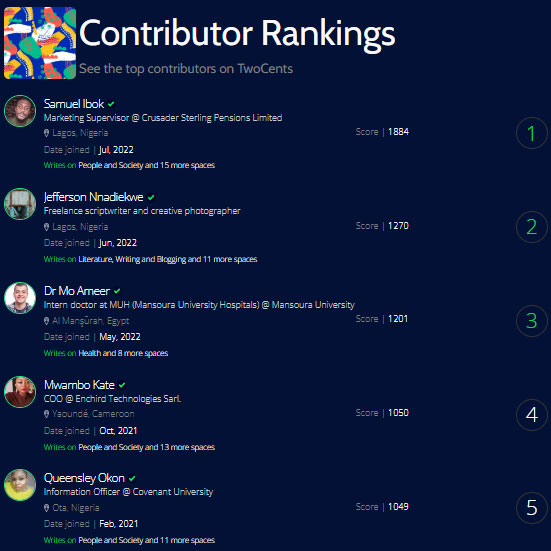
Contributor Rankings
The Rankings/Leaderboard shows the Top 20 contributors and engagers on TwoCents a monthly and all-time basis
— as well as the most active colleges (users attending/that attended those colleges)
The all-time contributors ranking is based on the Contributor Score, which is a measure of all the engagement and exposure a contributor's content receives.
The monthly contributors ranking tracks performance of a user's insights for the current month. The monthly and all-time scores are calcuated DIFFERENTLY.
This page also shows the top engagers on an all-time & monthly basis.
All-time Contributors
All-time Engagers
Top Monthly Contributors
Top Monthly Engagers
Most Active Colleges
Contributor Score
The all-time ranking is based on users' Contributor Score, which is a measure of all
the engagement and exposure a contributor's content receives.
Here is a list of metrics that are used to calcuate your contributor score, arranged from
the metric with the highest weighting, to the one with the lowest weighting.
1
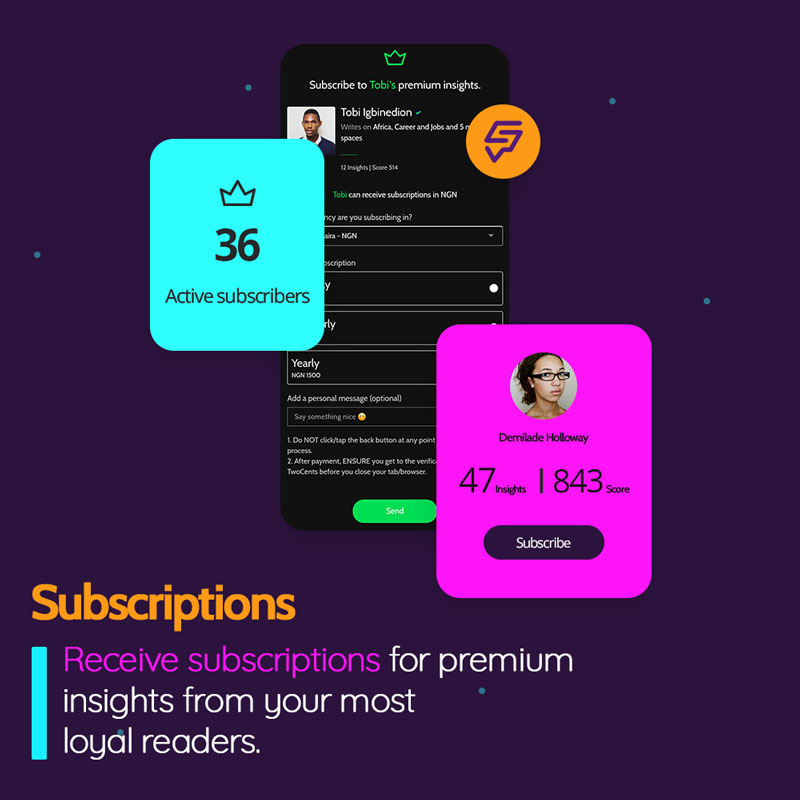
Subscriptions received
2
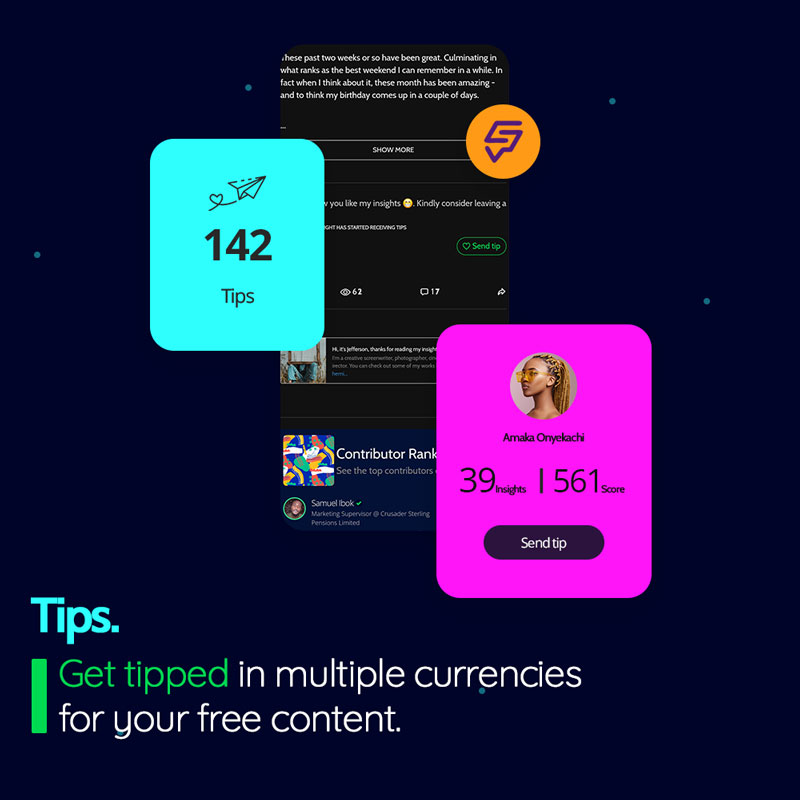
Tips received
3
Comments (excluding replies)
4
Upvotes
5
Views
6
Number of insights published
Engagement Score
The All-time Engagers ranking is based on a user's Engagement Score — a measure of how much a
user engages with other users' content via comments and upvotes.

Here is a list of metrics that are used to calcuate the Engagement Score, arranged from
the metric with the highest weighting, to the one with the lowest weighting.
1
A user's comments (excluding replies & said user's comments on their own content)


2
A user's upvotes
Monthly Score
The Top Monthly Contributors ranking is a monthly metric indicating how users respond to your posts, not just how many you publish.
We look at three main things:
1
How strong your best post is —
Your highest-scoring post this month carries the most weight. One great post can take you far.
2
How consistent the engagement you receive is —
We also look at the average score of all your posts. If your work keeps getting good reactions, you get a boost.
3
How consistent the engagement you receive is —
Posting more helps — but only a little.
Extra posts give a small bonus that grows slowly, so quality always matters more than quantity.
In simple terms:
A great post beats many ignored posts
Consistently engaging posts beat one lucky hit
Spamming low-engagement posts won't help
Tips, comments, and upvotes from others matter most
This ranking is designed to reward
Thoughtful, high-quality posts
Real engagement from the community
Consistency over time — without punishing you for posting again
The Top Monthly Contributors leaderboard reflects what truly resonates, not just who posts the most.
Top Monthly Engagers
The Top Monthly Engagers ranking tracks the most active engagers on a monthly basis
Here is what we look at
1
A user's monthly comments (excluding replies & said user's comments on their own content)

2
A user's monthly upvotes
Most Active Colleges
The Most Active Colleges ranking is a list of the most active contributors on TwoCents, grouped by the
colleges/universities they attend(ed)
Here is what we look at
1
All insights posted by contributors that attended a particular school (at both undergraduate or postgraduate levels)
2
All comments posted by contributors that attended a particular school (at both undergraduate or postgraduate levels) —
excluding replies
Below is a list of badges on TwoCents and their designations.
Comments