Score |
15



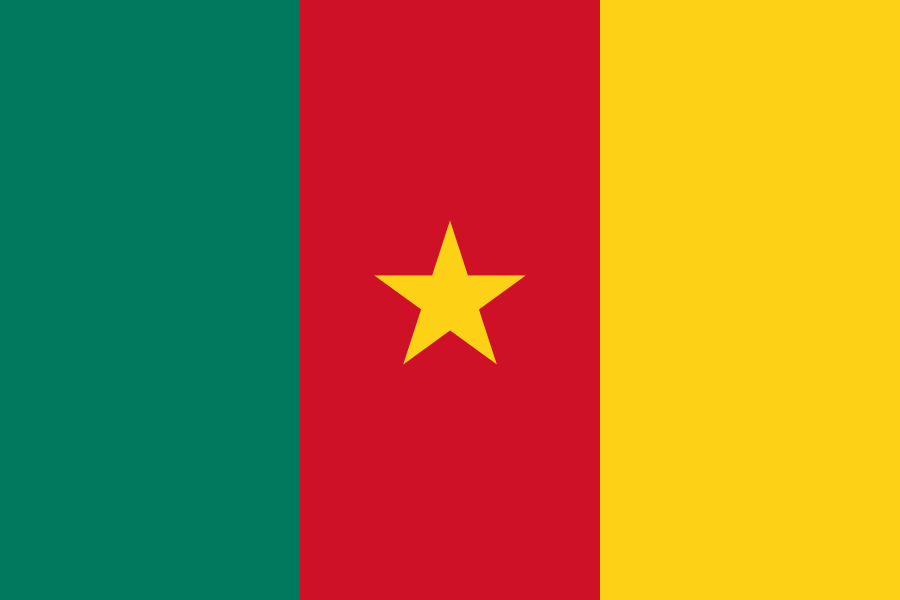



A Unique Vision for African Unity: One People, One Future

<p style="text-align: center; "><strong>A Unique Vision for African Unity: </strong></p><p style="text-align: center; "><strong><em>One People, One Future</em></strong></p><p>To me, African unity is not the idea that every African must speak the same language, practise the same culture, or belong to the same country. It is the understanding that, beneath our borders and differences, we share a history, a heritage, and a common future. It means seeing another African not first as a stranger from another country, tribe, or region, but as a fellow human being whose future is connected to mine.</p><p>Africa has many things that naturally bring us together. Our history is one of them. From the struggles against slavery and colonialism to the fight for independence, Africans have experienced challenges that created a shared consciousness. Our cultures also connect us. Across the continent, we find similar values of community, respect for elders, hospitality, family, storytelling, music, dance, and traditional knowledge. Even though our languages and customs differ, they often express remarkably similar ideas about who we are and how we should live together. The Pan-African movement, led by figures such as Kwame Nkrumah, Julius Nyerere, Patrice Lumumba, and others, also gave political expression to this idea of a shared African destiny.</p><p>Our common challenges can also become a source of unity. Poverty, unemployment, insecurity, climate change, migration, and underdevelopment do not respect national borders. No African country can completely isolate itself from these realities. When we trade with one another, share knowledge, support one another during crises, or celebrate African achievements in sports, music, literature, and technology, we demonstrate that unity is not merely an idea but a practical force for development. The African Continental Free Trade Area (AfCFTA), for example, is a practical attempt to strengthen economic ties by creating a single African market for goods and services. Similarly, regional organizations such as ECOWAS and CEMAC show that African countries can cooperate on matters that affect their shared interests.</p><p>Yet, Africa remains deeply divided. Colonial borders separated communities and sometimes placed people with different histories and interests within the same countries. Ethnic rivalry, political competition, religious tensions, nationalism, corruption, and economic inequality continue to weaken our sense of common purpose. Sometimes, we are quicker to identify ourselves by tribe or nationality than by our shared African identity. External political and economic interests can also take advantage of these divisions. For example, conflicts and political instability in parts of the continent have repeatedly shown how difficult it can be for African states to agree on collective responses to crises.</p><p>African unity, therefore, will not happen simply because we wish for it. It requires deliberate action. We need education that teaches true African history, leaders who place continental interests alongside national interests, stronger regional cooperation, greater intra-African trade, easier movement across borders, and meaningful opportunities for young Africans to participate in shaping the continent. The African Union's Agenda 2063, with its vision of a prosperous, integrated, peaceful Africa driven by its own citizens, provides an important framework for this work.</p><p>Above all, unity must begin with a change in mindset. Africa does not need to become one culture in other to be one community. Our diversity is not our weakness. If we learn to see our differences as pieces of the same African story, then our borders will no longer be walls between us but bridges connecting us.</p><p>African unity, to me, is ultimately a choice: to recognize that our destinies are connected and to build a future in which Africa's greatest strength is not merely its resources, but its people standing together.</p><p><br/></p><p>References</p><p>African Union Commission. (2015). Agenda 2063: The Africa We Want. African Union.</p><p>African Union. (2018). Agreement Establishing the African Continental Free Trade Area (AfCFTA).</p><p>Nkrumah, K. (1963). Africa Must Unite. Heinemann.</p><p>Organization of African Unity. (1963). Charter of the Organization of African Unity.</p><p>United Nations Economic Commission for Africa (UNECA). Information and publications on African regional integration and the African Continental Free Trade Area.</p>


 3
3


Other insights from Chefor Eugene











Referral Earning

Points-to-Coupons

Insights for you.


Igbo Kwenu!!!
Today, I refuse to be humble Not when I speak about my tribe...Cha Cha Cha Cha Cha,Igbo...
652 views
43 upvotes
35 comments


Confessions of a Nearly-Native
My name is Idara. I am Annang from Akwa Ibom. And I cannot speak my language.My mother ...
317 views
30 upvotes
31 comments

Agbada and Other Silences
They said it with authority no one questioned.... “Àgbà kì í wà l’ọ́jà, kí orí ọmọ tuntu...
293 views
19 upvotes
25 comments


ÌLÚ MI, ILÉ MI
Modakeke Akoraye omo ogunteludo omo akinkanju loju ogun. Maybe because of you my father...
281 views
16 upvotes
21 comments




DID YOU KNOW?
1. That the Sahara Desert wasn’t always a desert?A bazillion years ago, it was actually...
275 views
14 upvotes
14 comments


Love and Respect Your Mother Tongue.
Speaking more than one language is more than just an asset, it can also be a way to co...
1190 views
10 upvotes
15 comments






























Comments