Score |
34






English psychology
<p>What does “IS” really mean </p><p><br/></p><p>🩶 THE NUTSHELLS OF “IS” — A LITTLE JOURNEY INTO EXISTENCE</p><p><br/></p><p>Nutshell I — “IS” exists, but not necessarily as a thing.</p><p><br/></p><p>At first, I wondered whether “IS” itself exists.</p><p><br/></p><p>The word “IS” isn't an object that we can physically point to, but it exists as a concept and has meaning.</p><p><br/></p><p>So perhaps “IS” is non-existent as a physical thing, yet existent conceptually through the meaning we give it.</p><p><br/></p><p>---</p><p><br/></p><p>Nutshell II — “IS” may represent a deeper relation.</p><p><br/></p><p>I began to think that “IS” might not be the relation itself, but rather the name or linguistic representation we give to a deeper relation that already exists.</p><p><br/></p><p>For example, a chair can exist without anyone saying the word “IS.”</p><p><br/></p><p>The word didn't create the chair's existence.</p><p><br/></p><p>Therefore:</p><p><br/></p><p>Reality → relation → language represents the relation.</p><p><br/></p><p>This led to the question:</p><p><br/></p><p>What exactly is the deeper relation that “IS” represents?</p><p><br/></p><p>---</p><p><br/></p><p>Nutshell III — “IS” varies according to the relation.</p><p><br/></p><p>We discovered that “IS” doesn't have only one function.</p><p><br/></p><p>It can represent:</p><p><br/></p><p>• Existence: The chair is.</p><p><br/></p><p>• Identity: The chair is furniture.</p><p><br/></p><p>• Property: The chair is black.</p><p><br/></p><p>• Location/state: The chair is in the house.</p><p><br/></p><p>• Function: The chair is for sitting.</p><p><br/></p><p>• Meaning/description: The chair is useful.</p><p><br/></p><p>So “IS” can act as a linguistic/conceptual operator connecting something to its existence, identity, property, state, function, or meaning.</p><p><br/></p><p>---</p><p><br/></p><p>Nutshell IV — “EXIST” and “IS” overlap, but they aren't identical.</p><p><br/></p><p>“Exist” concerns having or having had being/reality.</p><p><br/></p><p>For example:</p><p><br/></p><p>🦖 Dinosaurs existed — they had being in the past.</p><p><br/></p><p>🪑 A chair exists — it has being now.</p><p><br/></p><p>But “IS” is broader than “EXIST.”</p><p><br/></p><p>We can say:</p><p><br/></p><p>The chair exists.</p><p><br/></p><p>But also:</p><p><br/></p><p>The chair is black.</p><p><br/></p><p>Here, “IS” isn't simply saying that the chair exists. It establishes a relationship between the chair and the property “black.”</p><p><br/></p><p>Therefore:</p><p><br/></p><p>EXIST → concerns being/existence.</p><p><br/></p><p>IS → can express existence AND establish other meaningful relations.</p><p><br/></p><p>---</p><p><br/></p><p>Nutshell V — The question behind “IS.”</p><p><br/></p><p>The deeper question became:</p><p><br/></p><p>«Is “IS” merely a linguistic phenomenon, or is language giving a name to something deeper that already exists in reality?»</p><p><br/></p><p>I chose the second possibility:</p><p><br/></p><p>«“IS” may be the linguistic representation of a deeper relation rather than the relation itself.»</p><p><br/></p><p>And that leaves us with a much bigger question:</p><p><br/></p><p>What is the fundamental relation that makes something “be” what it is?</p><p><br/></p><p>And perhaps that is where the real journey begins. 🩶</p><p><br/></p><p>— Almond's Theory of IS™ 🌚🧠</p>



 5
5


Referral Earning

Points-to-Coupons

Insights for you.


545 views
77 upvotes
69 comments

Your Mess has a Personality.
I know you probably don't know this, but what I'm about to tell you might actually blow...
119 views
45 upvotes
42 comments

Instincts
It's telling me, it's telling meGotten shut off a million timesBut, it's still telling ...
301 views
50 upvotes
36 comments
The Main Character Effect.
Have you ever walked past a mirror, caught your reflection, and immediately fixed your ...
148 views
36 upvotes
35 comments

Why Luxury?
If I brought you two bags right now;A Chanel bag and a Tote bag sewn by a roadside tail...
147 views
33 upvotes
36 comments
The Cage Called Her
You are her....Hidden..Wanting so badly to be and not be...Afraid of being seen, Yet cr...
331 views
43 upvotes
28 comments
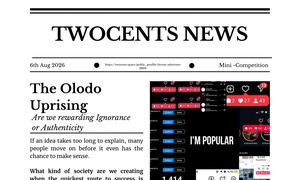

THE ALGORITHM RUNS THE SOCIETY NOW.
Seveentin!Yeah like she couldn’t spell it.It’s SEVENTEEN I know how to spell, before yo...
204 views
28 upvotes
27 comments


THE BEAST WITHIN US🤡
“Ivy! Ivy! Ivy!!! Answer me now.”“You two faced…”“Don’t even dare complete that stateme...
68 views
30 upvotes
25 comments

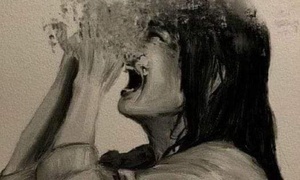
TRAUMA😣💊😊
"Get out of my house, you have no place in this world.""Why is she so quiet? She's dang...
382 views
22 upvotes
16 comments


How many, more? I'm tired...
The weight arrives before the morning light.A heavy hand presses upon the chest.We slee...
64 views
24 upvotes
25 comments