Score |
13






The Song You Write Yourself
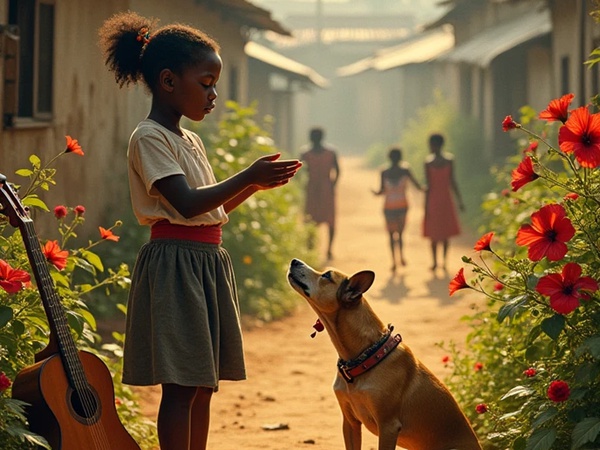
<p>When the taste of happiness departed from her life, Amina discovered that she must fashion it herself, as a carpenter shapes timber or a painter arranges color upon canvas. At first, her attempts were crude, serving only to sustain the fragile hours of the day; yet gradually, she learned the art of assembling fragments, so that each day might pass without collapsing entirely. The village around her continued its accustomed stirrings, as it always had, with roofs of tin clanging in the wind and smoke rising lazily from the hearths, curling and thinning like the memory of a forgotten dream. Children ran among these beginnings of light as if the day owed them some account, and in the midst of such quiet activity, Amina perceived the world through the soles of her feet, marking its unevenness with a count far older than speech, far older than deliberation.</p><p>Kuta approached her presently, his gait impaired, an ear absent, the evidence of some earlier misfortune etched upon his body, a silent testament to endurance rather than complaint. He had waited; he had endured. And now, in the shared stillness of their beings, he rested his head upon her palm, and she smiled, though softly, for it was a smile reserved for those who have known too little certainty to indulge in joy without reservation.</p><p>Memory, capricious as the storm, sometimes returned unbidden, like thunder arriving late to its appointed hour. She recalled, with the sharpness of pain and astonishment, the night when the firmament had seemed rent asunder. She was but three, and the air itself bore teeth; the tumult overwhelmed her tender frame, breaking something within that was never restored. People fled; fire consumed the roofs, and names dissolved into the night like startled birds. Her father had found her amid this chaos, singing softly, his chest rising and falling with a cadence she could neither name nor capture. When bullets tore through the air, he became a barrier, and all that followed effaced shape and order. When morning returned, the song was gone, and he along with it. No explanation reached her that could have steadied the trembling fragments of her understanding.</p><p>Since that hour, a certain weight had walked beside her, invisible yet relentless, constant, watchful, unresolved. It lingered at the edge of her steps, sometimes pressing too close, sometimes falling behind, marking her passage through the world. At times she found it manageable; at times, it threatened to unseat her entirely. In these latter moments, she would close her eyes and allow her body to bear the stagger, as if the world persisted somewhere beyond her reach and she might, by accident, intercept a fragment of its performance.</p><p>Her days passed not by sound, but by the measure of misstep: the pestle striking the mortar of a neighbor, the subtle creak of her mother’s feet upon the floor, the wind hammering upon the iron roofs above. Each reached her through the bones, an insistent and private rhythm, offering no explanation, only presence.</p><p>Behind her dwelling, she tended a garden seldom visited by any eye but her own. Hibiscus and cassava flourished there, alongside wildflowers that had claimed the red soil without instruction. Her hands, patient if imperfect, pressed the earth until it acknowledged her existence, or at least permitted it. At moments, she shaped a melody, a private vibration not intended for ears but to traverse her body, to release a pressure without name.</p><p>Her mother observed from the doorway, her expression caught between pride and sorrow, a mixture too intricate for the naming. She spoke softly with her hands, instructing, “Receive with your center,” and though Amina did not always understand the words, she nodded. Pressing her palm against the loosened soil, she felt the lingering impression of life and motion, faint and unbroken. The world was not empty; it was only demanding, in ways that seldom bore discussion.</p><p>When Amina reached the square, the drums had begun, and dust, thick as breath never expelled, clung to the air. The crowd pressed forward with an energy unspoken, calling names, clapping hands, poised for an event they had not fully agreed upon. She positioned herself behind the singers, hands unsteady, throat dry. The measure eluded her ears, yet her body, attuned to the rhythm of the earth beneath her, followed it nonetheless, stepping in cadence with an instinct older than language or thought.</p><p>For a fleeting instant, the old terror returned: fire, her father’s arms, the rupture that had unmade her world. She faltered, taking half a step backward, then straightened when she perceived her mother among the crowd, her silent nod both encouragement and acknowledgment. The Goje, her father’s instrument, lay in her hands, bearing warmth from hands long passed, resisting her fingers in ways that both humbled and steadied her.</p><p>When her turn arrived, she closed her eyes, letting her fingers move with hesitant certainty. The notes, though uncertain and uneven, climbed from her body into the night, carrying a private cadence of her own making. She sang, her voice trembling and late in places, yet whole in a manner that needed no approval. For a single instant, she was neither deaf, nor broken, nor small. She was a child of the land, the song her own, released from the captivity of unspoken years.</p><p>The village held a suspended breath, then responded in kind, stepping into her measure without understanding its nature. Amina smiled, faintly and without pretense, realizing that she needed not the recognition of ears to inhabit her song. Kuta settled at her side, tail brushing lightly against her leg, and in that narrow moment, she was not alone.</p><p>When the music ceased, it was not met with applause or speech, but with the quiet of shared acknowledgment, a recognition neither named nor demanded. Amina exhaled, hands aching, eyes burning, and opened them to the world, understanding that happiness is not a gift discovered, but a composition, wrought carefully by one’s own hand.</p>


 50
50


Other insights from Pen Kiel










Referral Earning

Points-to-Coupons

Insights for you.



THE MEETING
Sometimes it takes one meeting for our lives to change forever. It was never Femi'...
1240 views
12 upvotes
12 comments



OMÓ ÉSAN
They say the apple does not fall far from the tree, but I was the exception, or I was s...
1166 views
13 upvotes
5 comments



































Comments