Score |
41






Unity Dawn 2 : The Return
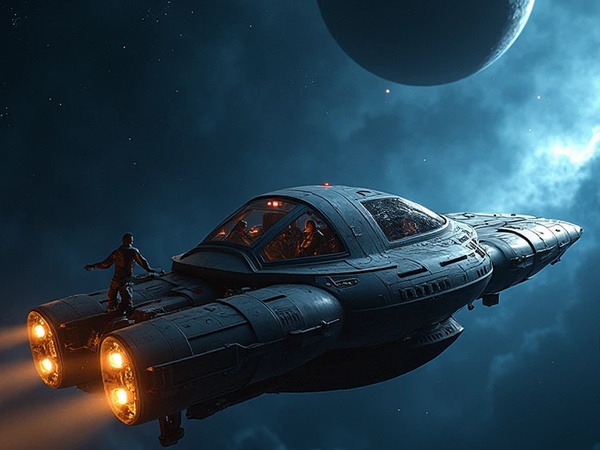
<p>The return of the Unity Dawn occurred at a time when the station had settled into its usual habits, and nothing in the conduct of the day suggested that its order would be disturbed. It is often so with events of great consequence, that they arrive without ceremony, and are known only afterward for what they truly were.</p><p>The vessel announced itself with proper form. Its signal bore no corruption, its identification was exact, and its request to dock was framed with the same restraint that had marked its earlier missions. Those who first observed the message remarked that there was nothing in it that could be called unusual, save for the fact of its existence.</p><p>For the Unity Dawn, as every man present knew, had already returned.</p><p>Captain Emeka Okafor was at that time employed in a minor consultation when the summons reached him. He listened to the report without interruption, and when it had concluded, he asked that the ship’s designation be read once more. This having been done, he thanked the officer and dismissed him. It was noted by those nearby that he remained seated for some moments afterward, his gaze fixed upon nothing in particular.</p><p>“It seems,” he said at last, “that our journey was not finished when we believed it was.”</p><p>The second Unity Dawn entered the bay with the ease of a vessel long acquainted with its surroundings. There was no hesitation in its approach, nor any correction required of its course. To those watching, it appeared not as a stranger arriving, but as a resident returning after an absence too brief to warrant explanation.</p><p>When the hatch opened, four figures emerged.</p><p>Emeka Okafor stood among the assembled officers and crew, and at the sight of the man who bore his face and name, he experienced not fear, but a peculiar fatigue, such as comes when one is asked to answer a question already answered many times before.</p><p>Ngozi’s breath caught audibly. Obinna turned away, pressing his hand against his mouth. Chioma alone maintained her composure, though her eyes did not leave her counterpart’s face.</p><p>The other Emeka Okafor inclined his head in greeting.</p><p>“You survived,” he said.</p><p>“So did you,” Emeka replied.</p><p>“Yes,” returned the other, after a brief pause. “Though not in the same manner.”</p><p>Inquiry followed, conducted with diligence and restraint. The visiting crew submitted themselves willingly, and no attempt was made on their part to evade examination. Physicians found no discrepancy in their persons. Records confirmed what sight had already made plain.</p><p>Yet as their testimonies were compared, it became evident that while their beginnings were identical, their accounts diverged sharply at a single moment in time. Each spoke of the dark form encountered beyond the known routes. Each recalled the unease that followed.</p><p>Where Emeka Okafor and his crew chose withdrawal, the others advanced.</p><p>“We believed retreat to be a form of safety,” Emeka said during one such comparison.</p><p>“And we believed,” replied the other Emeka, “that safety had already been lost.”</p><p>This exchange was recorded, though neither man appeared satisfied by it.</p><p>As days passed, the presence of the second crew produced a subtle alteration in the station’s character. Men spoke more carefully. Reflections in glass were avoided without conscious intent. Small errors in machinery were remarked upon more than usual, though none rose to the level of true malfunction.</p><p>Obinna confessed, in a moment of agitation, that he sometimes felt himself divided between two recollections of the same hour. Ngozi grew silent and withdrawn, preferring tasks that kept her hands occupied. Chioma attended closely to her duties, though it was observed that she now verified information twice where once she trusted it.</p><p>Emeka Okafor watched these changes with a steady attention. He did not attempt to reassure his crew, nor did he voice the doubts that pressed upon him. His manner remained composed, though those who knew him well perceived a growing heaviness in his speech, as if each word now carried a greater obligation.</p><p>When the two captains met in private, their conversation was long and conducted without witness.</p><p>“There is no place for two conclusions to the same journey,” Emeka said.</p><p>“On the contrary,” replied the other, “there is no journey with only one.”</p><p>They parted without agreement.</p><p>The authorities deliberated at length, and their difficulty lay not in disbelief, but in excess of belief. For once the possibility of such a return was admitted, many other assumptions grew uncertain, and the foundations upon which order depended began to show strain.</p><p>No public declaration was made.</p><p>The second Unity Dawn remained docked.</p><p>And Emeka Okafor, standing alone one evening near the observation glass, considered that the universe, having once been content with singular outcomes, had now demonstrated a troubling generosity.</p><p>It had not taken something away.</p><p>It had given something back.</p><p>And gifts, he knew, often demand payment later.</p>


 4
4


Other insights from Pen Kiel







Referral Earning

Points-to-Coupons

Insights for you.












































Comments