Score |
3




I'm Jobless writing stories @ Guardian of Planet Mars



2027 Election: The Voters Are Dead
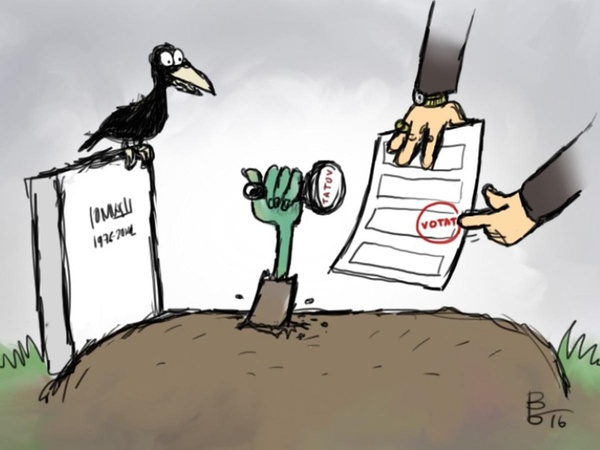
<p><br/></p><p>Four months before Nigeria officially opens the gates to the political theatre of the <strong>2027 general elections</strong>, the country is already rehearsing a disturbing paradox: <em>campaigns may begin on schedule, but the voters themselves may be missing.</em></p><p><br/></p><p>Not because they have lost interest.</p><p>Not because they forgot their Permanent Voter Cards.</p><p><br/></p><p>But because in many parts of Nigeria, <strong>the voters are dead, displaced, or too afraid to exist in public.</strong></p><p><br/></p><p>Across large swathes of northern and north-central Nigeria — from <strong>Borno to Plateau, Zamfara to Benue, Niger to Taraba</strong> — violence has begun to redraw the map of democracy. Entire villages are vanishing. Communities are emptying. Farmlands have turned into battlegrounds. Homes are becoming temporary shelters for grief.</p><p><br/></p><p>And in the midst of this, Nigeria is preparing for another election.</p><p><br/></p><p>The question is no longer <strong>who will win the election.</strong></p><p>The question is<strong> who will be alive to vote.</strong></p><p><br/></p><p>---</p><p><br/></p><h2><strong>Democracy Without People</strong></h2><p><br/></p><p>At its most basic definition, democracy is participation. It is the collective act of citizens choosing their leaders.</p><p><br/></p><p>But what happens when the citizens themselves are under siege?</p><p><br/></p><p>Recent reports indicate that hundreds of Nigerians have been killed in coordinated attacks in just the past few weeks alone. Many more have been abducted. Communities across <strong>Plateau and Benue states</strong> experienced particularly violent assaults during the Easter period — attacks that targeted not just homes but places of worship.</p><p><br/></p><p>For residents of these areas, daily life has shifted from living to surviving.</p><p><br/></p><p>Markets close early.</p><p>Schools operate in fear.</p><p>And gatherings — the very essence of political campaigning — have become security risks.</p><p><br/></p><p>Security analyst <strong>Jackson Lekan Ojo</strong>, a golden member of the International Security Association in Switzerland, puts the situation bluntly: without coordinated security operations, elections may become credible in cities but <strong>compromised in rural Nigeria</strong>.</p><p><br/></p><p>In other words, Nigeria could conduct a technically successful election while silently excluding millions of citizens.</p><p><br/></p><p>That is not democracy.</p><p>That is <strong>democracy on paper</strong>.</p><p><br/></p><p>---</p><p><br/></p><h2><strong>The Geography of Fear</strong></h2><p><br/></p><p>The 2023 governorship elections already provided a troubling preview.</p><p><br/></p><p>Across Nigeria, voter turnout was historically low. No state recorded participation above 50 percent. Only four states managed to exceed the 40 percent threshold.</p><p><br/></p><p></p><ul><li><strong>Jigawa</strong> led the country with 45 percent turnout.</li><li><strong>Adamawa</strong> followed with 43 percent.</li><li><strong>Sokoto </strong>recorded 41 percent.</li><li><strong>Plateau </strong>reached 40 percent.</li></ul><p></p><p><br/></p><p>Other states fared worse:</p><p><br/></p><p></p><ul><li><strong>Zamfara</strong>: 38 percent</li><li><strong>Benue</strong>: 29 percent</li><li><strong>Borno</strong>: just <strong>26</strong> <strong>percent</strong></li></ul><p></p><p><br/></p><p>These numbers tell a quiet story. A story not only about political apathy but about <strong>structural insecurity.</strong></p><p><br/></p><p>When citizens must calculate whether leaving their homes could cost them their lives, voting naturally becomes a secondary concern.</p><p><br/></p><p>A ballot cannot compete with survival.</p><p><br/></p><p>---</p><p><br/></p><h2><strong>Campaigns Without Access</strong></h2><p><br/></p><p>According to the Independent National Electoral Commission (INEC), campaigns for the <strong>Presidential and National Assembly elections</strong> will begin on <strong>19 August 2026</strong>, while <strong>Governorship and State Assembly campaigns</strong> will start on <strong>9 September 2026</strong>.</p><p><br/></p><p>But electoral timelines cannot override reality.</p><p><br/></p><p>How will candidates campaign in communities where roads are controlled by bandits?</p><p>How will rallies hold in villages where residents have fled into internally displaced persons camps?</p><p>How will political mobilization occur in territories where even security forces struggle to maintain presence?</p><p><br/></p><p>If insecurity continues at the current pace, candidates may campaign mostly in <strong>urban centers</strong>, while vast rural populations remain politically invisible.</p><p><br/></p><p>The result would be a dangerous imbalance — elections decided in cities while <strong>the countryside remains disenfranchised.</strong></p><p><br/></p><p>---</p><p><br/></p><h2><strong>Politics and the Cycle of Assurances</strong></h2><p><br/></p><p>Criticism of the federal government’s handling of insecurity has intensified.</p><p><br/></p><p><strong>Bolaji Abdullahi</strong>, National Publicity Secretary of the African Democratic Congress (ADC), argues that government responses to violent attacks have followed a predictable pattern since President <strong>Bola Ahmed Tinubu </strong>assumed office in May 2023.</p><p><br/></p><p>According to Abdullahi, each wave of killings is met with strong presidential statements and promises of decisive action — yet the cycle continues.</p><p><br/></p><p>His criticism echoes a growing frustration across the political landscape: <strong>words have become abundant, but solutions remain scarce</strong>.</p><p><br/></p><p>Meanwhile, <strong>Aminu Yakudima</strong> of the Peoples Democratic Party warns that the rising focus on 2027 political maneuvering could further distract leaders from addressing the underlying security crisis.</p><p><br/></p><p>When politics becomes louder than governance, insecurity often becomes its shadow.</p><p><br/></p><p>---</p><p><br/></p><h2><strong>Security: The Silent Ballot Box</strong></h2><p><br/></p><p>INEC Chairman <strong>Prof. Joash Amupitan</strong> has warned that credible elections cannot exist without security.</p><p><br/></p><p>He describes elections and security as “<strong>two sides of the same coin.”</strong></p><p><br/></p><p>This observation is more than a statement — it is a warning.</p><p><br/></p><p>Without safety:</p><p><br/></p><p></p><ul><li>Voters cannot register.</li><li>Campaigns cannot reach communities.</li><li>Polling units cannot function effectively.</li></ul><p></p><p><br/></p><p>In essence, insecurity becomes an invisible hand that shapes election outcomes long before ballots are cast.</p><p><br/></p><p>Public affairs commentator <strong>Dabo Sambo</strong> warns that failure to address banditry and insurgency may carry significant political consequences in 2027.</p><p><br/></p><p>Even traditional leaders have raised alarm.</p><p><br/></p><p>The <strong>Sultan of Sokoto, Muhammadu Sa’ad Abubakar III</strong>, has repeatedly described the deteriorating security situation as a direct threat to Nigeria’s unity and democratic stability.</p><p><br/></p><p>When monarchs begin to sound political alarms, it signals a deeper national anxiety.</p><p><br/></p><p>---</p><p><br/></p><h2><strong>Government’s Response</strong></h2><p><br/></p><p>The ruling <strong>All Progressives Congress (APC)</strong> insists that security remains a top priority.</p><p><br/></p><p>Party spokesperson <strong>Bala Ibrahim</strong> argues that tackling insecurity is central to the government’s <strong>Renewed Hope Agenda</strong>, adding that discussions on the issue occur regularly at the highest levels of leadership.</p><p><br/></p><p>According to him, the President has already declared a form of emergency on security, with ongoing reviews of strategies to improve outcomes.</p><p><br/></p><p>The assurance is familiar.</p><p><br/></p><p>But for communities living under constant threat, <strong>hope must eventually become visible.</strong></p><p><br/></p><p>---</p><p><br/></p><h2><strong>When Democracy Becomes a Memorial</strong></h2><p><br/></p><p>If the current trajectory continues, Nigeria risks holding an election where the loudest voices are not necessarily the most representative.</p><p><br/></p><p>Urban voters will dominate participation.</p><p>Rural communities may fade into silence.</p><p>Entire constituencies could be politically absent.</p><p><br/></p><p>And the tragedy is this:</p><p><br/></p><p>Many of those absent will not be silent by choice.</p><p><br/></p><p>They will be silent because <strong>violence erased their voices before democracy could hear them.</strong></p><p><br/></p><p>A nation cannot celebrate electoral victory while its citizens are buried in unmarked graves.</p><p><br/></p><p>Democracy is not merely about ballots.</p><p>It is about <strong>people</strong>.</p><p><br/></p><p>And today, in too many parts of Nigeria, <strong>the people are missing.</strong></p><p><br/></p><p>Until security returns to the villages, restores confidence in the towns, and allows citizens to live without fear, the country may continue preparing for elections that many Nigerians will never experience.</p><p><br/></p><p>Because when insecurity becomes widespread, the most endangered political institution is not the ballot box.</p><p><br/></p><p>It is the voter.</p><p><br/></p><p>And in that tragic reality, Nigeria may arrive at the 2027 elections only to discover a painful truth:</p><p><br/></p><p><strong>The voters are dead.</strong></p><p><br/></p><p>__________________</p><p><strong><em><br/></em></strong></p><p style="text-align: right; "><strong><em>Another TwoCents Insight by Emmanuel Daniji</em></strong></p><p><br/></p><p><br/></p>


 8
8






Other insights from Bigdan











Referral Earning

Points-to-Coupons

Insights for you.


Who is a news reporter?
Last time, we discussed the role and stakes of journalism in our everyday life. This ti...
1173 views
8 upvotes
6 comments

THE FISH HOUSE
One morning, I went with my mum to the … should I say fish house or fish market or fish...
1096 views
32 upvotes
15 comments

Role and Stakes of Journalism
Journalism is a profession that entails collecting, processing, and broadcasting inform...
1006 views
4 upvotes
3 comments






What Makes a Good Journalist?
Journalism is a complex yet interesting job. One has to be passionate about it in order...
638 views
2 upvotes
2 comments





























Comments