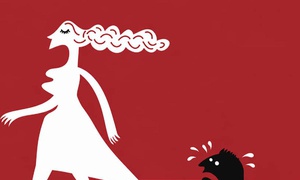
Hands in pockets, I walk. Passersby drift through the noise of highway traffic. A woman guides a Dalmatian. A foreigner. Another follows — Hispanic, ample-chested, dragging a microscopic Chihuahua. Then an Asian woman, Japanese or Korean perhaps, with a perfectly trimmed poodle. Blonde. Ebony. Caribbean? African? A beagle trots beside her.
Everyone has a dog.
Most of them live in the luxurious _Mazauna_ estate — _Anguwan turawa_, as locals call it. A monument to the new order and its imported ways. I doubt the _Hisbah_ smiles at such progress. Neither do I. Never had much reason to.
Some walk alone, most in clusters. Twos, threes, fours. One group of six. Faces carry borrowed expressions: joy, misery, neutrality. Masks all.
One man does not bother with a mask.
He staggers. Eyes red. Bags heavy. We brush shoulders. Dust bursts from his jacket like a sigh.
“I feel you,” I murmur once he passes. “They don’t care.”
A boy walks by. Headphones seal his ears.
“As I was saying,” I tell myself, “people pass suffering the way they pass streetlights — noticed, but never felt.”
When I turn back, the man is crouched, face in palms, sobbing.
I walk on.
Perhaps I lack sympathy, not empathy.
At the bridge stairs I see a boy in uniform, crying.
What do I do?
Help him? Ignore him? Continue?
He glances up. Wet eyes. A silent plea.
Uncomfortable.
Helping would be worse.
I decide to walk past.
Then I notice a woman approaching under an umbrella.
What if she helps him?
Simulation.
I would not like that.
Panic.
“Hey boy!” I call.
No response.
She is closer.
“Hey kid!”
Closer.
I grab his elbow and turn him.
“What’s the matter? Are you lost?”
He nods.
The woman walks past.
I had won.


 303