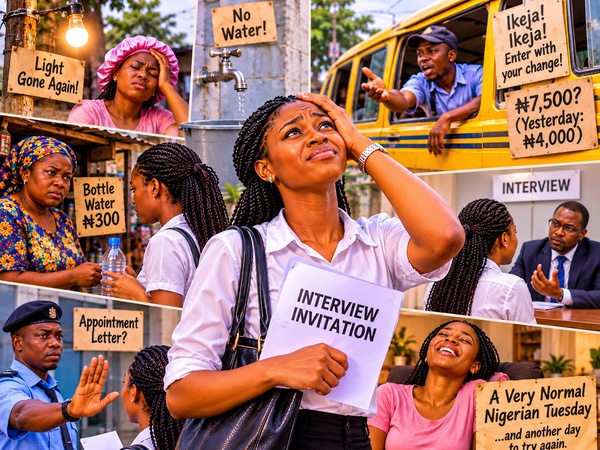
A VERY NORMAL NIGERIAN TUESDAY
Fiction
At 5:00 a.m, Amara woke up to the sound of her mother's voice.
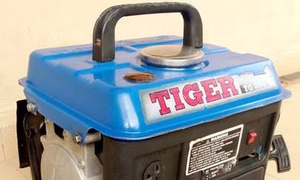
“There’s light oooo!!!”, NEPA has brought light!”.
In Nigeria, this announcement was more effective than an alarm clock. Within seconds, the entire household was awake. Her younger brother rushed to plug in his phone, her mother switched on the water pump, and Amara ran to charge her laptop.
For thirty glorious seconds, the house experienced what foreign countries apparently called normal life.
Then the light went off.
“Ahh!” her mother exclaimed. “They have taken it again!”
Amara stared at the ceiling.
She had an interview by 10:00 a.m. in Ikeja, and today was supposed to be the beginning of her new life. She had ironed her blouse the previous night, polished her shoes, printed her CV, and even practiced smiling in the mirror without looking like someone who desperately needed employment.
All that remained was to bathe, dress, eat, and leave.
Simple.
But Amara lived in Nigeria, where the word “simple” was often a warning that trouble was approaching.
She entered the bathroom and turned on the tap.
Nothing.
She turned it again, as if the tap might have reconsidered its decision.
Nothing.
“Mummy, there's no water!”
“Use the bucket in the backyard!”
The bucket contained enough water to wash one leg, negotiate with the second, and perhaps reach an agreement with her face.
Amara sighed and began the difficult exercise of distributing water according to importance. Face first, Armpits second. The remaining body parts would have to trust her perfume.
By 6:30 a.m., she was dressed and ready. Her mother had packed a small flask of tea for her, but there was no bread.
“The bread seller has increased the price again,” her mother explained. “Imagine! Ordinary bread!”
Amara nodded solemnly. In Nigeria, nothing was ordinary anymore, ordinary tomatoes had become luxury goods, transport had become a financial decision, Even the ordinary act of breathing seemed to require an economic plan.
She stepped outside and ordered a ride on her phone.
The fare was ₦7,500,
She blinked.
Yesterday, it had been ₦4,000.
Perhaps the driver was coming from another country. Perhaps the car was an aircraft. Perhaps the ride included a complimentary plate of assorted jollof rice, or better still included a treatment of Kings and Queens.
She cancelled the ride and headed for the bus stop.
At the bus stop, a danfo driver leaned out of his window.
“Ikeja! Ikeja! Enter with your change”
Amara entered.
The conductor collected her fare, examined it, and announced that the price had increased.
“But I paid the exact amount yesterday,” she protested.
“Madam, yesterday is not today.”
It was a profound statement. Somewhere, a motivational speaker was probably charging people money to teach them the same thing.
She paid the difference.
Inside the bus, a man was arguing on the phone about the price of fuel, another passenger was explaining that the government had promised relief. A third passenger laughed.
“Relief where? Maybe the relief is that we are still alive to complain.”
Everybody laughed, including Amara.
It was the Nigerian kind of laughter: the sort that came from a place too tired to cry.
At 8:45 a.m., she arrived at the bus stop closest to her destination. She was sweating, her blouse was slightly wrinkled, and her carefully arranged hair had begun to explore alternative careers.
She checked her phone.
The battery was at 12 percent.
Of course.
She entered a small shop to buy a bottle of water and perhaps charge her phone.
“Bottle water is ₦300,” the shopkeeper said.
“₦300? For water?”
The woman looked at her calmly.
“Madam, did you manufacture it?”
Amara paid.
She was beginning to understand that in Nigeria, asking why something was expensive was a form of comedy. Nobody expected an answer that would make sense. They simply expected you to pay.
At 9:35 a.m., she finally reached the office building.
The security guard stopped her at the entrance.
“Where are you going?”
“I have an interview.”
“Appointment letter?”
“I have the email on my phone.”
“Show me.”
Amara unlocked her phone. The screen went black.
Battery dead.
She stared at it in disbelief.
The security guard stared at her with the calm satisfaction of a man whose own phone was fully charged.
“Madam, without proof, I cannot allow you inside.”
“But I have an interview!”
“Everybody has something to do, madam.”
She nearly laughed. She nearly cried. Instead, she remembered that she had a printed copy of her interview invitation inside her handbag.
She produced it triumphantly.
The guard examined it, nodded, and allowed her to pass.
Amara had survived water scarcity, electricity scarcity, inflation, transportation, and a dying battery. Surely, nothing else could happen.
She was wrong.
The interviewer was already seated when she entered the room.
“You are late,” he said.
“Yes, sir. I'm sorry. There were transportation difficulties.”
He adjusted his glasses.
“Tell me, how do you handle pressure?”
Amara looked at him.
For a moment, she considered telling him the truth.
She handled pressure by waking up to electricity that disappeared before she could charge her laptop. She handled pressure by bathing with a bucket of water that had to be rationed like a national resource. She handled pressure by paying more for transport than she had budgeted, then arriving at an office where her dead phone nearly cost her the opportunity to be interviewed.
She handled pressure by living in a country where every ordinary task came with an unexpected examination.
Instead, she smiled politely.
“I'm adaptable, sir. I work well under pressure, and I'm able to remain calm when circumstances change unexpectedly.”
The interviewer nodded, impressed.
“Good. That's exactly the kind of person we need.”
Amara wanted to ask whether the company also needed someone who could survive on half a bucket of water, calculate three different transport fares before breakfast, and maintain professional composure while the country conducted practical examinations in suffering.
But she kept quiet.
The interview continued. They discussed her qualifications, her experience, and her willingness to learn. For the first time that morning, things seemed to be going well.
At the end, the interviewer smiled.
“We will get back to you.”
Amara thanked him and stepped outside.
She knew what that meant. It might mean tomorrow, It might mean next month. It might mean her application would enter the same mysterious place where electricity disappeared to.
Still, she had tried.
On her way home, she bought a small packet of biscuits. The price had increased again.
She did not argue.
She had reached a level of maturity that no textbook could teach and adapted once again.
When she arrived home, her mother asked, “How did it go?”
“I think it went well.”
“Thank God! Have you eaten?”
“No, ma.”
“There's food in the kitchen.”
Amara smiled and walked inside.
Then she remembered the electricity bill, the transport money she had borrowed from her younger brother, and the fact that she would have to print another CV if the next interview required one.
She sat down and laughed.
Her mother looked at her suspiciously.
“Why are you laughing?”
“Mummy, nothing.”
But it wasn't nothing.
It was the absurdity of having to be exceptional just to manage an ordinary day. It was the strange comedy of a country where survival itself could qualify as work experience.
That evening, the electricity returned.
“Up Nepaaaaa!!!!!”.
The whole house erupted in celebration.
Her brother shouted. Her mother ran to switch on the pump. Amara rushed to plug in her phone and laptop.
The light stayed on for exactly four minutes.
Then darkness returned.
Nobody screamed this time.
Her mother simply looked up and said, “At least we have seen light today.”
And somehow, that was enough to make everybody laugh again.
Because tomorrow, they would wake up early, search for water, calculate transport fares, complain about prices, and try again.
Not because life was easy.
Not because the system worked.
But because in Nigeria, even hope had learnt to manage expectations.
And if the country ever decided to put that skill on a CV, every Nigerian would be overqualified.
THE END.



 1