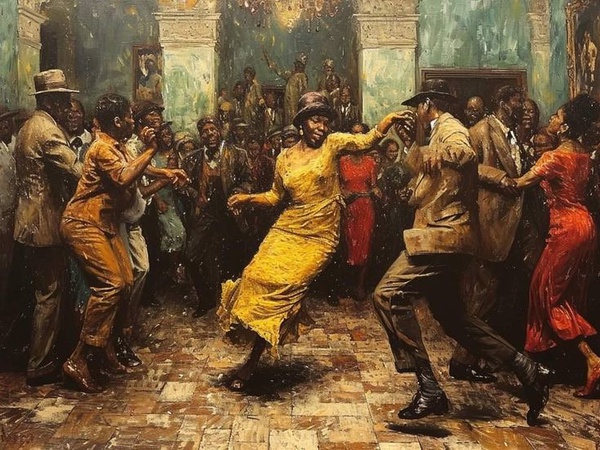
I was thirty-two the first time I saw a woman dance without caring who was watching.
It was a Saturday.
The moon was particularly generous that evening, spilling itself over the rooftops of our little village, finding its way into reflections of water in cooking pots, empty beer bottles and the narrow spaces between wooden doors. The air smelled of roasted corn, palm wine, charcoal and the sort of perfume women saved for weddings and funerals.
There was a celebration in the village square.
Nobody could remember whose idea it had been, but by sundown, it hardly mattered. Someone had brought out the talking drums, someone else had supplied the ogogoro, and before long, even the people who had sworn they would not attend were dragging stools towards the square to watch or join in.
I went because my husband had gone.
I stayed because the music was good.
And because, although I would never have admitted it aloud, I wanted to watch the women dance.
There is something seductive about a woman who has forgotten herself in music.
So I watched them from beneath the iroko tree, my wrapper tied firmly around my waist, my arms folded across my chest. They were not like me. They did not keep checking whether their blouses had slipped or whether the old men were watching. They did not seem to remember that their mothers had raised them to sit properly, speak softly and keep their knees together.
They danced.
Their waists moved in circles that seemed to have no business belonging to the human body. Some bent so low I feared they would never straighten again. Others rolled their shoulders, stamped their feet and threw their heads backwards, laughing as their ìlẹ̀kẹ̀ ìdí ( waist beads)clicked against one another.
One particularly audacious girl, who I was certain was barely twenty, had tied her wrapper so high above her knees that I nearly swallowed my tongue.
I shook my head.
Shameless girls.
Yet I watched her for another five minutes.
I was a little jealous, truth be told. Not of the attention they received, but of the freedom with which they occupied their bodies. At thirty-two, I had already spent years learning how to make myself smaller. How to sit. How to laugh without showing too many teeth. How to walk without attracting unnecessary attention. After all, it was only my husband’s attention I needed, and we saved that for the bedroom.
Those girls, though, had apparently missed that particular lesson.
The men were no better. They had loosened their shirts, abandoned their sandals and formed little circles around the women. Some danced with their hands raised, others with their knees bent and backs arched, competing to see whose waist could keep up with the talking drum.
Palm wine flowed freely.
An old man who sold yams at the market had removed his cap and was shaking his head so vigorously that I feared his neck would snap. His wife, who was at least sixty, was dancing with a bottle balanced on her head.
I laughed until my stomach hurt.
It was a beautiful night.
I remember that much.
I remember the children running between the dancers, the women fanning themselves with folded wrappers, the smell of pepper soup drifting from Mama Biodun’s stall. I remember a young couple arguing over who had stepped on whose toes. I remember a drunk man attempting to dance like a chicken and falling flat on his backside.
And I remember the boy.
His name was Seyi, the only son of the late Chief Akinwale. After the death of his first wife, Chief Akinwale had married a second woman, Ronke, only to die three months into the marriage following a brief illness.
I knew Ronke. Everybody did.
She had a peculiar way of laughing, with her whole body leaning forward, as though the laughter were too heavy to carry upright.
That night, Seyi was dancing with her.
At first, I thought he was dancing with one of the girls from the next compound. His fingers were moving rather fondly across her lower back.
Then I saw her face.
She wore the same yellow wrapper I remembered from her husband’s funeral. Her hair was gathered into the same low knot, and the little gold earrings she had worn every Sunday were still in her ears.
She held the boy’s face between her palms and moved with the music.
I blinked.
The boy laughed.
I blinked again.
She was still there, grinding her hips to his crotch as he held her close.
I looked towards the people standing beside me, but nobody seemed particularly interested in them.
Chief Akinwale’s brother was seated near the palm wine sellers, drinking from a battered aluminium cup. His eyes were fixed on his nephew.
He was not smiling.
I wanted to ask what he could see and why he wasn’t doing anything, but the drums grew louder, and the noise of the crowd swallowed my attention.
Perhaps it was the wine.
Perhaps it was simply the moon playing tricks on a thirty-two year old woman’s eyes.
At midnight, the music changed.
Nobody announced it. The drummers simply shifted into a rhythm I had never heard before.
It was slower at first, then quicker, until it became so impossibly fast that I wondered how their hands managed to keep up.
The dancing changed with it.
People who had been sitting began to rise.
A pregnant woman abandoned her chair and joined the circle. Two elderly brothers, who had not spoken to each other in eleven years over a piece of land their father had left began dancing together. A little girl danced with her grandmother. The village tailor danced with the woman whose wedding dress he had ruined two weeks earlier.
Even the priest’s younger brother, a man who considered laughter a form of indiscipline, was swinging his waist in the middle of the square.
It was becoming ridiculous.
And wonderful.
But something was wrong.
I noticed it first when Mummy Funke dropped her fan.
She did not bend to pick it up, even though she was sweating like a Christmas goat.
She simply kept dancing.
Then I noticed that nobody was drinking anymore. The calabashes sat abandoned on the ground, their contents spilling into the dust.
A man fell.
He got up immediately and continued dancing.
A woman stumbled against the firewood stall, scraped her knee and laughed without looking down.
The musicians were sweating terribly. One drummer’s hands had begun to tremble, but he did not stop. His eyes were fixed on something beyond the crowd.
I began to feel uncomfortable.
I turned towards my husband.
He was dancing.
My husband, who had once complained that dancing at our wedding was a waste of energy, was dancing with three women at once. His cap had fallen off. His shirt was open at the chest, and his face was shining with sweat.
I called his name.
He did not hear me.
I called again.
Nothing.
Then I noticed something that made the hair on my arms rise.
The people were no longer dancing to the drums.
The drums were following them.
Every movement, every turn, every stamp of the foot seemed to happen before the musicians could produce the corresponding sound.
It was as though the music had stopped being something they played and had become something the people were obeying.
I looked at the sky.
The moon was disappearing.
I decided to go home. When my husband was ready, he could come and meet me, I thought.
I had barely taken four steps when someone caught my wrist.
It was Ronke.
Her skin was cold.
She looked at me and smiled.
For the first time that night, I noticed that her feet were not touching the ground.
I screamed.
The drums stopped.
Not gradually. Not with a final flourish.
They simply stopped.
Every head turned towards me.
A cock crowed.
It was five o’clock.
I remember the exact time because the church clock, which had been broken for almost six months, struck five.
And then, as though somebody had cut an invisible string holding the village together, everybody fell.
Seyi fell first.
Then Mama Biodun.
Then the tailor, the priest’s brother, the pregnant woman, the little girl and her grandmother.
My husband fell with his hands still raised above his head.
Seyi fell into the arms of his stepmother.
Both of them hit the ground with a thud.
There were no screams.
No final words.
No dramatic struggle.
Just bodies.
Hundreds of them.
The drums lay scattered across the square. One of the calabashes had rolled into the gutter. A woman’s gold earring glittered in the dust beside a dead man’s hand.
I did not move.
I don’t know how long I stood there. Shock has a peculiar way of convincing the body that movement is no longer necessary. I simply stood, staring at people I had known all my life, waiting for somebody to get up and tell me it was a joke.
Nobody did.
By ten in the morning, the market women who had missed the celebration began arriving with their baskets of fish and fresh farm produce.
They were the first to scream.
By noon, the entire village had gathered around the square. People stared at their dead relatives, some refusing to believe what their eyes were telling them.
By one, the wailing had begun. The noise attracted people from neighboring villages.
By two, somebody had sent for the police officers from three towns away.
At three, the village had run out of explanations.
Some said poison. Others said a strange illness. A few insisted it was witchcraft.
four pm and the doctors had found nothing conclusive. There were no signs of poisoning, no evidence of violence, no explanation for why people of different ages, occupations and bloodlines had all died at precisely the same moment.
At five, I was tied to the belly of the same tree beneath which I had sat to watch the celebration.
My wrists were bound behind me. My wrapper was torn, my throat was dry, and nobody had bothered to explain what I had done wrong.
Apparently, being the only person who had survived the night was explanation enough.
Some said I had brought the misfortune upon the village. Others said I had known something and deliberately kept quiet.
One woman spat at my feet and called me a witch.
I wanted to tell them about Ronke.
About her cold fingers. About her yellow wrapper. About her feet that never quite touched the ground.
But I had already tried explaining that to the police. They had looked at me the way people look at a mad woman who has been given too much time to speak.
By six, the crowd had begun to thin.
The bodies had been covered with whatever cloths people could find. Mothers were still calling the names of their children. Men who had spent the afternoon insisting that poison was responsible had begun to whisper prayers.
I was left beneath the iroko tree.
Alone.
The evening grew unusually quiet. Even the birds seemed to have abandoned the branches above me. I could hear the distant cries of grieving families, the occasional barking of a dog and the rustling of dry leaves against the earth.
Then I heard it.
Three beats.
A pause.
Two beats.
Another pause.
Three beats.
I lifted my head.
It was the same rhythm from the previous night.
I pulled against my restraints, looking towards the village square. There was nobody there. The drums had been gathered and taken away hours earlier. I had watched them do it.
Three beats.
A pause.
Two beats.
Another pause.
Three beats.
This time, the sound seemed closer.
I tried to shout for help, but my voice came out as little more than a whisper. My chest tightened. The air around me grew unbearably heavy, and something cold began to crawl up my legs.
I remember thinking of my husband.
I remember wondering whether he had been afraid when he fell.
And then, for reasons I cannot explain, I looked towards the tree.
Its branches were moving.
Not with the wind. There was no wind.
They were swaying to the rhythm.
I closed my eyes.
The last thing I remember was the sound of the drums growing louder, until I could no longer distinguish one beat from another.
They found me the following morning.
I was still tied to the tree.
By then, the village had lost every last one of its witnesses.
Nobody could explain what had happened to me. Nobody could explain why my body was cold, or why the rope around my wrists had remained untouched.
They buried me beside my husband.
The iroko tree still stands in the village square.
Every year, when the anniversary of the Great Fall approaches, the elders warn the children not to wander near it after sunset. They tell them that the tree is old, that its branches are dangerous and that strange things happen beneath it.
But sometimes, particularly on quiet Saturday evenings, people hear something coming from the square.
Three beats.
A pause.
Two beats.
Another pause.
Three beats.
The elders say it is nothing.
They say the tree is only settling.
But nobody stays long enough to find out.
And if you ever hear that particular rhythm, wherever you are, whatever you are doing, do not stop to count the beats.
Do not look for the drummer.
And whatever you do, DO NOT DANCE


 16