Score |
249


Yemi And The Pen
 Writer | Educator | Student @ Lagos State University
Writer | Educator | Student @ Lagos State University



IDENTITY
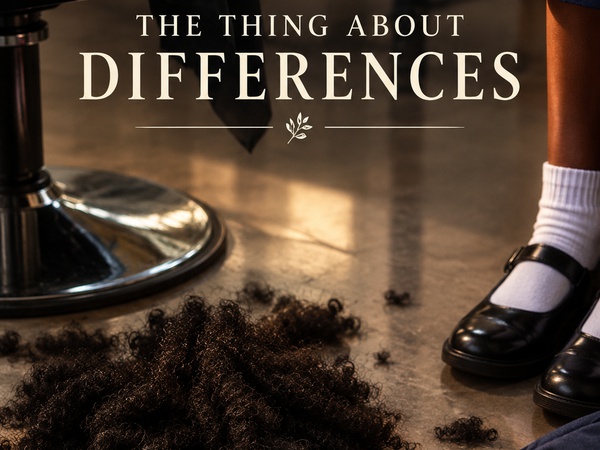
<p><strong><em>The Thing About Differences</em></strong></p><p><br/></p><p>One morning, a young girl stood outside a school building with her mother, holding her hand as they went inside to make inquiries about admission.</p><p><br/></p><p>She followed her mother into the principal's office and sat quietly while the adults talked.</p><p>They talked about uniforms, textbooks, fees, codes of conduct.</p><p><br/></p><p>Most of it went in one of her ears and out the other, until the principal said something that made her pay attention.</p><p><br/></p><p>“Girls are not allowed to keep long hair. It must be cut and maintained that way.”</p><p><br/></p><p>The young girl looked at her mother. Her mother gave no indication that she was bothered with the rule. That bothered her. But the girl knew better than to argue with an authority figure, so she kept quiet.</p><p><br/></p><p>On the way home, she made her position very clear. She did not want to attend that school.</p><p><br/></p><p>Her mother dismissed her concerns almost immediately. “It is the best school,” she said. “You don't need hair to excel. You need brains. The principal said low haircut will help you concentrate.”</p><p><br/></p><p>The girl said nothing. But she was furious.</p><p><br/></p><p>She had spent years growing her hair. It was thick, healthy and natural. It was part of her. Now someone had ruled that having it made her less capable of learning, and her mother had agreed with them.</p><p><br/></p><p>The next day, her mother took her to a salon.</p><p>She sat in the chair and watched her hair fall to the floor, strand by strand, until there was almost nothing left.</p><p><br/></p><p>She went to school. She followed the rules. Wore the uniform. Sat through her lessons. Answered questions. Wrote her examinations.</p><p>And, as expected, she learned perfectly well. Though she knew deep down nothing about her exceptional performance had to do with her lack of hair.</p><p><br/></p><p>A year later, another girl arrived at the school.</p><p>The same principal explained the same rules.</p><p>Except this time, there was an exception. The girl didn't have to cut her hair.</p><p><br/></p><p>Why?</p><p><br/></p><p>Was her father some billionaire who had managed to convince the school to bend its rules?</p><p><br/></p><p>No.</p><p><br/></p><p>She simply had paler skin. Her hair was finer and thinner. She was White.</p><p><br/></p><p>And suddenly, the rule that was apparently necessary for concentration wasn't so necessary anymore.</p><p><br/></p><p>The first girl couldn't look at the other girl without remembering the hair she had been forced to cut. It wasn't the girl's fault. She hadn't created the rule. She hadn't asked to be exempted from it.</p><p><br/></p><p>But her presence exposed something that had been easier to ignore when everyone was being treated the same.</p><p><br/></p><p>Ignorance was brought to light in the assumption that one kind of hair was acceptable and another was a problem that needed to be corrected.</p><p><br/></p><p>Disregard was revealed in the idea that African girls had to change something natural about themselves to become better students, while a White girl could walk into the same school with hers untouched.</p><p><br/></p><p>The double standard made her angry. And not irrationally because it was absolutely justified.</p><p><br/></p><p>If long hair truly made concentration impossible, why did the rule disappear for her?</p><p><br/></p><p>The girl began to understand that what had happened to her was bigger than a haircut. It was about the things people had been taught to consider beautiful, respectable and acceptable. It was about how easily colonial ideas could survive long after colonial rule had ended.</p><p><br/></p><p>She had grown up hearing that certain things were simply “the way things were.” And that was the problem. People had stopped asking why.</p><p><br/></p><p>Why was natural African hair considered untidy? Why did looking more European somehow become associated with being more presentable? Why were African children taught to feel ashamed of parts of themselves that had belonged to their people for generations?</p><p><br/></p><p>The girl didn't have all the answers. She only knew that the White girl wasn't superior because she was White. Her hair wasn't better. Neither was her skin. And the girl's own hair wasn't something that needed to be fixed before she could be educated.</p><p><br/></p><p>Years later, she would understand that unlearning colonial thinking would not happen overnight. It would require uncomfortable conversations, questions, resistance and, most importantly, people willing to challenge ideas that had been passed down without examination.</p><p><br/></p><p>Changing the minds of the elders wouldn't be easy. Changing the system would be even harder. But every change had to begin somewhere.</p><p><br/></p><p>Perhaps it could begin with a girl who had once sat silently in a salon, watching her hair fall to the floor. A girl who eventually learned that her hair had never been the problem.</p><p><br/></p><p>The system was the problem.</p>


 67
67


Other insights from Yemi And The Pen











Contributor Points
Points-to-Coupons

Referral Earning
Insights for you.


All that I gave
Oh, hey there!It's me... again...You know, There's so much I want to saySo much I want ...
583 views
97 upvotes
95 comments




The Root of Evil.🌚
I like money.But they said it's the root of evil. 🙂Sorry, get your facts straight.The l...
302 views
78 upvotes
88 comments

The Manipulation.
"Mom started looking at me differently from that day.I remember it like the back of my ...
301 views
75 upvotes
91 comments




The 3AM World.
My favourite time of every day is between 1 a.m. and 4a.m.That's when the world is the ...
270 views
67 upvotes
72 comments

Drowning.
I can't breathe.I tried again.Nothing.My lungs burned.The water surrounded me, cold and...
281 views
61 upvotes
72 comments

Eden.
I came to this house very young, with one other.We were accepted so warmly.Everyone lov...
266 views
59 upvotes
71 comments