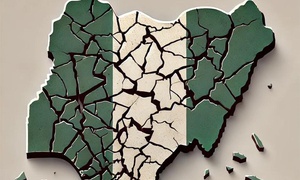
Isn't it both ironic and intellectually malnourished to claim that poverty, rather than illiteracy, is the bane of underdevelopment in Nigeria? At first glance, blaming poverty seems convenient. Yet a closer look at the core concepts at stake, namely bane, underdevelopment, poverty, illiteracy, and Nigeria itself, reveals that material poverty is merely the symptom, while functional illiteracy is the true disease.
To appreciate the weight of this argument, we must first understand what a bane truly is. A bane is not a minor inconvenience; it is the root cause of misery, ruin, destruction, and stagnation. Similarly, underdevelopment refers to a state of immaturity, a condition marked by low economic productivity and weak technological sophistication. To claim that poverty is the bane of Nigeria's underdevelopment is to argue that a lack of money is the sole origin and inciter of the nation's stagnation.
Poverty, in its conventional sense, is the deficiency of something needed or desired, or the state of lacking money, possessions, and basic necessities relative to one's contemporaries. However, poverty is never limited to material things like food, clothing, and shelter. Society also suffers from poverty of the mind, poverty of health, poverty of opportunities, poverty of discipline, poverty of leadership, and poverty of vision.
Just as there are varieties of poverty, there are varieties of illiteracy. Those who define illiteracy merely as the inability to read and write within the four walls of a classroom miss the larger reality. Education is not confined to books, pens, chalkboards, and desks. It is the holistic training of the mind through knowledge to reason, innovate, and solve problems. Illiteracy, therefore, is the poverty of proper education, or the inability to translate learning into productive action.
To prove that illiteracy, not poverty, drives Nigeria's underdevelopment, it is unnecessary to compare Nigeria with Britain or America. A fairer and more revealing comparison is measuring Nigeria against itself, looking at what it was before formal Western education arrived in Badagry in 1842. Long before colonial rule, Northern Nigeria sustained centuries of established Islamic and Ajami scholarship, while southern communities thrived on rigorous guild and apprenticeship systems in blacksmithing, weaving, farming, and trade. In those societies, poverty was not measured by a lack of cash income, because almost every family had access to farmland, practical skills, and communal support. Extreme deprivation was rare outside of war, plague, or drought, because indigenous education was tied directly to production and self-reliance.
Colonial education disrupted that foundation. Designed primarily to train clerks, interpreters, and civil servants to administer the British empire, it was never structured to build factories, modernize agriculture, or foster local industries. Decades later, Nigeria's curriculum still mirrors that white-collar mindset. As the nation's population expanded from roughly 15 to 20 million in 1900 to over 230 million today, formal schooling and urbanization pulled millions away from self-sustaining communal enterprises into cities where everything requires cash. Meanwhile, the civil service and industrial base failed to grow fast enough to absorb them.
Today, education in Nigeria is by no means scarce. According to the Federal Ministry of Education's Nigeria Digital Education Management Information System (NEMIS) Annual School Census, Ekiti State alone has 2,905 registered basic and secondary schools across its 16 Local Government Areas, with 424,582 enrolled learners. Scaled across all 36 states and the Federal Capital Territory, Nigeria produces millions of graduates, professors, and professionals.
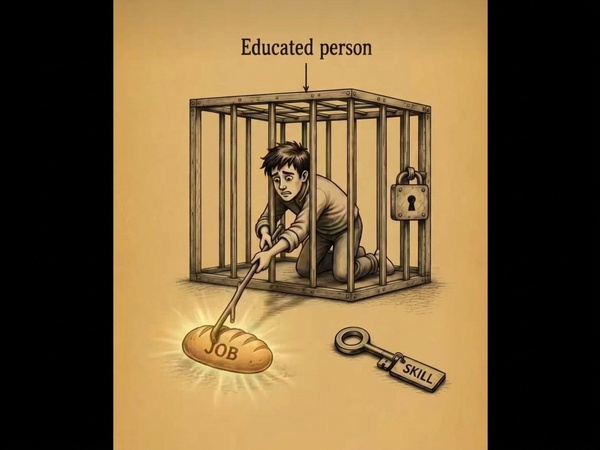
Yet the statistical reality remains sobering. The National Bureau of Statistics (NBS) reports that approximately 133 million Nigerians live in multidimensional poverty, lacking healthcare, clean water, sanitation, nutrition, or quality schooling, while World Bank estimates place over 100 million Nigerians in extreme monetary poverty. Meanwhile, millions of degree-holding youths remain unemployed or trapped in low-wage informal jobs. This structural mismatch begs a fundamental question: what is the point of an education without liberation? If illiteracy were not the root problem, why does poverty persist amidst millions of scholars?
Furthermore, Nigeria is not a poor nation. Statistically, Nigeria ranks among the most resource-endowed countries on earth, holding roughly 210 trillion cubic feet (TCF) of natural gas, 37 to 38 billion barrels of crude oil, 38 billion barrels of bitumen, 3 billion metric tonnes of iron ore, 2.3 trillion tonnes of limestone, 2.75 billion tonnes of coal, and 10 million tonnes of lead and zinc. Beyond these, it possesses rich alluvial deposits across the Schist Belt (Zamfara, Kebbi, Osun, Niger, Kaduna, and Kwara), high-value gemstones (sapphire, tourmaline, aquamarine, emerald), critical tech minerals like lithium, tin, columbite, and tantalite, and roughly 37 million hectares of arable land that make it the world's leading producer of yam and cassava.
With enough natural wealth to feed nations, Nigeria's crisis is clearly not a lack of resources. It is the illiteracy required to manage them. Too many citizens have confined literacy to narrow academic specialization, knowing everything about one subject while remaining ignorant of how to build systems or steward wealth. The result is a population filled with educated illiterates, meaning individuals who went to school without schooling their minds, and who hold certificates without the competence to build a nation.
Nigeria will only break free from underdevelopment when it redefines education beyond passing examinations. True progress demands holistic literacy, including literacy in financial management, leadership, governance, health, character, emotional stability, and civic discipline. Financial capital is only one currency in human development, and without intellectual and moral literacy to guide it, it is easily squandered. Until Nigeria educates its citizens to solve problems rather than wait on the government for survival, underdevelopment will remain its reality, proving beyond doubt that illiteracy, not poverty, is the true bane of the nation.



 17