Score |
299


Oluwakemi Lijofi
 Student @ Adekunle Ajasin University, Akungba-Akoko,



NIGERIAN GOVERNMENT AND ADMINISTRATION
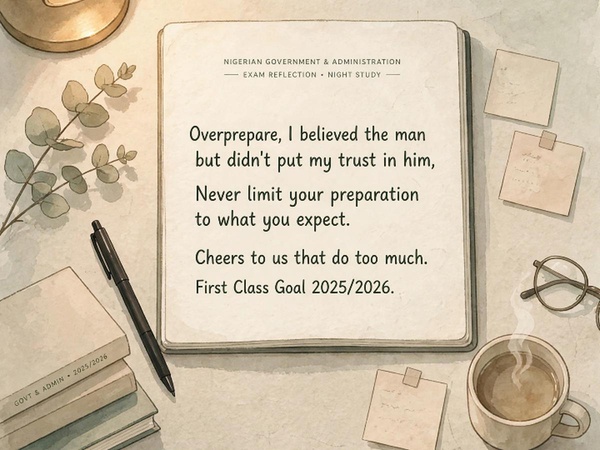
<p><br/></p><p>So guys, I wrote my first exam for the second semester examination today. </p><p>Let me tell you about a little experience that would have shocked me and pierced my heart if I wasn't more careful.</p><p><br/></p><p>Before the examination, in the last class I attended for this course, the lecturer in charge of the course recommended areas our reading should be concentrated on (something we call AOC).</p><p><br/></p><p>I was happy and excited with the thought that I was going to read with a sense of direction. But guess what, when the questions came, I saw that the AOC he gave was quite different from the questions asked. </p><p>Like I said earlier, my heart would have been pierced from seeing the questions.</p><p>Bur then,</p><p>Cheers to us that do too much </p><p>Cheers to us that take hundred steps when everyone is taking ten </p><p>Cheers to us that would believe things people say but still choose to be more careful so as to prevent unnecessary heartbreaks</p><p><br/></p><p>Thankfully, I read the AOC given and even read outside of it.</p><p>I believed the man but I didn't put my trust in him. Yes, there's a difference.</p><p>And my decision to read beyond the AOC was helpful because I was able to answer the questions.</p><p><br/></p><p>*A quick reminder: Never limit your preparation to what you expect; prepare for what you might not expect.*</p><p><br/></p><p><br/></p><p>Nigeria Government and Administration is a course that explores how Nigeria's political and administrative systems evolved.</p><p><br/></p><p>The area now called Nigeria was made up of different territories, kingdoms and empires. Each of these territories had their peculiar leadership structures and organisation. </p><p><br/></p><p>Nigeria's journey officially began under the British Colonial Administration during which systems such as the Indirect Rule was introduced. This system was successfully implemented in some areas while it completely failed in others. As time passed, Nigerians demanded for greater participation in administration and governance leading to policies such as Nigerianisation. </p><p><br/></p><p>Nigeria finally got her independence on the 1st of October, 1960. Sadly, the years that followed came with series of military interventions, leading to political instability and regional tensions. At different points military rule interrupted democratic governance until Nigeria returned to civilian rule on May 29, 1999 which marked the beginning of the Fourth Republic of Nigeria.</p><p><br/></p><p>Regardless of these changes that happened in the political life of the country, the public service of which the civil service is only a part of it, have remained important in governance, especially in the implementation of government policies, providing public services and promoting national development. </p><p><br/></p><p><br/></p><p>Studying this course has made me understand how Nigeria's government has evolved and I think her history still influences her till today. </p><p><br/></p><p>*Sometimes what saves us is what we choose to learn outside what we were told. Listen to guidelines but don't let it cover up for your own preparation*.</p><p><br/></p>


 21


Other insights from Oluwakemi Lijofi












Contributor Points

Points-to-Coupons

Referral Earning

Insights for you.


Drums Before Guns
Before we had tanks, we had talking drums. Before we had political parties, we had prai...
315 views
32 upvotes
29 comments


We want to live🥺
There's something I've noticed about Nigerians in the diaspora.They sometimes seem to h...
116 views
24 upvotes
27 comments
Classism in a third-world country is ...
If you've ever driven through Abuja, you'd see the absurd theater of our class wars. A ...
474 views
22 upvotes
30 comments


We Are All Olodo's
/oh-loh-doh/ A Nigerian slang used to describe someone who is dull, slow to grasp conce...
200 views
23 upvotes
22 comments

DISTURBED PEACE
My heart keeps racing With a speed uncontrollable What is happening to my peace?What ca...
132 views
19 upvotes
22 comments

IT IS OKAY TO CRY
It is okay to cry and just shed tears Shedding tears is only an outpouring of your emot...
130 views
18 upvotes
21 comments

Tight purse strings: trying to mainta...
Tight Purse StringsChinedu stared at his phone, the banking app's balance glaring back ...
529 views
17 upvotes
14 comments

The Fallen Giant: A lament for Nigeri...
Oh My Country NigeriaOh My Country Nigeria, your soil drinks the tears of toddlers, l...
241 views
18 upvotes
18 comments


Olodo Must Go! Or Must He?
The Big Celeb runs for dear life.The mob is faster.“See him there!”“Him wan try run. Ca...
174 views
21 upvotes
18 comments


THIS IS NIGERIA- NOT ALL OF IT
Popo stop me I fear dem wan to shoot meSearch my bags like say He wan to loot meComot m...
429 views
15 upvotes
19 comments
































