READY OR NOT, HERE WE COME
Somewhere, before the first disappointment, there must have been a moment when everything was exactly as it should be,
when nothing was broken,
nothing was missing,
and darkness was simply the absence of light, not a lifestyle.
Then came the beginning.
There was darkness.
Then God said, “Let there be light.”
And Nigeria said, “Oga, is there a prepaid meter?”
God, who had created galaxies without consulting a contractor, looked at His work and sighed.
He had not anticipated this.
He had created a country where even the sun would eventually be asked to submit an application before shining.
But I am getting ahead of myself.
Nobody knows tomorrow, except Nigerians.
Tomorrow is Wednesday.
Unless the government declares Thursday a public holiday, NEPA takes Monday, and the rain postpones the entire week.
Tomorrow knows everybody, has collected their details and is still processing their application.
Here, time does not fly. It enters a danfo, discovers the driver has no change, and spends the next three hours negotiating its existence.
The future is a beautiful place, we have been there several times,
usually during election campaigns.
We have shaken its hands, taken photographs with it, and watched it disappear into a convoy.
The Nigerian mother possesses a sixth sense capable of detecting an unopened bottle of malt from three rooms away, or noticing that a piece of meat has gone missing from a plate of supposedly identical portions.
She knows when you're pretending to sleep, even when you've mastered the art of lying completely still with your eyes shut.
She also remembers the exact amount of money she gave you in 2014, but somehow cannot recall the money she “kept for you”, or the one you gave her to keep, which has since become a non-refundable contribution towards the nine months she carried you.
She can also preserve an ice cream container for seventeen years, only for you to open the freezer expecting vanilla and discover that it has been repurposed to house egusi soup.
A danfo conductor can calculate seven passengers, four destinations, eleven different fares and the precise emotional weakness of a stranger in approximately six seconds.
And the Gala sellers.
Dear God.
The Gala sellers deserve an independent chapter in the history of physics.
Those men are not human, they are a highly classified species of celestial athletes who have rejected immortality in favour of roadside commerce.
I once watched one pursue a moving vehicle with a tray of Gala and La Casera.
The driver accelerated,
he accelerated.
The driver changed lanes,
he changed dimensions.
For a brief moment, the laws of motion submitted their resignation.
Somewhere in the world, a scientist detected an unexplained disturbance in the Speed Force.
The Flash had been overtaken by a man whose entire business model depended on your inability to resist a sausage roll.
He caught the vehicle. No surprise there.
Extended his hand.
“Oga, cold one. Take two.”
He collected his money,
he disappeared.
I suspect he was never there.
Perhaps this is why our national anthem should include a warning about supernatural activity.
Our roads are not roads.
They are archaeological excavations of abandoned promises.
Some potholes have developed political ambitions, others have been in office longer than the people elected to repair them.
One of them, I suspect, is currently considering a second term.
During the rainy season, they become lakes, acquire aquatic life and begin demanding fishing licences.
When the rain comes, the roads become rivers, danfo buses develop maritime instincts, conductors begin collecting fares like ship captains, and passengers discover that their transport fare apparently includes a complimentary baptism.
Motorcycles acquire the spiritual confidence of Noah's ark.
And somewhere, a man wearing a reflective vest stands beside a flooded road, directing traffic into a puddle deep enough to have its own ecosystem.
“Oga, move small!”
Small?
My brother, that water has a landlord.
We are a people of magnificent linguistic invention.
We have developed an entire dictionary out of emergencies.
Manage am,
a sentence that can mean anything from accepting an uncomfortable chair to surviving an entire economic system.
No wahala,
usually spoken immediately before wahala introduces itself.
We move,
said by a person who has not moved financially, emotionally, geographically or spiritually since 2019.
Omo It is well,
four words carrying the weight of a thousand unsent complaints.
God dey,
a theological position, an economic strategy and, occasionally, the only remaining item on the household budget.
We have learnt to fold catastrophes into ordinary conversation.
A man loses his job,
E go better.
A woman loses her husband,
God knows best.
A student loses four years to an academic strike,
At least I have experience.
We have become so fluent in endurance that suffering has mistaken us for its mother tongue.
Even grief has learnt to greet people before entering.
There are places in Nigeria where electricity arrives like an estranged relative.
It knocks unexpectedly,
everybody celebrates.
Phones emerge from their graves, irons begin their resurrection, refrigerators hum hymns. Somewhere, a neighbour screams, “UP NEPA!”
For approximately seven seconds, the entire street believes in miracles.
Then the light disappears.
Nobody speaks.
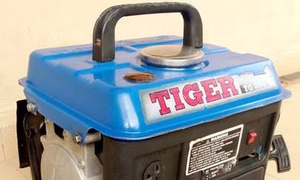
A generator clears its throat.
I imagine electricity as a particularly difficult lover, it comes when it wants, leaves without explanation, and somehow we are the ones apologising for not being available.
The generator, however, has never promised us anything.
It simply makes noise and collects money.
Maybe that is the secret to a successful relationship in Nigeria,
never promise permanence, just make enough noise to prove you're still around.
There is also the matter of Nigerian time.
A meeting scheduled for ten begins at twelve.
A wedding invitation says eleven, which means arrive whenever your conscience permits.
A politician says five years, and somehow the years begin counting from a different calendar.
We do not keep time here,
we negotiate with it, in Nigeria, ten o'clock is rarely ten o'clock.
You learn this eventually, sometimes after spending two hours waiting for somebody who insists they are five minutes away.
But there are things here that even misery cannot explain.
The woman who adds one extra piece of meat to your food because you look tired.
The conductor who waits for an old woman to cross the road, despite the passengers shouting that time is money.
The little boy who divides his biscuit into two unequal halves and gives you the bigger one.
We are a country of people who keep inventing small mercies in the middle of large inconveniences.
And perhaps that is what makes the whole thing so difficult to explain.
How can a place be so exhausting and so beautiful?
How can a people be so disappointed and still make music?
How can a mother tell her son to leave because she wants him to have a future, then spend the night crying because she wants him to have a home?
At the airport, departures have become a family tradition.
We hug our children beside conveyor belts.
We bless their passports.
Mothers bring out the anointing oil,
intending only to mark the forehead
with the small, familiar sign of the cross.
But the journey is long,
and apparently, so is the distance
between the forehead and the scalp.
By the time the prayer is finished,
the child is shining from hairline to eyebrow,
baptised in oil,
sealed against every airport demon
and whatever visa officer may be waiting.
We say, “Make us proud.”
What we mean is,
Go somewhere that does not require you to be this strong.
And when the plane disappears,
the mother does not look at the sky immediately.
She looks at the space her child occupied,
as though absence needs a moment
to become believable.
There is a boy in a classroom.
He has been asked to draw his country.
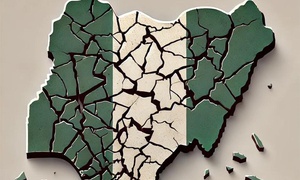
He draws a map.
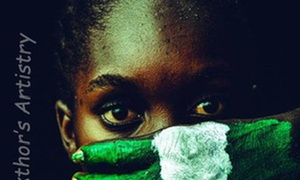
He colours it green, white, green.
The teacher asks what the colours represent.
He says the green is for agriculture.
The teacher smiles.
He says the white is for peace.
The teacher smiles wider.
Then he asks why the farm is hungry and the peace is always missing.
The boy looks at his drawing.
He adds a small door to the map.
The teacher asks what it is for.
He says,
“In case we need to leave.”
Now, I want to tell you about a game.
We used to play it when we were young.
It was one of the few games
where disappearing was allowed,
where being found was the point,
and where everyone was expected
to come back.
One person closes their eyes.
The others disappear.
The seeker counts to ten.
There are rules.
No peeking.
No moving from your hiding place.
No crying when you are found.
And when the seeker finishes counting, they must shout,
“Ready or not, here I come!”
I have been searching for Nigeria.
I searched the National Assembly,
found a room full of people discussing the future in the past tense.
I searched the universities,
found students old enough to remember the faces of three different vice chancellors.
I searched the hospitals,
found a doctor stitching together a country with thread meant for human skin.
I searched the markets,
found a woman selling tomatoes whose prices changed more frequently than the weather.
I searched the churches,
found people asking God to fix what men had broken.
I searched the mosques,
found people praying for a country that seemed to have misplaced its own prayer mat.
I searched the airports,
found a thousand people leaving.
I searched the graveyards,
found people who had been promised a better tomorrow.
And then I found a little girl.
She was sitting beneath a staircase.
A geography textbook lay open beside her.
The Nigerian map was on the cover.
She was crying.
I asked her what happened.
She said she had been told that the country was playing hide-and-seek.
She said she had been counting for a very long time.
She said nobody had come back.
I sat beside her.
I told her perhaps the country was hiding somewhere nearby.
She looked at me.
Then she asked,
“If we are the ones looking for Nigeria, who has been looking for us?”
I wanted to tell her about the Gala seller,
about the woman who adds extra meat,
about the boy who shares his biscuit,
about the generators that sing through the night.
I wanted to tell her that we were still here.
That we had not abandoned the game.
That somewhere, beneath all this madness, there was still something worth finding.
But I remembered the airports.
I remembered the empty classrooms.
I remembered the people who had learnt to call survival a successful day.
And for a moment, I did not know what to say.
Outside, life continued, as it always does, with the extraordinary ability to carry on without asking permission from the people carrying it.
A bus conductor shouted his destination.
A woman negotiated the price of pepper.
Somewhere, a generator coughed itself awake.
A man was selling Gala at the speed of light.
I looked at the little girl.
She had stopped crying.
Then she covered her eyes and began to count.
One.
Two.
Three.
I looked around the room.
There were people who had stayed because they had nowhere else to go.
People who had returned because somewhere, beneath all their disappointment, home had refused to become a memory.
People who were still waiting for a country they could recognise without having to explain it.
Four.
Five.
Six.
I almost closed my eyes.
It would have been easier.
After all, we had become very good at looking away.
We looked away when the roads swallowed our journeys, when the hospitals swallowed our savings, when the classrooms swallowed our years.
We looked away when another person packed their entire life into a suitcase and called it an opportunity.
We looked away so often that eventually, even the things happening directly in front of us began to look like somebody else's problem.
Seven.
Eight.
Nine.
I almost joined the counting.
Ten.
She opened her eyes.
For a moment, nobody moved.
Then she looked at us and asked,
"Are you still looking for Nigeria?"
Nobody answered.
Perhaps because we had spent so long searching for a country that we had forgotten what it meant to belong to one.
maybe because we had mistaken its borders for its identity, its flag for its character, its anthem for its conscience.
Or perhaps because, somewhere along the way, we had become comfortable with the idea that Nigeria was always somewhere else.
In Abuja.
In the next administration.
In the next election.
In the next promise.
Always somewhere ahead of us, never quite within our reach.
The little girl looked down at her textbook.
She ran her finger along the outline of the map, tracing the borders as though she were trying to remember the shape of something she had once known.
Then she asked one final question.
"If Nigeria is hiding, why are we hiding too?"
And there it was.
Not the answer.
The question we had spent generations avoiding.
Because perhaps the country we keep searching for is not waiting to be discovered.
Perhaps it is waiting to be made.
Not by another campaign, another speech, another man standing behind a podium promising to give us tomorrow, but by the millions of ordinary decisions we make when nobody is watching.
In the way we treat the person who cannot repay us.
In the things we refuse to excuse.
In the standards we refuse to lower.
In the small, almost invisible moments when we choose not to become the very thing we complain about.
I looked at the little girl.
She was no longer crying.
She closed her textbook, stood up and walked towards the door.
I followed her.
Outside, the afternoon was still Nigerian.
The roads were broken.
The electricity was uncertain.
Somebody was arguing over the price of tomatoes.
Somewhere, a politician was promising a tomorrow that had been promised before.
Nothing had changed.
And perhaps that was the most uncomfortable part.
We had spent the entire afternoon looking for a country.
But the country had been looking back at us.
In every face we passed.
In every child we sent to school.
In every person who had to choose between staying and leaving.
In every ordinary Nigerian who had been asked to make extraordinary sacrifices just to live an ordinary life.
The little girl reached the doorway.
She turned around.
"Are you coming?"
I looked at the room one last time.
Then I stepped outside.
And for the first time in a very long while, I did not ask when Nigeria would become the country we deserved.
I wondered what kind of people we would have to become to deserve the country we kept asking for.
Behind me, the little girl began another game.
This time, nobody was hiding.
And nobody was counting.
We were finally ready to be found.



 1