By the ninth day without electricity, the fish had begun to smell like government promises.
My mother stood before our dead freezer, hands on her waist, calculating her losses. Inside were cartons of titus, croaker, and mackerel that had cost her money she could not afford to lose. To be precise, the money had been borrowed from a woman who charged interest rates like she was using every kobo to breathe.
Outside, the El Niño heat was doing what NEPA had failed to do for nine days: making a lasting impression.
Whatever spirit touched them, we sha thanked God when they restored the power the next morning, just as we were on the verge of losing all our stock.
Then the Minister of Power appeared on television before a banner reading RENEWED ENERGY, RENEWED HOPE.
“Places that didn’t have light at all for three months are now having 18 hours plus of light daily,” he announced. “Some areas called me to say, ‘Look, I should slow down, that everything in their freezer is freezing.’”
“JI-HO-VA! Freezers are freezing keh, as in this one?!” I screeched in pure shock, looking at my equally flabbergasted mother.
She stared at the screen, then back at me.
“Me that bought the freezer for my business, I wanted it to double as a microwave, abi?” she asked.
We burst into laughter, hard and mirthless, because the minister was clearly a joker, a very dry one. Then she switched off the television because even the electricity required to watch a man insult her intelligence was costing somebody money.
Of course, as if on cue, or perhaps because they thought we were laughing for joy, NEPA interrupted the power once more. We could only imagine how long it would be before we saw light again. By evening, we had salvaged what we could, sold the fish at a loss, and started thinking about how to balance the gbese we already owed Madam Semi while calculating fuel money for the rickety generator we could only hope was still of use.
Welcome to Nigeria, where a business owner could lose money because there was no electricity, spend more money to compensate for the electricity, and still be expected to pay every bill as though the electricity had been available throughout.
My name is Agu Amara, and I have quite a story to tell. So relax the way you would in a danfo at Oshodi bus stop by 5 AM on a Monday morning, because this is about to be a real bumpy ride.
I was the one with a laptop, which meant everybody assumed I could fix things. Phones, other laptops, printers, the university portal, my cousin’s relationship with a boy who had stopped replying to her messages. Everything, in essence. Nobody had asked me to fix Nigeria yet, but I suspected that was because nobody wanted a repeat of End SARS.
Resumption came with fatter fees, fresh deadlines, and the familiar announcement that the university portal was experiencing “technical difficulties.” The portal had been unavailable for hours, but the deadline for payment remained firmly available. I refreshed the page until my laptop began to sound like a generator of its own, and when the portal finally opened, it displayed my outstanding balance with the confidence of a system that had never failed anybody in its life.
My mother and I had the usual conversation about money. How much remained? When was the deadline? Could I pay in instalments? Had I tried the scholarship office? I had tried everything. We had reached that stage of financial planning where you moved money between imaginary categories and hoped one of them would become real.
That was when I started noticing some girls.
Last semester, some of them had borrowed money for handouts and begged their roommates to lend them cash for lunch. One girl had nearly missed a core examination because her fees were incomplete. Now she had an iPhone 18, fresh braids, and the best accommodation paid for.
You sef shock abi?
When she caught me staring at the phone, she only smiled and said "God is good,”
“God is,” I agreed, looking at my OPay balance.
I was less certain about the source of her new phone.
Nobody asked too many questions. We were not stupid; curiosity just did not pay school fees. So yes, everybody half-knew something was happening. These girls disappeared for certain events and returned with money, and whenever anyone asked what they actually did, their answers became vague enough to qualify as official statements. Naturally, we suspected they were runs girls, but where they found these their odogwu's was beyond me. Like, wdym Tina, whom all the guys had dubbed the least thick girl in class during our last anonymous, was now using a MacBook Pro?
One evening, my coursemate Sade sat beside me in my mother’s shop while I struggled to make my finances add up. She was quite literally a nepo baby and occasionally helped me with things at school. She lived in the school's preferred off-campus residence because she did not want that secondary-school feeling at university.
As I lamented about how depressing the economy was while walking her back towards the residential area outside school, she abruptly interrupted me.
“Amara, I know where Tina and friends got their financial glow-up from.”
“As how? They’re not nepo babies like you now.”
She just smiled and sent me a WhatsApp link.
The group was called EVENT STAFF.
“Don’t ask me where I got it sha,” she said.
The first booking paid fifteen thousand naira. I read the amount three times. ₦15,000 for three hours? The instructions requested neat dressing, punctuality, and obedience to the coordinator. It was a government launch for a digital development initiative, complete with dignitaries, cameras, refreshments, and a presentation about how technology was transforming the lives of ordinary Nigerians.
But there I was, an ordinary Nigerian who had definitely not been transformed, dressed and early on the day of the event.
At the venue, a woman wearing an earpiece arranged us into rows and explained that we were beneficiaries of the programme. When somebody asked which programme, she checked her clipboard and said we should please cooperate because the event was already running late. A man with a microphone instructed us to clap whenever the speaker mentioned innovation, youth empowerment, economic growth, or the word historic.
Of course, we clapped.
The minister standing before us announced that the programme had created thousands of opportunities, and we cheered. He declared that young Nigerians no longer needed to leave the country to succeed. Somebody behind me shouted, “Preach on!” and the coordinator gave him a thumbs-up.
Then a young woman presented a tablet displaying colourful graphs showing jobs created, households reached, businesses supported, and a suspicious amount of national happiness. My phone vibrated inside my handbag with a notification from my portal, reminding me that I had yet to pay my school fees.
The irony was so concentrated that I nearly laughed, and my laughter is quite embarrassing.
The coordinator shouted, “More energy, people!” The cameras were moving towards our section, and we were instructed to stand, wave our flags, and demonstrate our confidence in the government’s achievements. Then she gave the instruction that would follow me onto television.
“Roll on the ground! Celebrate!”
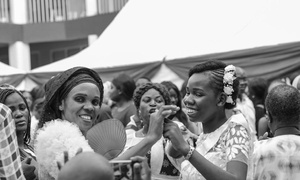
For one second, nobody moved. Then the girl behind me dropped to her knees, laughing. Another guy followed. Soon, students in carefully ironed clothes were rolling across an expensive conference hall floor, waving flags as though free electricity had just been discovered.
I watched Tina roll past my shoe. She caught my eye, and for a moment neither of us smiled. We understood exactly how ridiculous we looked. We also understood that fifteen thousand naira could buy food, pay a bill, or keep somebody in school.
So I got down too.
That evening, the news showed the minister smiling beside his dashboard. Apparently, some part of the programme involved giving students 100 MB of free data daily, something I had completely missed, probably because I had been rolling on the ground. My mother called me thirteen minutes into the usual evening news. She did not know I was watching from behind the dining table, anxious because they had warned us that the event would be broadcast.
“Amara?”
I froze.
“Is that you?”
“They paid us,” I said.
She was quiet for a moment before asking, “Did they pay you enough?”
That question hurt more than anger would have. She understood why I had done it. She also understood what it meant that I had needed to.
After the second event, I began paying attention to the details. The same contractors appeared on banners for different government initiatives, and the same company names kept turning up in public procurement records. Reports claimed thousands of beneficiaries, but when I checked the projects against what people in the supposed beneficiary communities knew, the stories did not always add up. I saved the records and screenshots from EVENT STAFF, initially out of curiosity, until an unknown number warned me to stop investigating things I did not understand.
Then a private foundation offered me a scholarship covering my tuition and a modest stipend. One of its connections appeared in the records I had been investigating, but my fees were due, my mother had debts to settle, and I was tired of watching opportunities pass me by because I could not afford them.
I accepted.
I told myself I could take the money without taking sides, that a scholarship was a scholarship, and that I would keep looking into the contracts. Eventually, however, I stopped checking the records. My fees were paid, my mother restocked her shop, and I returned to being an ordinary student. It was easier to tell myself I had done nothing wrong when I no longer had to think about what I had done.
Then Tina got hurt at another event, this time connected to a political campaign. She returned with an injury and a missing phone, only for the coordinator to deny she had ever been on the guest list. When she complained, the group administrator removed her after reminding us all that the work was voluntary.
That word stayed with me. Nobody had forced us to join the group, but that did not make it right to use our desperation as an excuse to treat us as disposable. I contacted a journalist at an independent media outlet, shared the records I could verify, and explained how the events worked. The story gained attention, and for a brief moment, people started asking better questions because the politician’s promises could not even hold helium, lies as they were.
Then the opposition began sharing my footage, calling me courageous and promising that things would be different under a new administration. I cannot lie; I felt a tad bit power-drunk. At last, somebody seemed to be listening.
That night, I saw yet another coordinator in an opposition campaign video, directing another crowd with the same earpiece and the same hand signals. The shirts were a different colour, but the faces in the rows looked familiar.
I checked EVENT STAFF. Another booking had appeared, with the same coordinator and the same payment structure. The crowd was to be presented as unpaid volunteers who had spontaneously rallied behind the candidate.
I sent the details to the journalist. Soon, the ruling party called my allegations misinformation, the opposition stopped mentioning my story, and the events contractor threatened legal action. My scholarship was suspended pending review, and screenshots of me rolling on the ground began circulating online. Suddenly, everybody had an explanation for my behaviour, although nobody seemed particularly interested in explaining the contracts.
By the time the 2027 general elections drew closer, the campaign posters had returned, and I had learnt to look past the crowds in the photographs. I still thought about my mother’s freezer, the school fees, and the money I had accepted. I thought about Sade, who had sent me the link because she knew I needed help, and Tina, whose financial glow-up had first made us curious enough to look. None of us had joined EVENT STAFF because we wanted to deceive the country. We had joined because fifteen thousand naira could solve a problem that our leaders’ speeches could not.
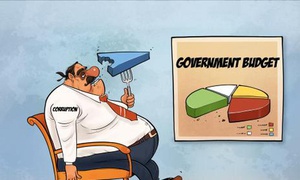
It was ironic, really. Everyone is always complaining about corruption and nepotism, but if we were being honest, how many of us would refuse the money, especially when your uncle worked with the government like Sade’s, or when you were as desperate as I was?
The next election would bring fresh promises, fresh campaign videos, and fresh crowds cheering for candidates who would insist that the people had spoken. But I had seen what happened behind the cameras. Some of you would think I'd become politically apathetic, and while I was never really interested in the dealings of mind games and empty promises, I will be voting next year, and will also be sticking to my laptop more, wish me luck.
So, to everyone who asked, yes, I was one of the students rolling on the ground. I had done it for fifteen thousand naira, without even knowing that the programme was supposedly giving students 100 MB of free data a day. Data I was yet to see, because even the data I paid for seemed to disappear before I could finish using it. Shame really wore me agbada that day when I saw the meme that went,
"Come, which of una dey roll for ground?" 😔
The light, at least, was consistent. It went off every night, rarely to be seen during the day.



 1