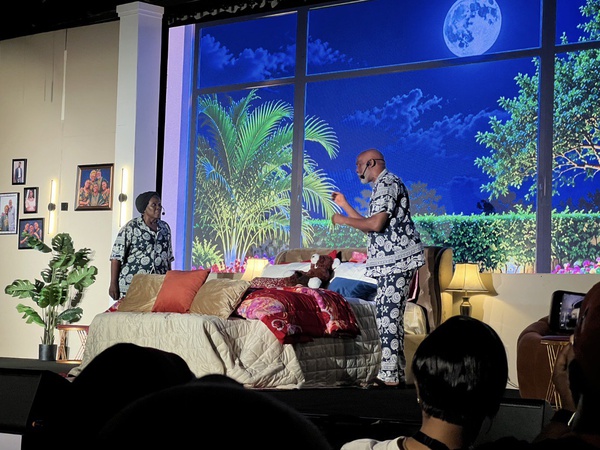
Writing a character who has done something indefensible and making an audience sit through the explanation without wanting to throw something at the stage themselves is a great skill that is used to separates a flat villain from a genuinely unsettling character. Last week Saturday at CANEX WKND 2026, I watched A Husband's Wife, a two-hander stage play with Nollywood veterans, Richard Mofe-Damijo and Joke Silva, built almost entirely around a single confrontation. Femi has been unfaithful. His wife, Tomi, has finally caught him in it. What follows is thirty-two years of marriage being picked apart in real time and the writing earns every minute of it through the quality of Femi's defence.
Femi's justification arrives in two parts and the first is domestic. He says he had started to feel less like a partner and more like a man constantly being corrected and managed rather than loved. The second is almost absurd. He references a television advert that asked viewers when was the last time they did something for the first time. Thirty-two years of fidelity suddenly looked, to him, like stagnation rather than virtue and he decided an affair was his answer to the marketing slogan on the television advert.
The playwright never asks the audience to accept the excuse as reasonable. The point is that people frequently build real decisions on flimsy justifications and the flimsiness is exactly what makes them feel true to life. Nobody walks into an affair with a fully reasoned manifesto. They walk in with a half-formed grievance and a convenient line to justify their actions, then dress the whole thing up afterwards to sound more coherent than it was.
A weaker script would let Femi's excuse sit there as the scene's centre of gravity. This one does not. Tomi meets each justification head-on, refusing to let the loneliness line or the advert line stand unexamined. When he tries to frame his infidelity as something she pushed him towards, she turns the accusation back on him immediately, stopping him from getting away with trying to make his unfaithfulness her fault. That single exchange is doing the structural work. An excuse only reveals character when something in the scene actively resists it. Tomi’s refusal to accept the reframing is what stops the scene from quietly validating Femi's logic by default. Silence after a bad excuse can read as agreement. Confrontation after a bad excuse forces the audience to judge the excuse on its own terms, rather than being nudged towards a verdict by the structure of the story.
If you are writing a character who needs to justify something morally indefensible, resist the instinct to give them either a watertight argument or an obviously hollow one. Watertight arguments make the audience feel manipulated into sympathy. Obviously hollow ones make the character cartoonish and the scene weightless. The more effective path sits in between giving the character a reason that is emotionally real to them and logically thin to everyone else, then putting another character in the scene who is willing to say so out loud. The gap between how the character experiences their own justification and how it actually sounds, spoken aloud to someone who is not inclined to be generous, is where the honesty of the writing lives. That gap is harder to write than either extreme. It is also the only version that leaves an audience thinking about the story much longer.
It is important to note that A Husband's Wife is built on far more than this single exchange and I have deliberately stayed away from how the story resolves to avoid spoilers for those who haven’t seen it.
If anything in this piece raised a question, whether about the play, the craft of writing a believable excuse or story development more broadly, leave it in the comments. I am available to take your questions and will answer them as fully as I can.


 19