THE LANDLORD’S ROOF
The blue papillon bucket was the house’s first tenant. We had owned it so long my little brother believed it was part of the furniture.
It was pale blue, with a white handle and a crack near the bottom that Mama sealed first with candle wax, then with a paste Papa bought from a roadside mechanic who swore it could seal an engine block. The paste smelled like burnt rubber and lasted just a few days. The bucket however outlived the repair by years.
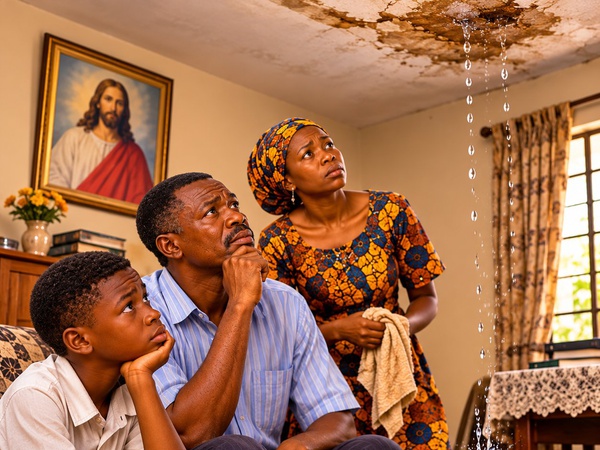
It stood beneath a brown patch on the ceiling. My earliest memory of the house already included the bucket, the dining table, and a framed picture of Jesus that leaned permanently left, watching the room with one sceptical eye.
When the rain came, we nudged the bucket a few inches to the left. When the rain stopped, we nudged it back. The brown patch on the ceiling was its compass; the bucket never drifted further than the leak allowed.
Papa’s shirts smelled of chalk dust and the stubborn optimism of his Civic Education syllabus. He spoke of the rule of law as though it were something he could repair, like the bathroom door, which had to be lifted before it would close. Every other Thursday, he spoke to the landlord instead.
I never heard the landlord. I heard only Papa, standing at the window where the network was better.
“Good evening, sir.”
“We thank God, sir. About the roof...”
“Yes, sir. Somebody.”
“When, sir?”
A long pause.
“Soonest. Thank you, sir.”
The landlord’s half never changed, so I never needed to hear it. He had not forgotten us. He was sending somebody. Soonest.
Papa would put the phone down and tell Mama that one had to be patient with people. Mama would ask whether patience was included in the rent. Papa would tell her not to start.
The house was small but required careful management. Two bedrooms, a sitting room, a kitchen, and a bathroom. The prepaid meter sat on the wall like a guest who contributed nothing. When the light went off we blamed NEPA. When it returned we thanked God. When the units finished early we blamed the meter.
Papa called this the Nigerian condition. Mama called it managing.
She sold provisions from a wooden stall at the bus stop, backed against a storeroom that belonged to a widow, Mama Kunle, who had been trying to rent it out for a year. Mama knew wholesale prices, retail prices. She understood her customers and was good at winning their trust. What she could not do was pull enough income to cover us across the months since the school started paying Papa late: first by two weeks, then by a month, then whenever the local government education authorities deemed it fit to pay workers.
One afternoon she spread her money on the bed, arranged the notes by denomination, and began columns in her exercise book: Rent. Food. Transport. Electricity. School fees. The numbers refused to cooperate. She sighed, seemingly lost in thought for a minute before her gaze locked on me.
“Go and bring the bucket,” she said.
It had started raining.
The bucket had a second duty, which was to be hidden on specific occasions.
When visitors came, Mama carried it to the bedroom. When Papa’s friends dropped by, he pushed it under the table. I once asked why, and was ignored.
The afternoon Elder Bamidele came, it was already raining. Mama knocked a spoon off the table in her hurry, threw a rag over the wet patch on the floor, and signalled to me with a snap of her fingers to move the bucket out of sight. I did. Promptly.
Papa, all smiles, straightened his shirt and opened the door.
Elder Bamidele wore his trousers high. He was chairman of the church building committee. He sat on our best chair. Mama served him the bottled drink she had been saving. The elder looked around. A thin line of water had begun to creep down the wall above the television. Papa cleared his throat.
The elder smiled. “We are trusting God to complete the new auditorium before the end of the year. The contractor says the roofing sheets must be purchased now. Prices are changing every week. The church cannot do everything alone.”
Papa nodded.
The elder leaned forward. “Your contribution is still outstanding.”
Papa explained that the school had not paid since September. He explained it quietly, in the voice of a man confessing something. The elder listened with rapt attention. “These things happen,” he said. “But we must not allow our circumstances to hinder the work of God.”
The water reached the floor. Nobody mentioned it.
At the door, the elder prayed for our family, for the school, even for our leaders. He prayed that God give them a compassionate heart towards the masses. When he had gone, Mama dragged the bucket out from under the bed and set it beneath the leak.
Plink.
Plink.
Plink.
Papa remained in his chair. After a while he said, “He is a good man.”
Mama was wringing the rag into the bucket. “A good man?” she scoffed. “He sat on that chair, he saw the water coming down the wall in front of him, and still had the boldness to ask us for money.”
Papa looked at her. “Yes, but he wasn’t asking for himself. Is it not for—”
Mama lifted the bucket and carried it to the kitchen to empty it before Papa could finish. Neither of them spoke about it again that evening.
That night I got up for water and found Papa still in his chair beneath the picture of Jesus, writing in his lesson notes. Every few minutes he raised his eyes to the brown patch, the way a man checks a clock in a room where he is waiting for someone.
I assumed he was preparing a lesson.
---
On Sunday, the building fund had its own basket.
There were three that day, passed down the pews on long handles by ushers who stared straight ahead, as if money made no sound. The first was for tithes. The second was for offering. The third was newer and a different colour, with BUILDING written on masking tape across the front, and it came last, when everyone had already given and had to find something else.
Papa found something. I watched him fold a note until it was small enough to hide in his palm. Mama’s face did not move, which was how I knew what she had seen.
Then Elder Bamidele stood at the pulpit with a sheet of paper and read out the progress: so many roofing sheets bought, so many still needed. Many families had redeemed their pledges. He read their names slowly. After each one, the church clapped, briefly.
Then the pastor prayed for the congregation. Some of the prayer were all too familiar. He prayed it every Sunday: for peace to reign in the nation, that we do not lack any good thing and that God gives our leaders wisdom. By now I could say it along with him, word for word, at the same speed, like an anthem of a sort.
During the closing hymn. I wondered to myself where all our prayers really went.
---
My pocket money used to come every morning at the door, with a warning not to lose it. Then it came on 'some' mornings. Then it became a once in a while thing and whenever Papa or Mama was overly stern for no obvious reason, I knew not to bother asking.
I became careful with everything. My uniform mustn't get torn, I mustn't lose my mathematical set, my books had to be in good condition, good enough to pass down to my brother, same went for my shoes. Any damage meant another lecture or beating depending on Papa or Mama’s mood.
I began saving my pocket money until I had enough to buy a tin of Peak milk. There was milk in the kitchen cabinet, but Mama had declared it untouchable. I drank mine in secret, making each tin last as long as I could. Eventually, it became a habit.
One Saturday, Mama returned from the market earlier than usual. I was on my bed, spoon in hand, when I heard her footsteps approaching. I shoved the tin beneath my mattress and sat up.
“What are you hiding?”
“Nothing.”
She came closer. “Then why are you sitting like that?”
I reluctantly brought out the tin. She turned it over, examining its nearly empty contents.
"You bought this?"
I nodded.
She looked at me for a moment, then placed it on the bedside table.
"Next time, don't leave things under the mattress. Ants will enter it."
That was all.
I had prepared myself for a lecture, perhaps even a spanking. Instead, she walked out, leaving the tin on the table.
That evening, it rained again, heavily. The bucket was already beneath the leak, but the water had begun to find its way down another part of the ceiling. Mama dragged the bucket across the room, and Papa placed an old basin beneath the new leak.
---
The landlord finally sent somebody.
The man arrived on a Sunday evening, inspected the ceiling, climbed halfway up a ladder and came down with the expression of someone who had discovered an alarming problem.
"The whole roofing needs attention," he said.
Papa nodded. "We have been saying so."
The man scratched his chin. "I will report to Oga first."
"Please do." Papa replied.
He left. We never saw him again.
The following Sunday, Papa was back in church. The building fund was still receiving contributions. Elder Bamidele announced that the contractor had warned of another increase in the price of roofing sheets. Papa listened with his hands folded between his knees.
On our way home, we stopped at a roadside woman selling cooked meat and bought some beef to go with the rice Mama had left at home. Papa seemed unusually cheerful. He told us that a spokesperson from the local government education office had sent a memo assuring teachers that their outstanding salaries would be paid within the week.
"At least, something is moving," he said, smiling.
Mama asked whether the landlord had called.
Papa shook his head. "Not yet."
"Well, one problem at a time," she said. Papa agreed with her.
That night, the rain returned.
I woke to the familiar sound of water striking plastic. Plink. Plink. Plink. I got out of bed and found Mama standing in the sitting room, moving the blue bucket towards the leak. Papa was holding the basin beneath the other one.
For a while, I watched them.
Then I remembered the empty Peak tin on my bedside table. I went to fetch it.
The smaller leak had started dripping onto the floor beside the television. I placed the tin beneath it. The drops landed inside with a thin metallic sound.
Mama glanced at it.
"What's that one doing there?"
"Helping the bucket," I said.
She looked at me, then at the tin.
For the first time that night, she laughed. Papa laughed too, although I wasn't sure he had heard the joke. By morning, the tin was half full. The bucket was nearly full. The basin had collected enough water to require emptying.
I carried the tin to the kitchen and poured its contents away.
The salaries came that week, just as promised. Papa brought home his pay, settled some outstanding bills and even gave me my pocket money without being reminded. Mama bought more provisions for her stall. For a few days, the house felt lighter.
The roof, however, continued leaking.
Papa called the landlord several times. The familiar conversations resumed, complete with the greetings, the assurances and the promise that somebody would come. Nobody did.
Eventually, Papa called a roofer to inspect the damage. The man climbed onto the roof, spent some time examining it and came down with a quotation. Papa showed it to Mama. She read through the figures twice before asking how much it would cost to move into another apartment.
They made enquiries. There was rent, agency, agreement, caution fee, transport and the small matter of finding somewhere that did not already have its own collection of problems. Eventually, Mama returned the quotation to Papa.
"Repair it," she said.
Papa sighed, his jaw clenched tight as he folded the paper and put it in his shirt pocket.
A few days later, the workmen arrived. They removed the damaged roofing sheets, replaced some of the wood beneath them and fixed the new sheets in place. Papa paid them from his salary. The landlord was informed, of course. He thanked Papa for taking the initiative and promised to remember it when the rent was due.
The bucket was no longer needed.
For several weeks, it remained beneath the brown patch on the ceiling, empty and slightly dusty. Nobody moved it. Mama eventually put it in the storeroom, where it joined old paint containers, broken slippers and things we kept because they might still be useful someday.
The first heavy rain after the repairs came on a Tuesday night. I woke out of habit and waited for the familiar sound.
Nothing.
I got out of bed and went to the sitting room. The floor was dry. The television stood safely beneath the ceiling. Even the brown patch had begun to fade after Papa painted over it.
In the morning, he stood beneath the repaired roof and looked up with satisfaction.
"At least," he said, "we can sleep in peace now."
It didn’t come as much of a surprise but when the rent became due again, we had to pay in full.



 1