


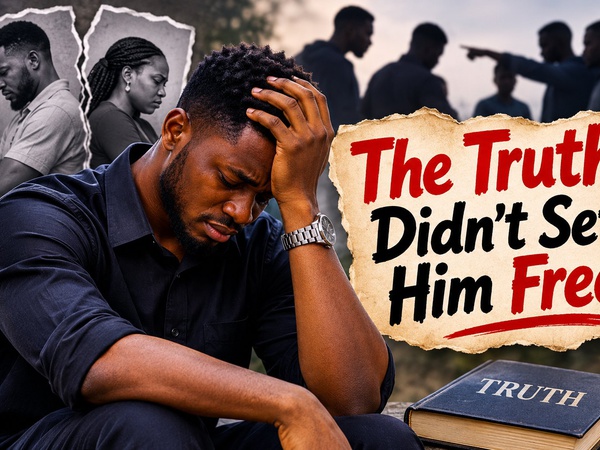
They always say the truth will set you free. It is one of those statements people repeat whenever they want to encourage honesty. We grow up believing that telling the truth is always the right thing to do, that honesty brings peace, and that no matter how painful the truth might be, it is always better than living a lie.
But what happens when the truth doesn't set you free?
What happens when telling the truth becomes the beginning of your suffering? What happens when the very thing you thought would bring you peace becomes the reason you lose everything you have worked so hard to protect?
This was the reality Daniel faced.
For years, Daniel had lived with a secret. It wasn't the kind of secret that could easily disappear with time. It followed him everywhere, disturbed his sleep, affected his relationships, and made him question the person he had become.
He had made a terrible mistake years earlier. At the time, he convinced himself that keeping quiet was the best option. He believed that if nobody discovered what had happened, life would eventually return to normal.
And for a while, it did.
He got married, built a career, made friends, and became someone people admired. To everyone around him, Daniel was a responsible man who had everything figured out.
But behind his smile was a truth he was terrified to reveal.
Every time someone spoke about honesty, his heart skipped a beat. Whenever he heard people discussing forgiveness, he wondered whether anyone would ever forgive him if they knew what he had done.
One evening, he decided he had suffered enough.
He called the person whose life had been affected by his actions and confessed everything. He explained what happened, why he had made that decision, and how deeply he regretted it.
He expected anger. He expected disappointment. But somewhere in his heart, he hoped that his honesty would open the door to forgiveness.
Unfortunately, things did not happen the way he imagined.
The person he confessed to was devastated. The trust that had taken years to build disappeared within minutes. His explanations sounded like excuses, and his apologies could not erase the pain he had caused.
Within days, his marriage was in trouble. Friends stopped answering his calls. People who once respected him began looking at him differently.
The truth was finally out, but Daniel was more miserable than he had ever been.
He had expected freedom, but he received rejection.
He had expected understanding, but he received judgment.
He had expected forgiveness, but he was confronted with consequences.
For the first time, Daniel understood that telling the truth does not automatically repair the damage caused by a lie.
Sometimes, people are not ready to forgive you. Sometimes, your confession arrives too late. And sometimes, the people you hurt are entitled to walk away, even when you are genuinely sorry.
But does that mean telling the truth was a mistake?
Not necessarily.
The truth did not restore Daniel's relationships, but it forced him to confront the person he had become. He could no longer hide behind excuses or pretend that his actions had never happened.
He had lost something important, but he had also gained an opportunity to take responsibility for his life.
Perhaps that was a different kind of freedom.
We often misunderstand what it means to be free. We think freedom means escaping punishment, avoiding embarrassment, or getting people to forgive us.
But sometimes, freedom begins when we stop running away from our mistakes.
The painful reality is that honesty does not guarantee a happy ending. It does not guarantee forgiveness, acceptance, or a second chance. The truth can destroy relationships, expose weaknesses, and change how people see us forever.
However, living a lie has its own price.
You may successfully deceive everyone around you, but you cannot always silence your conscience.
And perhaps the greatest tragedy is not that Daniel lost the people he loved after telling the truth. It is that he spent so many years believing that silence was protecting him.
The truth didn't set him free. It simply forced him to face the consequences of the life he had been living.
Sometimes, the truth is not a door to freedom. Sometimes, it is a mirror, and what you see in it can be difficult to accept.
But no matter how painful the reflection is, you cannot change what you refuse to confront.
Score |
3


Speed Eze
 Student @ Unicross
The Truth Didn't Set Him Free


 4


Other insights from Speed Eze





Contributor Points

Points-to-Coupons

Referral Earning

Insights for you.

All that I gave
Oh, hey there!It's me... again...You know, There's so much I want to saySo much I want ...
669 views
101 upvotes
97 comments




The Root of Evil.🌚
I like money.But they said it's the root of evil. 🙂Sorry, get your facts straight.The l...
385 views
78 upvotes
88 comments
The Manipulation.
"Mom started looking at me differently from that day.I remember it like the back of my ...
372 views
75 upvotes
92 comments




The 3AM World.
My favourite time of every day is between 1 a.m. and 4a.m.That's when the world is the ...
337 views
67 upvotes
72 comments

Drowning.
I can't breathe.I tried again.Nothing.My lungs burned.The water surrounded me, cold and...
355 views
61 upvotes
72 comments

Think with Me?
A series of random thoughts flooded my mind yesterday, and I just decided to pour them ...
295 views
56 upvotes
61 comments

Eden.
I came to this house very young, with one other.We were accepted so warmly.Everyone lov...
339 views
59 upvotes
71 comments

































