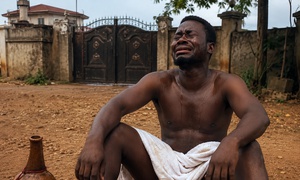
Emeka Okafor knew his life had reached a new level of suffering when he started negotiating with God over ₦500.
“Father Lord, if You can just provide ₦5,000 before Friday, I promise to stop complaining.”
He paused.
“Actually, make it ₦10,000. Things are expensive now.”
His phone vibrated.
It was his landlord.
Good morning, Emeka. This is a reminder that your rent expires in two weeks. The new annual rent is ₦650,000. Kindly prepare accordingly.
Emeka stared at the message.
“God, forget what I said. Let's discuss this rent issue first.”
He was twenty-eight, a graduate of Political Science, and an employee at a private company in Lagos where he earned ₦90,000 monthly. His rent was ₦450,000 annually, his transport fare consumed nearly a third of his salary, and his employer had not paid him for the previous month.
He lived in a single room with a leaking roof, a stubborn ceiling fan, and a window that opened directly into his neighbour's kitchen.
Every morning, he woke up to the smell of fried fish, even when there was no food in his own room.
He had once complained to the neighbour.
“Madam, please, can you close your kitchen window when frying fish?”
She looked at him with genuine confusion.
“Why?”
“The smell enters my room.”
She shrugged.
“My brother, is it my fault that you don't have fish?”
Emeka had never complained again.
On Monday morning, he woke up at 5:30 a.m., washed with water borrowed from his neighbour, and prepared for work.
The electricity had gone off at midnight.
His phone battery was at four per cent.
His breakfast consisted of two slices of bread and the determination to survive.
Before leaving, he checked his bank account.
₦3,250.
He nodded slowly.
“Riches are coming.”
Then he checked his WhatsApp messages.
His mother had sent him a voice note.
“My son, good morning. May God bless you. Please, your younger sister needs ₦30,000 for school fees. Also, your uncle's son is getting married next month, and we are expected to contribute ₦50,000. Don't forget to send money for foodstuff. God bless you.”
Emeka listened twice to ensure he had heard correctly.
Then he replied, “Amen, Mummy.”
He did not mention the money.
Sometimes, silence was the only financial management strategy available to a Nigerian man.
He left the house and headed for the bus stop.
A danfo conductor approached him.
“Where you dey go?”
“Ikeja.”
“Seven hundred.”
“Yesterday, it was five hundred.”
The conductor sucked his teeth.
“Oga, yesterday is yesterday. Today is today.”
Emeka entered the bus.
He had discovered that arguing with a danfo conductor was like debating with a politician: everybody had an opinion, nobody would change their mind, and you would probably lose money before the conversation ended.
Halfway through the journey, the bus stopped at a police checkpoint.
The driver was ordered to park.
A policeman demanded his documents, inspected them, and began an argument with him.
Emeka checked the time.
8:15 a.m.
He was supposed to resume work at eight.
A passenger complained.
“Officer, please, some of us are going to work.”
The policeman turned.
“Are you the driver?”
“No, sir.”
“Are you the owner?”
“No, sir.”
“Then face your front.”
The passenger faced his front.
Twenty minutes later, the driver returned and announced that everybody would pay an additional ₦200.
The bus erupted.
Emeka leaned back and closed his eyes.
“God, if You are testing my patience, I think I have passed.”
By 9:00 a.m., he arrived at work.
His supervisor, Mr Adewale, was waiting at the entrance.
“Emeka! What time is this?”
“Good morning, sir.”
“Don't good-morning me! Why are you late?”
“Sir, there was traffic and a police checkpoint.”
“Excuses! Does traffic not affect other people?”
Emeka looked at the generator behind him.
It was not working.
He looked at the air conditioner.
It was not working either.
He looked at the ceiling fan.
It was rotating so slowly that he suspected it was practising for retirement.
“Yes, sir,” he replied.
“Go inside.”
At 10:30 a.m., management sent an email announcing that salaries would be delayed due to the prevailing economic situation.
At 11:00 a.m., another email announced that staff members were expected to work an additional hour daily without extra pay.
At noon, the office lost electricity.
Emeka looked at his colleague, Bisi.
“Do you think these people know we are human beings?”
Bisi continued fanning herself with a file.
“Emeka, please. I am saving my energy for when my husband calls to ask what we are eating tonight.”
They both laughed.
That afternoon, Emeka received an unexpected phone call.
It was his university friend, Tunde.
“Guy! I have good news!”
“You got a job?”
“No.”
“You got a visa?”
“No.”
“You finally paid your debts?”
“Are you mad? Listen first!”
Tunde explained that he had discovered an investment opportunity. With an initial payment of ₦200,000, Emeka could supposedly earn ₦500,000 within three months.
Emeka was interested.
“What business is this?”
“Forex and cryptocurrency combined.”
Emeka went silent.
“Tunde, do you understand either of them?”
“Guy, I have watched several videos.”
“How much do you currently have?”
“₦4,000.”
“And you want to teach me how to make ₦500,000?”
“That's why you need to stop thinking negatively!”
Emeka laughed.
“My brother, two broke men cannot become rich simply by combining their ignorance.”
Tunde ended the call.
That evening, Emeka returned home and found his landlord waiting outside.
“Emeka, I hope you are preparing my money.”
“Sir, I am trying.”
“Trying is not money.”
“I know, sir.”
“Then find money!”
Emeka looked at the man.
“Sir, if I knew where to find money, do you think I would be standing here discussing it with you?”
The landlord frowned.
“Are you insulting me?”
“No, sir. I am sharing my financial reality.”
The landlord walked away angrily.
Emeka entered his room, dropped his bag, and sat on his mattress.
He had barely settled when his mother called.
“My son, have you sent the money?”
“Mummy, I don't have it yet.”
“But your sister's school fees are due!”
“I know.”
“What happened to your salary?”
“They haven't paid us.”
His mother sighed.
“When will you people stop complaining? You are a graduate. You should be doing something with your life.”
Emeka stared at the ceiling.
“Mummy, I am doing something. I am working.”
“But what are you earning?”
He looked at his bank balance.
“Apparently, experience.”
His mother became silent.
Then she said, “You need to pray more.”
Emeka almost laughed, but stopped himself.
“Mummy, I pray. Sometimes I even wake up at midnight to pray.”
“Then continue.”
“Mummy, at this point, I think my breakthrough has misplaced my address.”
She ended the call.
For several minutes, Emeka sat quietly.
He was tired.
Tired of struggling to pay for necessities. Tired of explaining why he could not help everybody. Tired of hearing that his problems were caused by a lack of faith, discipline, or ambition.
He was not lazy.
He was not unintelligent.
He was simply a young man trying to build a life in circumstances that made even ordinary things unnecessarily difficult.
The following morning, he received a message from an unfamiliar number.
Congratulations! You have been selected for a special financial breakthrough programme. Pay ₦25,000 registration fee to unlock your destiny.
Emeka read it twice.
Then he replied, Please, can I pay after the breakthrough?
The sender blocked him.
Emeka laughed so loudly that his neighbour knocked on the wall.
“Emeka! Are you okay?”
“No!”
“What's wrong?”
“My destiny has blocked me!”
The neighbour went back to sleep.
By Friday, things had become worse.
His employer had still not paid him.
His landlord had started sending messages every morning.
His sister was threatening to miss her examinations because she could not complete her school registration.
Emeka sat at his desk, staring at his computer, when his supervisor approached him.
“Emeka, I need you to stay late today.”
“Sir, I have a family emergency.”
“Everybody has emergencies.”
“Sir, I haven't been paid for last month.”
Mr Adewale adjusted his tie.
“Do you think the company is making money?”
Emeka glanced around the office.
“Sir, I don't know. But if it isn't, perhaps we should discuss that before asking people to work for free.”
The supervisor stared at him.
“Are you challenging management?”
“No, sir. I am asking a question.”
“Be careful.”
Emeka returned to his computer.
He had learned that in Nigeria, asking reasonable questions could be interpreted as an act of rebellion.
That evening, he boarded a bus home.
A little boy sitting beside him was eating biscuits.
The boy offered him one.
Emeka smiled.
“Thank you, my brother.”
The child's mother looked embarrassed.
“Sorry, oga. He doesn't know you.”
Emeka laughed.
“Madam, no problem. In this economy, we should appreciate every form of assistance.”
The woman laughed too.
They began talking.
She was a nurse at a public hospital. She told him about patients who could not afford medication and doctors who worked long shifts without adequate equipment.
Emeka told her about his unpaid salary and his landlord.
They laughed at their circumstances, but beneath the laughter was exhaustion.
Before she got off the bus, she said something he remembered.
“Sometimes, I think we Nigerians have become so used to surviving that we have forgotten we are allowed to demand better.”
Emeka nodded.
For once, somebody had said exactly what he was thinking.
That night, he made a decision.
He would stop waiting for one miraculous event to rescue him.
He updated his CV, applied for jobs, and began learning a digital skill online using his phone whenever he could charge it.
He also spoke honestly with his mother.
He explained what he could afford and what he could not.
She did not take it well at first.
But eventually, she understood that her son could not solve every problem in the family while struggling to solve his own.
Two months later, Emeka secured a better job through a former university classmate.
The salary was ₦220,000.
It was not enough to make him wealthy, but it was enough to breathe.
He paid his outstanding rent, helped his sister with her school fees, and bought himself a new pair of shoes.
On his first day at the new job, he arrived thirty minutes early.
His new supervisor welcomed him warmly.
“We value punctuality here,” she said.
Emeka smiled.
“Thank you, ma.”
He sat at his desk.
The electricity went off.
He stared at the ceiling.
Then the generator started.
For a few seconds, he felt hopeful.
The generator stopped.
Emeka slowly removed his new shoes, placed his head on the desk, and began laughing.
His supervisor rushed over.
“Emeka! What's wrong?”
He looked up, tears gathering in his eyes.
“Nothing, ma. I just wanted to confirm that I am still in Nigeria.”
She stared at him.
Then she burst out laughing too.
Outside, traffic crawled along the road. A conductor shouted at a passenger. Somewhere, a politician was promising to improve the economy. A woman was negotiating the price of tomatoes. A young graduate was sending out another job application.
And in a small office in Lagos, Emeka laughed at a generator that had once again refused to cooperate.
His life was not perfect.
The country was not suddenly better.
But he had learned something important: he could acknowledge the madness without allowing it to convince him that his own life was worthless.
That evening, he called his mother.
“How are you, Mummy?”
“I am fine, my son. Have you eaten?”
“Yes, Mummy.”
“Good. Your uncle says you should contribute ₦100,000 to a family project.”
Emeka closed his eyes.
“Mummy, please tell Uncle that I have contributed my prayers.”
His mother gasped.
“Emeka!”
He burst out laughing.
Then she started laughing too.
For a few moments, there was no landlord, no unpaid bill, no school fees, no generator, and no traffic.
There was only a mother and her son, laughing at a country that sometimes made ordinary life feel like an extreme sport.
When the call ended, Emeka checked his phone.
A bank notification appeared.
ACCOUNT MAINTENANCE FEE: ₦50.
He stared at the message.
Then he looked up at the ceiling.
“God, I have a final question.”
He paused.
“Who is maintaining this account? Because nobody is maintaining my life.”
He switched off his phone, lay on his mattress, and closed his eyes.
Tomorrow, he would wake up early, go to work, and try again.
Not because suffering was noble.
Not because everything happened for a reason.
But because he still had a life to live, and he refused to spend all of it waiting for Nigeria to make sense.
Outside, somebody's generator started.
Emeka pulled his pillow over his head.
“Goodnight, Nigeria.”
The generator roared louder.
He sighed.
“Actually, goodnight to everybody except Nigeria.”
And for the first time that week, he fell asleep smiling.



 2