Score |
452






We Sent the Colonizers Away, But Did They Leave Our Minds Free?
With


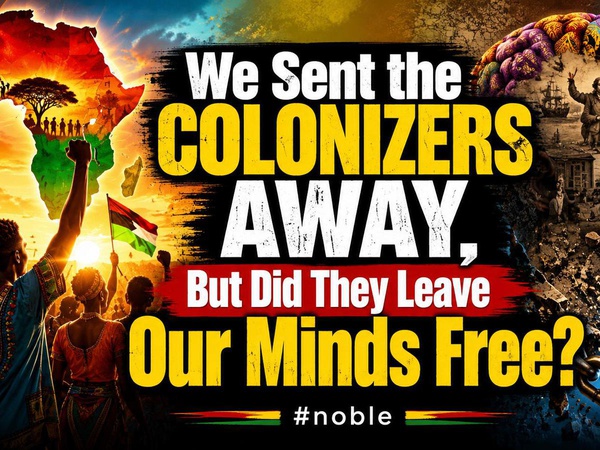
<p>In the mid-twentieth century, across the vast stretch of the African continent, flags were lowered and new ones raised. Independence ceremonies rang with speeches, anthems, and the promise of self-rule. Ghana in 1957. Nigeria in 1960. Kenya in 1963. Dozens more followed. The colonizers packed their bags, folded their maps, and departed. Or so it seemed. The physical occupation ended. The question that still echoes, decades later, is whether the occupation of the mind ever truly did.<br/></p><p><br/></p><p>“We sent the colonizers away, but did they leave our minds free?” This is not a rhetorical flourish for academic papers. It is a living challenge that every African generation must confront. Political independence was a necessary victory. Mental independence remains unfinished business.</p><p><br/></p><p>Colonial rule was never only about land, taxes, and administrative posts. It was also about reshaping how Africans saw themselves, their past, their languages, their systems of knowledge, and their place in the world. Mission schools taught that African religions were superstition. Colonial curricula presented European history as the center of human progress and African history as a brief preface of darkness. Local languages were relegated to the home and the market while the colonizer’s tongue became the language of power, prestige, and opportunity. Beauty standards shifted toward lighter skin, straighter hair, and European features. Traditional governance structures were dismissed as primitive while Western models were presented as the only path to modernity. Over time, many internalized the idea that authentic progress meant becoming more like the former master.</p><p><br/></p><p>That internalization did not vanish with the last colonial governor. It adapted. Today it appears in subtler forms. Many African elites still measure success by how closely institutions, cities, and lifestyles resemble those of Europe or North America. Boardrooms and government offices often operate primarily in English, French, or Portuguese even when the majority of the population speaks local languages more fluently. University syllabi in many countries still lean heavily on Western theorists while African intellectual traditions receive secondary treatment. Popular culture frequently celebrates foreign aesthetics and narratives over indigenous ones. Young people sometimes feel that speaking their mother tongue fluently is less “modern” than mastering the former colonial language with a perfect accent. The result is a quiet hierarchy of value that places the external above the internal.</p><p><br/></p><p>This mental residue has practical consequences. When African solutions are automatically viewed as inferior or temporary, societies struggle to build institutions that fit their own social realities. When economic policy is framed primarily as attracting foreign investment rather than cultivating domestic capacity, dependency deepens. When educational systems prioritize credentials recognized abroad over skills that solve local problems, brain drain accelerates. When beauty and cultural validation are sought externally, self-respect erodes. The colonizer no longer needs to be present if the colonized continue to police themselves according to the old standards.</p><p><br/></p><p>Yet the story is not only one of loss. African thinkers have long diagnosed this condition and proposed remedies. Kenyan writer Ngũgĩ wa Thiong’o argued powerfully for the decolonization of the mind, insisting that language is not neutral and that writing and thinking in African languages is an act of recovery. Frantz Fanon, though from Martinique, analyzed the psychological effects of colonialism with clarity that resonated across the continent. Julius Nyerere, Amílcar Cabral, Thomas Sankara, and others experimented—sometimes imperfectly—with models that tried to root development in African realities rather than imported blueprints. Contemporary movements in literature, film, music, fashion, and technology show growing confidence in African aesthetics and innovation. Afrobeat, Nollywood, African literature in translation, and tech hubs in places like Lagos, Nairobi, and Kigali demonstrate that creativity flourishes when people stop seeking permission from external validators.</p><p><br/></p><p>The lesson for Africans is neither nostalgia nor rejection of all that is foreign. Useful knowledge, technology, and ideas should be taken from anywhere. The danger lies in uncritical imitation and the quiet assumption that African ways are lesser by default. Decolonizing the mind means recovering the capacity to evaluate ideas on their merit rather than their origin. It means teaching children that African history did not begin with the arrival of Europeans and that African societies developed sophisticated systems of trade, governance, agriculture, medicine, and art long before colonial maps were drawn. It means investing in African languages so they can carry science, law, literature, and technology without apology. It means reforming education so that critical thinking, problem-solving for local contexts, and pride in African intellectual heritage sit alongside global knowledge. It means building economies that prioritize productive capacity, value addition, and regional integration rather than perpetual extraction and aid dependence. It means cultural confidence that does not require external applause to feel legitimate.</p><p><br/></p><p>Practical steps matter more than slogans. Parents and teachers can encourage fluency in both local languages and global ones without ranking them. Universities can expand research into African philosophies, histories, and scientific traditions while remaining open to universal knowledge. Governments can support creative industries and local manufacturing instead of treating them as secondary. Media can tell African stories with complexity rather than exoticism or self-pity. Citizens can question the automatic preference for foreign brands, foreign degrees, and foreign solutions when local alternatives exist or can be developed. Young people especially carry responsibility: the generation that grew up with greater access to information and connectivity has tools previous generations lacked. They can choose to curate their influences rather than absorb them uncritically.</p><p><br/></p><p>There is also a caution. Romanticizing a pure pre-colonial past is as unhelpful as denying the damage of colonialism. African societies before European rule contained achievements and failures, justice and injustice, innovation and stagnation—just like societies everywhere. The goal is not to freeze culture in an imagined golden age but to reclaim the right to define progress on terms that serve African people. Neither is the point to nurse perpetual grievance. Grievance without agency becomes another form of mental captivity. Agency requires clear-eyed assessment of both external historical forces and internal choices made since independence: leadership failures, corruption, ethnic politics, and policy mistakes that compounded colonial legacies.</p><p><br/></p><p>The physical colonizers left. The question of mental freedom remains open because it is not decided by treaties or independence dates. It is decided daily in classrooms, homes, boardrooms, studios, farms, and digital spaces. Every time an African values competence over foreign credentials, invents rather than merely imports, speaks and writes in a language that carries ancestral memory alongside global reach, or builds institutions that fit local social fabric, the mind edges closer to freedom.</p><p><br/></p><p>Africa’s greatest resource has never been only minerals or land. It is the intelligence, creativity, and resilience of its people. Those qualities cannot fully flourish while an invisible hierarchy still ranks the foreign as inherently superior. The colonizers were sent away. The harder, quieter, and more decisive work is to ensure they no longer occupy the mind. That work belongs to Africans themselves. It is unfinished. It is urgent. And it is possible.</p>



 127
127


Other insights from Tacue Allen Mushore













Contributor Points

Points-to-Coupons

Referral Earning

Insights for you.


Dear African Parents,
Every "African parent" disapproves of suicide. "Why take his life over something so lit...
403 views
70 upvotes
76 comments


SOMETHING MUST KILL A MAN
Something must kill a man! That's what Emeka thought to himself that afternoon, outside...
256 views
42 upvotes
39 comments


BREAST IRONING
Ever heard of the breast ironing practice? well, I am from Cameroon and we have strong ...
1949 views
37 upvotes
43 comments


UNTAMED WORDS
They came with fire, but feared our flame,taught us silence, then gave it a name.Stole ...
421 views
33 upvotes
27 comments


My Greatest fear
My Greatest FearMy greatest fear isn’t death ,it’s the inability to write.I have a wild...
428 views
28 upvotes
29 comments


Divide The National Moi Moi
While embarking on my beauty stroll this evening, I pondered what I would write about. ...
1004 views
21 upvotes
24 comments


BE CAREFUL OF WHAT YOU START
Work hard.Be consistent.Be patient.These are the songs we hear,the sermons we swallow.B...
233 views
23 upvotes
25 comments

LET'S TALK ABOUT YOUR COUSINS
Family has always been the foundation of social relations.the ↗ very first people you c...
607 views
29 upvotes
25 comments


Hotel Rwanda 🇷🇼 part 1 Nomshu
Hotel Rwanda: Part 1 – How I Ended Up in the MadnessOkay, so you know how life sometime...
151 views
24 upvotes
24 comments

THE GIVE AND TAKE OF MASTURBATION
GBAM!Door closed.Shiiiiiiion!Window closed.The hand becomes the most useful and wonderf...
278 views
23 upvotes
28 comments