Score |
79


Nonso Obi
 Student @ Nnamdi Azikiwe University,Awka.
Student @ Nnamdi Azikiwe University,Awka.



WHAT FUTURE IS LEFT - WE USED AI.
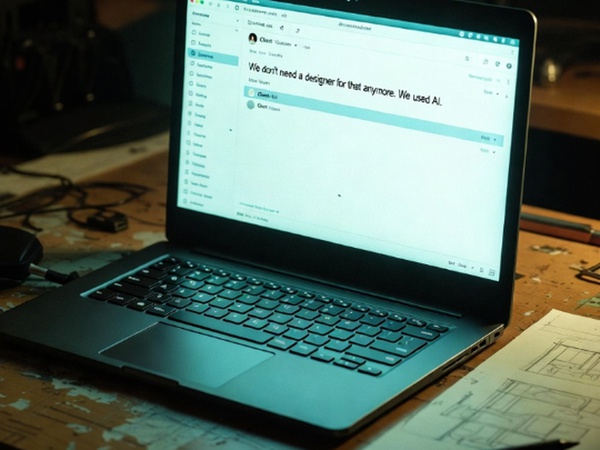
<p><span style="background-color: transparent;">What happens to your hands when the machine learns your job?</span></p><p><br/></p><p><em>"We don't need a designer for that anymore. We used AI." — A client message. </em></p><p><br/></p><p>Somewhere in Lagos, a graphic designer refreshes her inbox. The brief she was expecting is not there. Instead, there is a short message — the client found a tool, generated something overnight, liked it enough. She has been doing this for three years. She is good at it. And she did not get a memo that the rules had changed.</p><p><br/></p><p><span style="background-color: transparent;">She is not alone. Across Africa in 2026, the same quiet displacement is happening in offices, studios, newsrooms and living rooms turned workspaces. Not with dramatic announcements. Not with mass retrenchments. But with frozen vacancies, smaller briefs, and client messages that arrive like the one above — matter-of-fact, bloodless, final.</span></p><p><span style="background-color: transparent;"><br/></span></p><p><span style="background-color: transparent;"><em>92,000+ technology workers lost their jobs globally in the first months of 2026 - companies now openly citing AI as the reason.</em></span></p><p><br/></p><p> With AI advancing at lightning speed, what future is left for African workers in the digital economy? This question deserves an answer that does not look away.</p><p><span style="background-color: transparent;">The fear is real. And it is specific. It is not the abstract fear of a distant robot takeover. It is the fear of an Awka writer watching his freelance opportunities shrink by the month. </span></p><p><br/></p><p>In South Africa, where youth unemployment already sat at nearly 44% at the end of 2025, economists warn that the next wave of displacement will not come loudly. It will come through companies that grow their output without growing their headcount. Vacancies that stay frozen while AI fills the gap. The work disappears. The workers remain.</p><p><br/></p><p><span style="background-color: transparent;">And this is particularly sharp for Africa because the continent was already running a deficit. Broadband access remains unequal. Digital literacy training is scarce. The International Finance Corporation projects that by 2030, 28 million jobs in Nigeria alone will require digital skills — skills that most workers were never offered the chance to build. The advice to "just adapt, just upskill, just use AI" is delivered freely and costs nothing to give. </span></p><p><br/></p><p><em>The workers most at risk did not choose to be under prepared. They were simply never invited to the conversation about what was coming</em>.</p><p><br/></p><p><span style="background-color: transparent;">AI does not arrive on a level field. It lands on a continent where some have fast internet and laptops and time to experiment — and many do not. Where some companies have budgets for retraining — and many workers have only themselves. The digital divide was already a wound. AI is not healing it.</span></p><p><br/></p><p><span style="background-color: transparent;">And yet — the hope is also real.B</span><span style="background-color: transparent;">ecause across the same continent, something else is happening. The graphic designer who lost the logo brief is not gone. She learned the tool that replaced her. Now she uses it to produce in a day what once took a week, takes three clients instead of one, and spends the time she saved on the creative thinking no algorithm could replace. She did not survive AI. She absorbed it. But that absorption took three months of late nights on her laptop, a friend who pointed her to the right tutorials, and the quiet privilege of time that not every worker has.</span></p><p><br/></p><p><span style="background-color: transparent;"><em>In Nigeria, writers, developers and creators are finding that AI does not replace the person who knows how to use it with intention. AI is a multiplier — but only for the person holding it.</em></span></p><p><br/></p><p><span style="background-color: transparent;">Africa has always done more with less. The continent leapfrogged landlines into mobile banking. It built creative economies from limited infrastructure. It has survived disruptions that were not of its making and adapted with a resourcefulness that no report fully captures. That instinct is not gone. It is exactly what this moment demands.</span></p><p><br/></p><p><em>The future belongs not to those who fear the machine — nor to those who blindly trust it — but to those who learn to think alongside and ahead of it.</em></p><p><br/></p><p> But here is the question that cannot be answered by workers alone: who is building the bridge? Because the burden of adaptation cannot rest only on the individual designer refreshing her inbox. Governments must invest in digital infrastructure and training at scale — not as a footnote, but as a line item in every 2026 budget. Companies deploying AI must ask what they owe the workers their tools displace — and answer with retraining funds, not farewell emails. Educational institutions must stop preparing students for industries that are already changing shape beneath them.</p><p><br/></p><p><span style="background-color: transparent;">The future of African workers in the digital economy is not sealed. The workers who will survive this are already adapting. But survival should not require them to do it alone.</span></p><p><span style="background-color: transparent;">T</span><span style="background-color: transparent;">he machine is not the enemy. Indifference is.</span></p><p><br/></p>



 262
262





Other insights from Nonso Obi











Contributor Points
Points-to-Coupons

Referral Earning
Insights for you.


My Unpopular opinions of Social Media.
I Really Hate Social MediaWait, hear me out.I'm not saying this from a place of pride o...
242 views
33 upvotes
40 comments


Meet Amina the AI
Well yes, the image attached to this post was created with DALLE. After some interestin...
1476 views
20 upvotes
12 comments

If You Can’t Beat Them, Join Them
I didn’t experience the “before.” Before landlines, before phones, before mobile money—...
322 views
28 upvotes
25 comments


Grandpa lied (A little)
"Grandpa said, farming pays and not even your AI can take that away" that was my cousin...
337 views
25 upvotes
26 comments


Social Media vs Reality – Let’s Be Fo...
Let’s talk. Be honest, have you ever looked at someone’s Instagram story and immediatel...
442 views
15 upvotes
15 comments

Are we becoming who we are, or who we...
We are shaped long before we realize itby things we do not question,by voices we do not...
307 views
19 upvotes
20 comments

Three (3) reasons why AI is losing to...
This article explains how Google's new policy affects AI-written content and flagging g...
845 views
18 upvotes
18 comments

Over sharing with a bot : it's not th...
Lately I’ve realized my most stable relationship might actually be with ChatGPT. 😭 I co...
467 views
16 upvotes
16 comments

The Impact Of Social Media vs Books: ...
A social media personality emerged on the internet months ago and a basic small toy tha...
388 views
19 upvotes
15 comments
Tech is the New White Collar Job
Tech is the New White Collar Job
Tech is the new currency; with tech, you can say cr...
1069 views
17 upvotes
11 comments