They asked you how you did it.
You told them, slowly.
First, you learned the shape of the knife,
how easily a life could be divided
into before and after.
You chose your words carefully.
There was no screaming, no blood on the floor.
Only a silence that grew heavier
every time you walked through the door.
You remember the night it happened.
The lights were on. The windows closed.
You stood before the bathroom mirror
and watched someone you almost knew.
They said the victim trusted you.
That you had been there from the start.
That no stranger could have done this—
not with such precision, not without a mark.
They asked if you felt guilty.
You said, you have no idea.
They asked if you would do it again.
You looked them in the eyes
and told them you had already begun.
Because murder isn't always violent.
Sometimes, it's a thousand little things:
the dreams you bury to be loved,
the songs you stop singing,
the truth you swallow until it stings.
Sometimes, you kill in self-defence.
Sometimes, you kill to belong.
Sometimes, you don't even notice
until the silence has lasted too long.
And you suppose that's what frightened them most—
how calmly you described the scene,
how you spoke of the victim in past tense
as though they'd never been anything to you.
They asked for the body's location.
You told them it was somewhere safe.
They asked if they could see the face.
So you led them to the bathroom,
where the mirror still hung in place.
They searched the room for evidence,
for a body, for a sign.
They found no blood upon your hands,
no weapon they could find.
Then one of them looked at the mirror
and asked you, "Who is the victim?"
You pointed at the glass.
"That was me," you said. "I killed myself."
They stared at you in disbelief,
so you explained what you had done:
You murdered every piece of you
that dared to be someone.
You killed the child who spoke too freely,
the dreamer who reached too high,
the person who thought they deserved love
without having to justify why.
You buried every truth that hurt them,
every want that made them leave.
You strangled all the parts of you
they found too hard to believe.
And when there was nothing left to change,
nothing left to rearrange,
You looked into the mirror one last time
and couldn't recognize your face.
They'd been searching for a murderer.
They'd been searching for the dead.
But the victim was the person you had been,
and the murderer was the person you became.
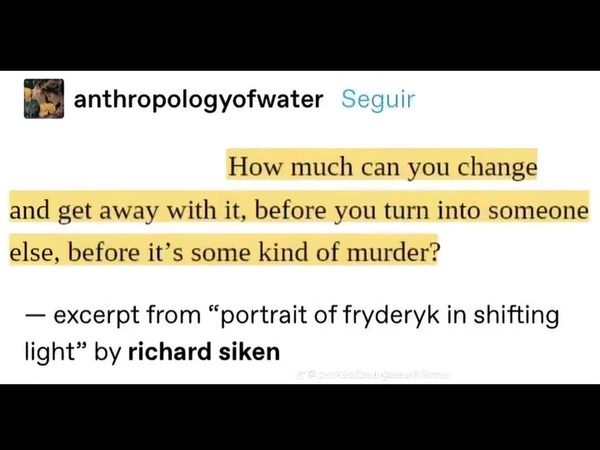
Because when does changing
become a kind of crime?
When does losing who you are
mean you've crossed an invisible line?
Was it murder when you silenced
every part of you that cried?
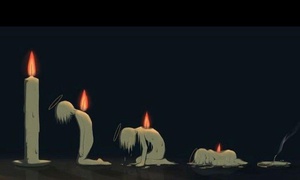
Or did you die a thousand deaths
just to keep the rest alive?


 69