Score |
126





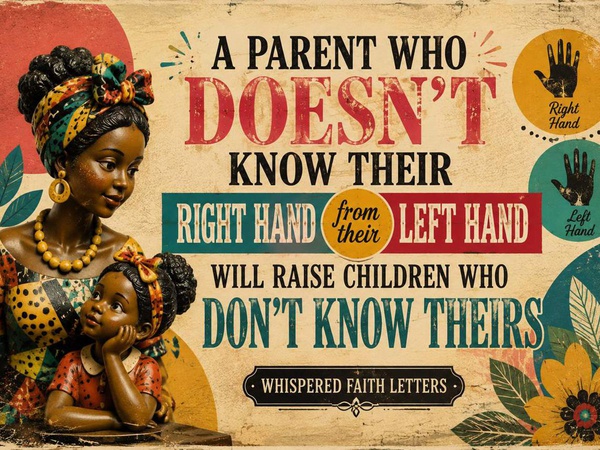
A Parent Who Doesn't Know Their Right Hand From Their Left Will Raise Children Who Don't Know Theirs
<p>I used to think confusion was something children grew out of. That the muddiness of not knowing who you are, what you want, which way to turn that it was just a phase of youth, something time would sharpen into clarity. But watching the women around me, I've started to believe something else. I've started to believe that confusion is inherited. That it is handed down, quietly, from a parent who was never sure of their own hand.</p><p><br/></p><p>Think about it plainly. A child does not learn left from right by being told once. They learn it by watching which hand their parent reaches with, again and again, until the pattern becomes instinct. The reaching hand becomes the trusted hand, simply because it was the one used most, the one that never wavered. But what happens when the parent themselves never resolved that question? What happens when the one who is supposed to model direction is still, deep down, unsure which hand is truly theirs — switching depending on the room they're in, the person watching, the fear they're carrying that day?</p><p><br/></p><p>The child does not become balanced. That is the lie we tell ourselves about ambidexterity that using both hands equally is a gift, a flexibility, something to be admired. But a child raised by an unresolved parent does not gain two strong hands. They gain two uncertain ones. They grow up reaching for everything with the same hesitant grip, never fully trusting either side of themselves. Ask them to choose and watch the hesitation not because they lack desire, but because no one ever showed them which hand was allowed to lead.</p><p><br/></p><p>Amara knew this without having language for it. Her mother had spent a lifetime switching between two versions of herself the woman who said a wife submits, and the woman who quietly resented every time she did. She never chose. She lived both, unreconciled, and called it womanhood. Some mornings she would tell Amara to never let a man raise his voice at her twice. Some nights Amara would hear her mother's voice go small and apologetic through the bedroom wall, folding herself smaller than the argument required. Amara absorbed both currents at once, and neither one ever won. So Amara grew up reaching for love with one hand and bracing against it with the other. She could not tell you, even now, which hand was supposed to lead the one that opens, or the one that guards.</p><p><br/></p><p>Tolu's father was the same, in a different shape. A man who preached hard work as the only path, yet cut every corner he could when no one was watching. He would sit Tolu down and speak of discipline like scripture, and then, in the same week, take a shortcut that undid everything the sermon had built. He never resolved which hand he believed in the disciplined one or the desperate one. And Tolu inherited both, so that even now, in her thirties, she cannot tell if she is building a life or just performing the appearance of building one. She works hard and then quietly wonders why she's working hard, whether it's for the life or for the look of the life. That question was never hers to begin with. It was her father's, unfinished, passed to her like a debt she didn't take out.</p><p><br/></p><p>Reyna's inheritance came dressed as freedom. Her mother never told her what to want not a husband, not a career, not a country to settle in. She said, again and again, "you can be anything," and meant it as a gift. But Reyna noticed, over the years, that her mother had never once said what she herself wanted. Not once, in Reyna's whole childhood, did her mother reach for something with a full hand and hold it. She had simply never chosen, and called the not-choosing open-mindedness. So Reyna grew up with every door unlocked and no compass for which one to walk through. She calls it options. Some nights she calls it something closer to grief for a mother who could have shown her one true direction and gave her a hallway of open doors instead.</p><p><br/></p><p>This is the quiet inheritance nobody warns you about. Not money. Not trauma, exactly. But indecision. The unresolved parent does not fail to teach their child a direction they succeed in teaching them two directions at once, and call it options, and call it freedom, when really it is just the transfer of their own unhealed uncertainty. It doesn't arrive with a warning label. It arrives disguised as flexibility, as broad-mindedness, as a mother who "just wants you to be happy" when what she actually never did was decide, for herself, what happiness required her to choose.</p><p><br/></p><p>I think of Adaeze, who tells me she doesn't know if she wants a career or a home, a man who challenges her or one who soothes her, a life that is loud or one that is still. She says it like it's her own confusion, freshly hers, something she alone must sit with and untangle. But when she describes her mother, I hear the same split, one generation earlier, wearing different clothes. Her mother, too, stood at every fork in her own life and refused to pick a path, calling it patience, calling it faith, calling it waiting on God, when really it was just a hand that never learned to reach with conviction. Adaeze isn't lost. She's holding a map someone else never finished drawing.</p><p><br/></p><p>Maybe the work, then, isn't choosing for our children. It isn't handing them a fixed direction just to spare them the discomfort of not knowing. Maybe it's choosing for ourselves first sitting with our own indecision until it resolves into something we can stand on. Knowing our own right hand from our left, so plainly, so certainly, that there is nothing left to pass down but clarity. Not a rulebook. Not a rigid path. Just the simple, steadying knowledge of which hand is ours, so that when a child reaches to imitate us, there is something solid there to imitate.</p><p><br/></p><p> Subscribe </p><p><br/></p><p>If you're reading this do you know which hand is yours? Or are you still reaching with both, the way someone once </p>


 19
19


Other insights from Whispered Faith Letters




Referral Earning

Points-to-Coupons

Insights for you.
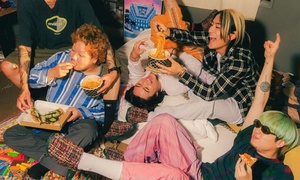

Gen Z, Are We.... Hungry?
If aliens were to read our texts, they'd think Gen Z are in a perpetual state of starva...
516 views
49 upvotes
54 comments


In Her Likeness.
I hail from the southwestern part of Nigeria, and oftentimes, when I walk through the n...
104 views
43 upvotes
49 comments

Dear Dad
Dear dad,It's been 7 years, 3 months and 1 day and your name still echoes in my brain.W...
213 views
44 upvotes
35 comments

Curiosity or Clout?
Omooo I have a bad habit. 😭Whenever something starts trending in Nigeria, I click on it...
143 views
32 upvotes
41 comments
I Think We Broke Gen Alpha
I think we broke Gen Alpha...Yesterday I opened TikTok.A child who couldn't have been o...
242 views
35 upvotes
36 comments


GOD IS A GIRL DAD.
Fathers and daughters, a match made in heaven.Literally.They say a girl's first love is...
412 views
27 upvotes
28 comments

Insufficient!
I met a young man this evening in a shared ride, first it was Arsenal that got us talki...
536 views
30 upvotes
38 comments