I was taught to say good morning
with careful teeth,
polished and proper.
But my tongue softens into "Ẹ káàrọ̀"
and the morning stretches its limbs.
Yoruba does not walk into a room.
Yoruba dances,
owereke.
It rolls in my throat like palm oil,
warm and golden,
leaving its trace on every word that follows.
English stands upright in my mouth,
a well-behaved guest.
But Yoruba is barefoot thunder,
ṣé o gbọ́?
It does not knock.
It arrives.
I did not inherit silver spoons.
I inherited oríkì
folded into my name like prophecy.
My grandmother did not hand me diamonds.
She handed me àṣà,
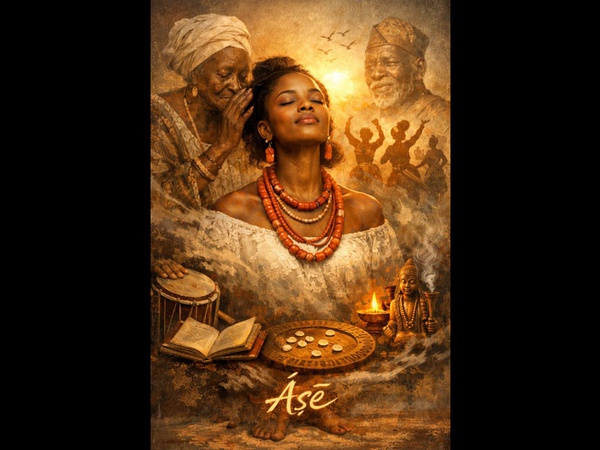
I remember her fingers, wrinkled and wise,
tracing patterns on my palm while she spoke,
each word a seed planted in my chest,
waiting to bloom when I needed to remember.
She was praying, I realize now.
Not with folded hands,
but with every word she pressed into me.
I am my ancestors' answer.
She said,
"Má gbàgbé ẹni tí o jẹ."
In English, it means remember who you are.
In Yoruba, it feels like
if I forget,
the ancestors will clear their throats.
At school, I am fluent and filtered.
At home, I am ilé,
I am ọkàn,
I am the echo of women who sang before microphones existed.
My language is not just sound.
It is inheritance.
It is rebellion.
It is drum skin memory.
And when I speak it,
soft or fierce,
the earth answers back —
so I speak.
Barefoot. Thunder. Uninvited.
Àṣẹ.




 331