PART TWO
Sikirat had spent her short life building businesses, building a home, building a family, and building a future for the children she loved. Then, in the very moment she brought Taye and Kende into the world, her own journey ended.
But death was not the end of Sikirat’s story. It was only the beginning of what would happen to everything, and everyone she left behind.
After Sikirat’s death, people came from far and near.
They cried as though their hearts would break.
Some mourned the woman they had known.
Some mourned the mother she had been.
Some mourned the daughter, sister and friend she had become.
But for her children, the mourning was only the beginning.
They had lost their mother.
And now, without understanding why, they were about to discover what it meant to lose the protection her presence had given them.
Among the people who came forward was Monsura.
Monsura was not just a cousin.
She was the daughter of Sikirat’s mother’s younger sister, but the word cousin could hardly describe their closeness.
They had grown up together.
They were age-mates.
They were family and friends.
People called them sisters.
Some called them friends.
Some even called them twins.
That was how close they were.
After Sikirat died, Monsura said she would help with the children.
She gathered some of Sikirat’s belongings, saying they would be kept safely for the children until they were old enough.
The clothes.
The new dresses.
The gold.
The jewellery.
The computers.
The equipment from her digital business.
Other valuable things Sikirat had worked hard to acquire.
Even the things connected to the sawmill business were not left untouched.
The family believed that somehow, someday, the children would benefit from what their mother had left behind.
There was a Yoruba saying people repeated:
“Aye tí ẹṣin ò jẹ, ìrù rẹ̀ á jẹ.”
The idea was simple: what the horse does not live long enough to enjoy, its tail will eventually enjoy.
Sikirat had not lived long enough to enjoy everything she had built.
So people believed her children would.
They would inherit the fruits of her labour.
They would grow up and enjoy what their mother had sacrificed to build.
But the proverb sounded different when life began to unfold.
Because Sikirat’s mother now had the daughters to take care of, while her old mother In-law had the twin to worry about as Sikirat had always wanted before her death.
Before Sikirat died, she had been the one supporting her mother.
Now the same woman was expected to care for Sikirat’s children.
The burden came suddenly.
School fees.
Food.
Clothes.
Transport.
Daily needs.
One expense after another.
The grandmother borrowed.
She begged.
She moved from one doorstep to another.
She became familiar with the offices of microfinance institutions—LAPO, Grooming, Bozak, Eagle Eye, and others.
She was there regularly.
She borrowed, repaid what she could, and most times borrowed again because another need had already arrived before the previous one was settled.
Debt became part of her life.
Not because she was careless.
Because she was trying to keep Sikirat’s children going.
And when the money was still not enough, she went to family.
Sometimes she asked quietly.
Sometimes she had to swallow her pride.
Sometimes she returned empty-handed.
Only one of Sikirat’s uncles consistently tried to help with whatever little he could.
Everyone else seemed to have their own reasons for being unavailable.
Meanwhile, the people who had taken Sikirat’s belongings were not coming forward to carry the responsibility.
The promises made at the funeral began to disappear.
The children still needed food.
They still needed school fees.
They still needed clothes.
And their grandmother still had to find a way.
There were days when what was on the table was simply amala and okra soup.
There were days when it was garri without sugar.
The children did not eat those things because they had chosen them.
They ate them because that was what their grandmother could afford.
And somehow, even with so little, she tried to make the children feel loved.
They hugged her.
They sat beside her.
They tried to make her laugh.
And whenever they saw how tired she looked, they gave her promises of the future.
“Grandma, when we grow up, we will buy you a car.”
“We will build a house for you.”
“You won’t suffer again.”
She listened.
Perhaps those words were the only wealth the children could give her at the time.
But they meant everything.
As time flies grandma gradually became weak that she could not do much stress but what would the kids eat?
Who will provide their needs?
Then Jumoke stepped deeper into the family’s struggle.
She was one of the grandmother’s daughters, and as the situation worsened, she became one of the major providers.
She worked.
She found ways to make money.
She supported the children.
She supported her mother.
She also began paying the grandmother’s debts little by little.
The burden was enormous.
But she carried it.
Still, Lagos was becoming too expensive.
The grandmother was getting sick.
The cost of living was too much.
The debts were following her.
She could no longer maintain the life she was trying to maintain there.
Sadly, she returned to the village because she needed help.
She needed somewhere she could breathe.
Somewhere where life would not cost as much.
The girls remained with Jumoke in Lagos.
They did not move permanently to the village.
But whenever they had the opportunity, they went to visit their grandmother.
Those visits became precious.
They would sit with her.
Help her sell things at the market.
Hug her.
Talk to her.
Make her smile.
And for a little while, the woman who had spent so much of her life worrying about money could forget about money.
She could simply enjoy being their grandmother.
But her health kept getting worse.
Her body was becoming weak.
The woman who had once walked from one doorstep to another begging and borrowing was now struggling to carry her own body.
The girls saw it.
They knew.
But they still held on to their promises.
They still believed there would be a day when they would make everything better.
A car.
A house.
A comfortable life.
They would give her everything she deserved.
But that day never came.
Their grandmother already gave up the ghost before they could fulfil those promises.
And when the news reached them, the pain was different from the loss of their mother.
They had already lost Sikirat.
Now they had lost the woman who had stepped into the empty space their mother left behind.
The woman who fed them.
The woman who borrowed for them.
The woman who begged for them.
The woman who endured humiliation for them.
The woman who kept saying, “Don’t put your hope in human beings,” even as she silently carried the disappointment of those very human beings.
She was gone.
The children were left helpless.
And Jumoke became even more to them.
She became their protector.
Their provider.
Their support.
In many ways, she became their mother.
But the children still had to grow up with memories that refused to disappear.
The two most important persons in their lives left them without hope of seeing forever again.
Now, they don’t cry for their mother alone, they now have another soul they lost.
They remembered Sikirat and their grandmother.
They cried.
They prayed.
They called their names.
Sometimes, when they cried, it felt as though they were calling into a room that had been emptied of its most important person.
They were not there.
But everything about their lives reminded them that they had once been.
Their memory lived in their hearts.
Their work lived in the things she had left behind.
And the absence lived in every moment.
Then came their grandmother’s burial.
It was there that the girls met Monsura again.
And something happened between Monsura’s first daughter (Tomiwa) and Sikirat second daughter (Leemah) over greeting
Tomiwa said Leemah didn’t greet her properly.
Tomiwa slapped Leemah for being rude.
They were age mate.
The girl stood still.
She could have fought back.
She was not weak.
But she understood that this was her grandmother’s burial.
There was already enough grief in the place.
So she chose silence.
She did not respond.
Not because she could not.
Because, at that moment, silence was wiser than another fight.
She carried the pain quietly.
That made the girl remember a painful memory that happened years back at Monsura’s house.
During one holiday like that, they went to spend a few days with Monsura.
They did not live there.
They were simply visiting.
And while they were there, they saw something familiar.
Their mother’s computer.
The equipment that had once belonged to Sikirat.
The things they had been told were being kept for them.
One of the girls reached toward the computer.
“Don’t touch that!” Monsura shouted.
The girl froze.
“Do you want to spoil it?
Do you even know how to operate it?”
She looked at the computer.
Then she looked at Monsura’s own children, who were using it.
For a moment, the girls could not understand what they were seeing.
This is my mother’s property.
Why can’t I even touch it?
The question sat heavily in her heart.
But she did not ask it aloud.
She knew that speaking too much could make things worse.
So she swallowed the words.
And that was how some of the children learned to survive.
By keeping quiet.
By watching.
By understanding things they were too young to understand.
By accepting that sometimes, the people adults said would protect them were the same people who could hurt them.
Years passed.
The girls continued growing.
Sikirat older daughter (Muibat) could not continue her education as she had hoped.
She had to work.
She made money.
She helped support herself and her younger sister.
The younger sister kept studying.
With the help of others who were not the family members it just wanted to help the poor girl reach her goals.
There was a woman who helped financially and also give motherly advices too.
And also a guy who took her like a sister and made her attend tutorials without paying a dime.
She passed her WAEC in one sitting and also JAMB result with results good enough for her to get admitted in university of her choice.
Then came the news she had been waiting for.
Admission.
University.
The future she had worked toward was finally opening.
But she needed help.
Jumoke and her sister were already carrying the weight of the family.
So the young girl had to put aside her pride.
She called Monsura.
She asked for support.
Not because she wanted luxury.
Not because she wanted anyone to live her life for her.
She simply wanted to go to school.
The response broke her heart.
She told her to terminate the admission.
The university was too far.
She said she had meetings with the family.
They would give her money to write JAMB again.
She was devastated.
She told the people around her.
They understood what was going to happen.
So they came up with a plan.
It was for her to tell the family that she had terminated the admission.
Not because she should actually give up.
But because she wanted to see whether the family would truly keep the promise they had made.
The girl followed the advice.
She told them she had terminated the admission.
They accepted it.
Then the calls stopped.
They stopped picking up.
They did not send the promised money.
They did not even call to ask what happened next.
And that was when she knew.
She was going to have to fight for herself.
So she did.
With the help of people around her.
She went to university.
She continued her education.
And she succeeded.
Her sister succeeded too, in her own way.
The one who could not continue her education found another path.
The one who went to university built hers.
Different roads.
Same determination.
And eventually, the two girls became successful.
The children who had once eaten amala and okra soup because that was what their grandmother could afford grew into women capable of taking care of themselves.
And they did not forget the family they came from.
They helped their twin brothers, Taye and Kende.
They also supported their paternal grandmother, the woman with whom the boys had stayed.
The cycle had changed.
Sikirat had spent her life helping people.
Her mother had spent her final years helping Sikirat’s children.
Jumoke had carried the family when she could.
And eventually, Sikirat’s daughters grew strong enough to carry others.
Perhaps that was Sikirat’s greatest inheritance.
Not the computers.
Not the jewellery.
Not the businesses.
Not the money.
Not even the house.
It was the strength she had planted in her children.
She had lived a successful life.
She had built businesses.
She had employed people.
She had supported people.
She had raised children.
She had owned a home.
She had created a life.
She simply did not live long enough to enjoy all of it.
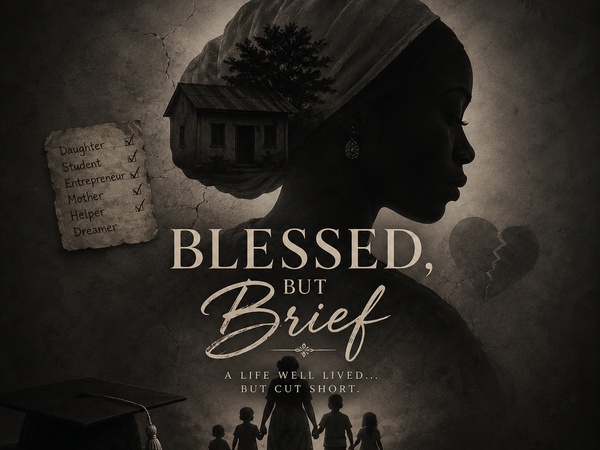
Her life was blessed.
But brief.
And maybe that is why the story of Sikirat is not really about death.
It is about what remains after death.
The people you helped.
The children you raised.
The lives you touched.
The strength you planted in people who may not even understand its value until you are gone.
Sikirat left this world too soon.
But she did not leave empty-handed.
She left behind four children.
Two daughters who eventually found their feet.
Two sons, Taye and Kende, who would grow under the care of others.
She left behind a sister who refused to let the family collapse.
She left behind memories.
And she left behind a question that may never have an answer:
Why does life sometimes give a person so much, only to give them so little time to enjoy it?
Perhaps there is no answer.
Perhaps some lives are measured not by their length, but by their impact.
Sikirat’s life was short.
But the story she left behind was not.


 134