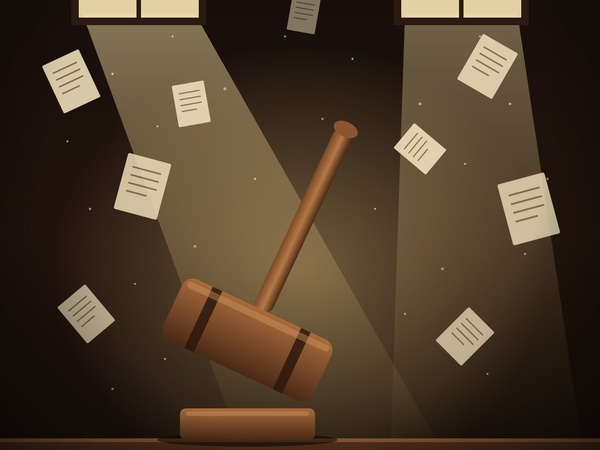
Members of the jury, I stand before you accused of one thing: writing well.
The evidence against me is simple.
A clean essay.
A big word.
A proverb that cut deep.
And before I could say a word in my defence, the verdict was ready: "No African could have written this alone."
But I ask you to remember that this trial is not new. Chimamanda Ngozi Adichie, in her talk "The Danger of a Single Story," told of a professor who said her characters were not "authentically African." They were educated, middle-class, and drove cars. In the same talk, she told of a roommate who was shocked that she spoke English so well. Neither of them was judging her writing. They were judging her against a picture they had already drawn in their heads.
Today, AI is only the new prosecutor. The old suspicion is the same.
Once, they said, "This is not African enough."
Now they say, "This is too good to be human."
The words are different, but the refusal is the same: a refusal to believe that an African mind can produce something polished and original.
Let me tell you where our good English comes from.
In Nigeria, we do not pick it up by accident. We learn it in classrooms, through textbooks, dictionaries, and exams. We read widely, we practice, and we lose marks for every mistake. So when our English is clean, it is not the work of a machine. It is the work of years. To call that suspicious is to punish us for the very discipline we were taught.
Then there is the proverb.
In our communities, proverbs are not decoration. They are how our elders think, argue, and teach. A sharp proverb in an essay is not a sign of a machine. It is a sign that the writer grew up listening. The same is true of Pidgin, of the rhythm of our mother tongues, and of the way we turn a sentence. These are not tricks. They are inheritance.
Now, the prosecution has a fair point, and I will not hide from it. AI writing is real, and it is everywhere.
Some people copy, paste, and take credit that belongs to honest writers. A writing community has every right to protect its work, and I would defend that right myself.
But the answer is not to judge a writer by how they sound.
Style proves nothing.
Process proves everything.
Ask for the drafts. Ask the writer to explain their choices. Ask why this word and not that one. A writer who did the work can always answer. A copyist cannot. This way, the guilty are found, and the innocent are not punished for being skilled.
And let us be honest about one more thing. There is no single African voice.
A Yoruba proverb, a Pidgin joke, and a formal essay all sound different, and all of them are ours. Africa has thousands of languages and many ways of writing. To demand one "authentic" sound is to repeat the same single story in a new form. All we ask is this: do not decide how we should sound before you believe us.
I will also tell you what this trial costs.
To be doubted is to reread your own best sentence and wonder if it is too good to be safe. Some writers begin to cut their best words, flatten their style, and write worse on purpose, just to look human. That is the real damage. Not a wrong verdict, but a generation learning to hide its talent.
So what makes a voice truly mine?
It is mine when I had the thought, chose the word, and can stand behind every line. It is mine when I can explain why I wrote it and what I meant. No machine can do that for me, and no suspicion can take it from me.
Members of the jury, brilliance is not a crime.
Eloquence is not a confession. Do not ask us to write worse so that you will believe us.
The defence rests.



 14