Score |
482


Ruthdaprotagonist
 Executive Assistant | CRM Specialist | AI Automation | Customer Support/Success Specialist @ Freelancer
Executive Assistant | CRM Specialist | AI Automation | Customer Support/Success Specialist @ Freelancer



IKEMEFUNA
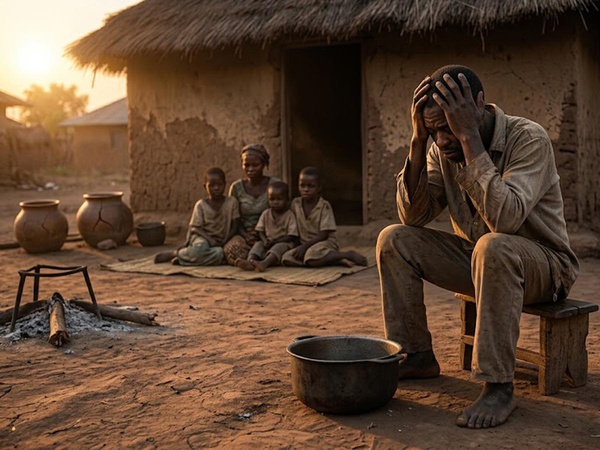
<p>For more than a year, Ikemefuna had lived from hand to mouth.</p><p>Every morning, he woke up not knowing what his family would eat that day.</p><p>Some days, there was enough for breakfast but nothing for dinner. On other days, breakfast never came at all.</p><p>His wife had become an expert at making little look like something.</p><p>A handful of garri could become breakfast.</p><p>A few pieces of yam could become dinner.</p><p>And when there was nothing, she simply added more water to whatever was left in the pot and hoped the children would sleep before their hunger became too loud.</p><p>For more than a year, Ikemefuna had watched his family slowly adjust to poverty.</p><p>His children stopped asking for meat.</p><p>They stopped asking for new clothes.</p><p>They stopped asking him for things he could no longer afford.</p><p>That hurt him more than their crying ever did.</p><p>Because children should ask.</p><p>They should ask for sweets, toys, shoes, school books and things that make childhood feel like childhood.</p><p>But his children had learned not to ask.</p><p>And Ikemefuna knew it was because they had begun to understand that their father could not provide them.</p><p>By the third day without food, Ikemefuna stopped telling his children that there was food coming.</p><p>The first day, he had said, “Your mother is cooking soon.”</p><p>The second day, “I will bring something before sunset.”</p><p>On the third day, his youngest daughter simply asked, “Papa, are we eating today?”</p><p>Ikemefuna looked away.</p><p>He hated that question.</p><p>Not because he did not know the answer, but because he did.</p><p>There was nothing in the house.</p><p>No yam.</p><p>No cassava.</p><p>Not even a handful of garri.</p><p>His wife had begun adding more water to the morning pap until it looked almost like rain.</p><p>Ikemefuna had once been a strong man.</p><p>People in the village remembered him carrying two sacks of grain on his shoulders without stopping to rest. He had owned a small farm and three goats. In those days, his children had eaten before asking if there would be food tomorrow.</p><p>Then the rains failed.</p><p>The harvest became smaller.</p><p>The debts became larger.</p><p>One goat became two goats sold.</p><p>Then the farm was mortgaged.</p><p>Then the debts came looking for him.</p><p>Every morning, Ikemefuna walked to the market hoping someone needed a labourer.</p><p>Every evening, he returned with the same empty hands.</p><p>His wife never complained.</p><p>That somehow made it worse.</p><p>One evening, as he sat outside staring at the dying fire, a man named Nwosu approached him.</p><p>“I heard you need work.”</p><p>Ikemefuna looked up.</p><p>“What kind?”</p><p>Nwosu smiled.</p><p>“The kind that pays.”</p><p>There was something in the smile that Ikemefuna did not like.</p><p>But hunger has a way of making dangerous things look reasonable.</p><p>That night, Nwosu took him behind an abandoned warehouse.</p><p>Three sacks lay on the ground.</p><p>“Tomorrow morning, move these to the riverbank,” Nwosu said. “Someone will collect them.”</p><p>“What is inside?”</p><p>Nwosu laughed.</p><p>“Do you want money or questions?”</p><p>Ikemefuna stared at the sacks.</p><p>He knew.</p><p>Not exactly what was inside, but enough.</p><p>The goods had not been legally obtained.</p><p>He should have walked away.</p><p>Instead, he thought of his daughter asking if they were eating.</p><p>He carried the first sack.</p><p>Then the second.</p><p>Then the third.</p><p>For the first time in weeks, Ikemefuna returned home carrying money.</p><p>His wife looked at the notes in his hand.</p><p>“Where did you get this?”</p><p>“Work.”</p><p>She looked at him for a long moment.</p><p>Then she quietly took the money.</p><p>That night, the children ate until there was nothing left on their plates.</p><p>Ikemefuna watched them.</p><p>For the first time in months, he smiled.</p><p>But the money brought food for only three days.</p><p>And Nwosu returned.</p><p>“There is another job.”</p><p>This one was bigger.</p><p>More money.</p><p>More danger.</p><p>Ikemefuna hesitated.</p><p>Nwosu noticed.</p><p>“You want your children to starve because you suddenly found a conscience?”</p><p>The words entered Ikemefuna like a knife.</p><p>He accepted.</p><p>The second job went wrong.</p><p>The police were waiting.</p><p>Nwosu disappeared into the darkness.</p><p>Ikemefuna was caught with the goods.</p><p>By morning, the entire village knew.</p><p>His children were fed.</p><p>But now they had a different hunger.</p><p>The hunger to understand why their father was being taken away.</p><p>As Ikemefuna was led through the village, he saw his wife standing by the doorway.</p><p>She said nothing.</p><p>His youngest daughter held onto her wrapper.</p><p>“Papa?”</p><p>He stopped.</p><p>For a moment, he wanted to tell her everything would be fine.</p><p>But he had learned that promises were expensive.</p><p>So he only looked at her and said:</p><p>“Forgive me.”</p><p>Years later, people would remember Ikemefuna as the man who broke the law.</p><p>Few would remember the three days he spent watching his children go hungry.</p><p>And fewer still would ask the question that mattered:</p><p>When a man is given the choice between breaking the law and watching his family suffer, how much of that choice truly belongs to him?</p><p><br/></p><p><br/></p>


 87
87


Other insights from Ruthdaprotagonist




Contributor Points

Points-to-Coupons

Referral Earning

Insights for you.

All that I gave
Oh, hey there!It's me... again...You know, There's so much I want to saySo much I want ...
584 views
97 upvotes
95 comments



The Root of Evil.🌚
I like money.But they said it's the root of evil. 🙂Sorry, get your facts straight.The l...
302 views
78 upvotes
88 comments
The Manipulation.
"Mom started looking at me differently from that day.I remember it like the back of my ...
301 views
75 upvotes
91 comments




The 3AM World.
My favourite time of every day is between 1 a.m. and 4a.m.That's when the world is the ...
270 views
67 upvotes
72 comments

Drowning.
I can't breathe.I tried again.Nothing.My lungs burned.The water surrounded me, cold and...
281 views
61 upvotes
72 comments

Eden.
I came to this house very young, with one other.We were accepted so warmly.Everyone lov...
266 views
59 upvotes
71 comments