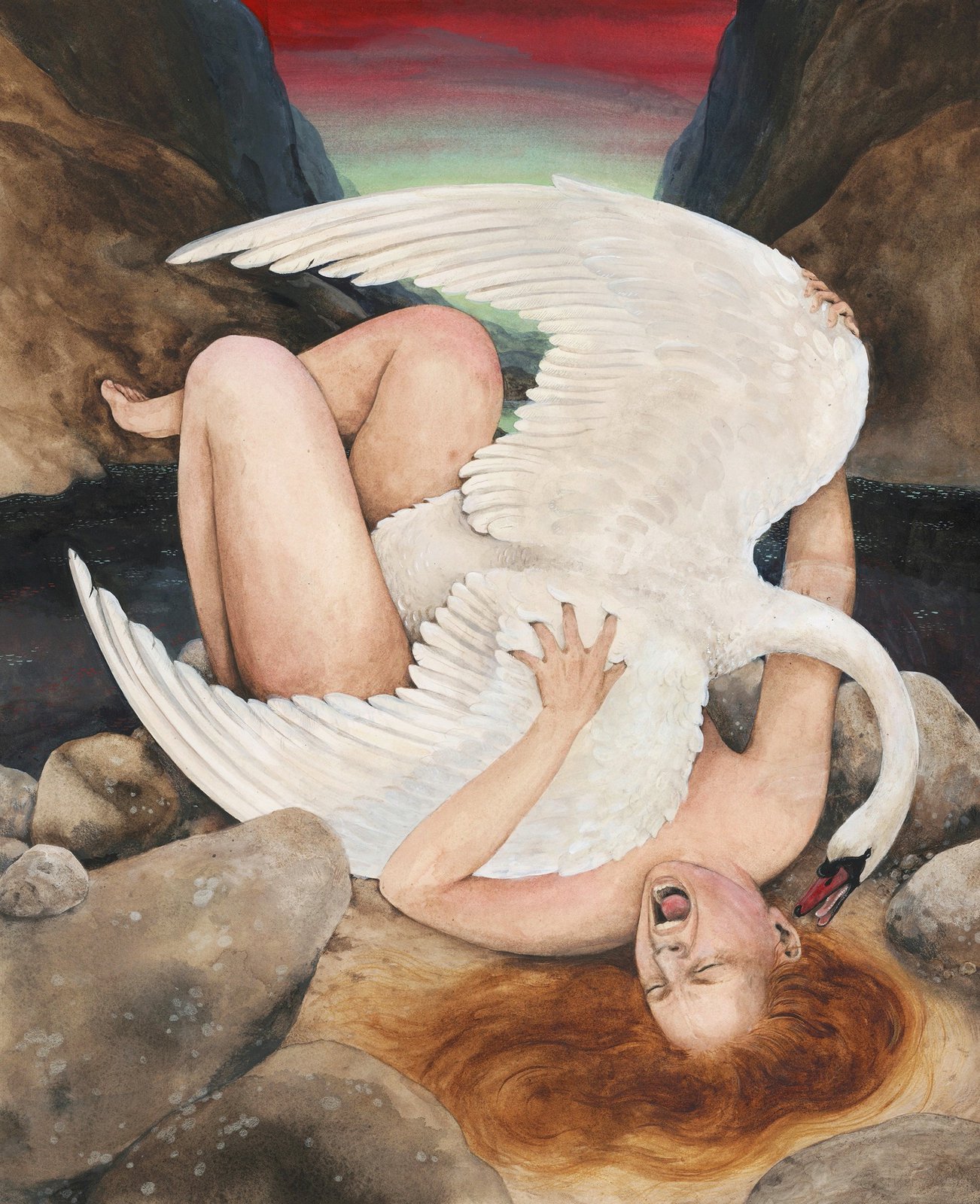
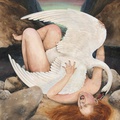
Leda and the swan by Esther Sarto
The river keeps its own counsel, but the reeds remember. They remember the weight that came down on her like weather, the wing across her mouth, the god's patience, which was only the absence of her consent. Afterward, the feathers are blamed for drifting. Then, she is asked what she was wearing. She lays an egg in the long grass. It is warm and it is not a gift. Out of it climbs a girl who did not choose a face that will one day be a fleet of a thousand ships. The god is already gone back to a sky where nothing he does has weight and the grass keeps the shape of her body for three days before the wind decides to forget.
There were four children in all. Two brothers who would be sung as stars, a sister who would learn what a house does to a woman who is made to wait in it and Helen, whom history will blame for the violence done to her mother, as if the egg had asked to be laid.
Now look at the hospital in the next century and the next and the one that is still happening. A woman on a tiled floor, her pulse stuttering, her womb a locked door with the wrong key. The committee has met and decided what her body is for. A man who has never bled signs the page that says WAIT and the page says wait and the clock says wait but the blood does not read. Somewhere a cupboard holds what would ease her, shelved between the rules and the borders. The word convenience is spoken over her head like a verdict, as though pain were a luxury and she had asked for too much of it to be taken away.
In another room, another woman is told she must have more for the nation, for the number, for the ones who are being counted against. In another room, a woman is told the thing growing in her is a child, though it has lodged itself in the narrow tube where no child can live and swells against the wall of her like a fist against a door. The doctors know the arithmetic and the law knows only the word LIFE, so they wait, because the law has put a heartbeat above her pulse. They wait for the tube to tear, the liver to fail, the leg to swell then, the blood pools in her where no one can see it, for her shoulder to ache with the strange pain of her own insides drowning, for her to be sick enough to count. Her mother is told to pray and her husband is told to sign, a slave to those whose laws were made without her in mind. In the next country, she is told to have none and to be grateful for the quiet. Her cloth is a law in one country and a crime in the next and in both she is the one who is looked at while the lawmakers go unseen. Her body is a border that everyone wants to draw and no one has asked the country.
And when the child has come, when the gateway has done what gateways are made to do and opened wide enough for a whole person to pass through, someone arrives with a needle. The door is not mended so much as edited. One more stitch, the doctor says, a small one, a kindness for him. Nobody asks the woman, who is still shaking with the work of the last hours and has not yet held what she made. The portal was built to return to its own size, patient as a tide, knowing exactly how wide to be to let the living in and how narrow to keep the rest out. But a man's pride has drawn its own measurements, the thread pulls them tight and she will carry the cinched hour in her body for years, in every step, in every turn of her hip, in every night she braces at the threshold of her own house. She learns what it is to be a doorway that someone else has decided how to hang. The swan did not ask the river neither did the needle ask the door. Both call it nature or mercy or the way things are done.
In a city where the ceiling has been opened to the sky, a surgeon works by the light of a phone. He apologises to the woman while he cuts. There is no sleep to offer her, only his hands and the sound of her teeth. The sky is not empty, an olive tree is bulldozed to make a clean line of sight and a grandmother carries her key for sixty years in a pocket sewn shut. Her house now has strangers' laundry on its roof. The strangers say the land was always theirs, the way the swan said the river was. A woman gives birth at a checkpoint, the soldiers neither look away nor do they help. The child arrives into a queue. Her first breath is measured, found suspicious and logged. Names are read aloud like a census at dawn. The list does not end and no one has been told to stop counting. Small shoes are lined up along a wall as if they were waiting for their feet. A man carries a bag of flour like an infant and an infant like a bag of flour and the cameras turn politely toward the weather.
A mother dresses her daughter in the cloth the neighbours approve of, another is stripped of hers at the wire. They are the same hands, folding the same morning into the same small shapes and both are guarding something older than any border: the fact that she goes on. That she carries the tongue in her mouth and the recipe in her wrist and the names of the dead in the lullaby she is not supposed to sing.
Leda's daughter grows. She has done nothing but be born and the war arrives at her door like a debt. Smoke over Troy and still no one traces the thread back to the wing, to the single hour when a god decided that no was only a kind of weather. The men who built the walls say it was the woman. The men who burned them say it was the gods. The reeds say nothing because the reeds were there. The thread runs forward. What is done in an hour is inherited by a century. The god who left is never present for what he made and we, who stay, are not spared either. We are here, watching, with our own hands and our own signatures and the consequence does not wait for our deaths to come due. It sits at the table and asks to be fed.
The dead are not absent but only waiting, in the grandchildren, the wars and the clear water that no longer runs clear. Somewhere, a woman is still lying on the tiled floor, still asking in the only language the body has, for the door to be opened. Furthermore, a god is still walking away, unhurried and the grass is still learning the shape of what he left.
The thread runs forward, the pen is in a hand. Whose?



 8