Score |
106






Meat is Meat
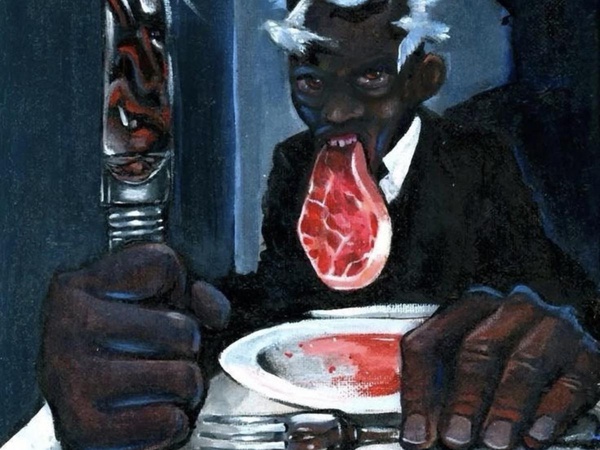
<p>My name is Mustafa, but everyone in Lagos calls me Suya Master. I wake up before the sun does, when the air is still thick with the night’s secrets and the roosters are just starting to clear their throats. My small room in the heart of Oshodi market smells of charcoal and spices, the kind that clings to your skin for days. I stretch my arms, feeling the ache in my shoulders from yesterday’s work, and I smile because pain means business is good. I am the biggest suya man in Lagos, you see. People come from Ikoyi, from Victoria Island, even from the mainland’s dusty corners, just to taste my skewers. They say my meat is tender, spicy, and smoky like the fires of hell itself. But they don’t know the half of it.</p><p>I started small, back when I was a boy in a small village in Katsina. My father was a butcher, hacking away at goats and cows with a machete that sang through the air. He taught me how to slice, how to season, how to grill until the fat drips and sizzles. But the village was too quiet for me, too full of prying eyes and empty pockets. So I came to Lagos, the city that swallows dreams and spits out kings. I arrived with nothing but a bag of spices and a dream of fire. At first, I sold on the streets, pushing a cart through the traffic jams where danfo buses honk like angry geese and okadas weave like shadows. My suya was good, but not great. Not yet.</p><p>The market in Oshodi is a beast of its own. By dawn, it’s alive with traders shouting prices, women balancing baskets of yams on their heads, children darting between legs like minnows in a river. The air hums with the chatter of Yoruba and Igbo mixing like oil and water, and the smell of fried plantains battles with the exhaust from generators. I set up my stand under a faded umbrella, near the bus stop where commuters flood in like a tide. My grill is a metal drum cut in half, filled with glowing coals that I fan with a piece of cardboard. The spices are my secret blend: ground peanuts, cayenne pepper, ginger, garlic, and a pinch of something I won’t tell. I skewer the meat on long sticks, thin slices that curl in the heat, and watch as the fat renders out, popping and hissing.</p><p>Customers line up before noon. There’s Iya Risi, the buka owner with hips wide as a doorway, who buys a bundle for her stew. She laughs and says my suya makes her customers sing. Then come the office workers in starched shirts, sneaking away from their desks in Ikeja for a quick bite. They chew with their eyes closed, moaning about how no one else can match my flavor. Even the area boys, those rough ones with scars and quick hands, respect me. They don’t harass my stand; instead, they protect it, because I slip them free skewers now and then. At night, when the neon lights flicker and the music from bars pulses like a heartbeat, the big men arrive in their SUVs, honking for service. Politicians, businessmen, celebrities with dark glasses hiding their eyes. They buy in bulk, wrapping the suya in newspapers stained with oil, and drive off into the shadows.</p><p>But success didn’t come easy. Lagos is a city of hustlers, and every corner has a suya seller trying to steal your fire. I had competitors, men with louder voices and cheaper prices. Their meat was tough, stringy like old rope, from cows that grazed on roadside grass. Mine was different. Softer. Juicier. People whispered that I had juju, some charm from the village that made my grill enchanted. I let them whisper. </p><p>It started one night, years ago, when I was desperate. Business was slow; a rival had undercut me with imported spices. I wandered the backstreets after closing, my pockets empty, my stomach growling. That’s when I found him, a drunk staggering home from a bar, his shirt untucked and his steps weaving. He bumped into me, mumbled something rude, and before I knew it, my knife was out the one I use for trimming fat. It was quick, in the shadows of an unlit alley. No one saw. No one cared. Lagos eats its own, they say.</p><p>I dragged him to my room, heart pounding like a talking drum. At first, I panicked. But then I looked at the body, at the flesh, and thought of my father’s lessons. Meat is meat, isn’t it? I worked through the night, careful with the cuts, mixing it with cow parts I’d bought cheap from a farm where disease had struck. The cows there were sick, spotted with sores, but their meat was plentiful and no one asked questions. I ground it all together, seasoned it heavy to mask any strangeness, and grilled it the next day.</p><p>The customers raved. “Mustafa, this is the best yet!” they said, licking their fingers. “So tender, so full of life!” I smiled and nodded, pocketing their naira. That was the beginning. Now, I source my special ingredients carefully. The humans come from the forgotten ones: beggars, thieves, those who vanish without a trace in this sprawling city. I lure them with promises of food or work, lead them to quiet places. The diseased cows I get from contacts in the abattoirs, where inspectors turn blind eyes for a small fee. Foot-and-mouth, tuberculosis, whatever ails them it doesn’t matter. The sickness makes the meat soft, easy to blend. I mix it all, human and bovine, into a symphony of flavors that no one can resist.</p><p>Dawn breaks with the call to prayer from the mosque nearby, a melodic wail that cuts through the fog. I rise, splash water on my face from a bucket, and head to the slaughterhouse on the outskirts. The air there is thick with blood and fear, cows lowing as they’re led to their end. My supplier, a gaunt man named Yusuf, nods at me. “Fresh batch,” he says, pointing to pens where animals cough and stumble. “Cheap for you, Suya Master.” I select the weakest, pay him, and haul the carcasses back in a hired truck, the road bumping under tires worn thin.</p><p>Back at the market, I prepare in my hidden shed behind the stand. The door creaks as I enter, and the fluorescent light buzzes like an angry bee. I sharpen my knives on a stone, the scrape echoing. First, the cows: I strip the hides, carve the flesh, ignoring the pus-filled lesions. It’s all protein, I tell myself. Then, if needed, the other source. Last week, it was a young man who’d pickpocketed the wrong person. I found him bleeding in a gutter, finished the job mercifully. His thighs were lean, his arms muscled from street life. I dice it fine, blend with the cow meat in a grinder that whirs like a storm. The mixture is pink and marbled, perfect for skewering.</p><p>By midday, the grill is hot. Coals glow orange, and I fan them until sparks dance. The skewers go on, sizzling as fat drips down. The aroma wafts out, a siren call: spicy, nutty, charred. People gather, saliva pooling in their mouths. A woman in a colorful wrapper buys five, wraps them for her children. “God bless your hands,” she says. I bless her back, silently amused. An old man with a cane chews slowly, his eyes distant, perhaps remembering his youth. Teenagers cluster, sharing one skewer, laughing as juice runs down their chins.</p><p>Afternoon brings the heat, the sun beating down like a hammer. Sweat beads on my forehead, mixes with the smoke. I wipe it away, keep grilling. Traffic snarls outside the market, horns blaring in a chaotic symphony. Vendors hawk wares: cold drinks, phone credits, knockoff watches. A preacher stands on a crate, shouting about sin and redemption. I listen half-heartedly, wondering if he tastes the irony in the air.</p><p>As evening falls, the market transforms. Lights string up like stars, music blasts from speakers. Bars open, beer flows. My stand becomes a hub. A group of friends arrives, ordering a feast. One is a doctor from Lagos University Teaching Hospital, crisp in his white coat. “Your suya is addictive,” he jokes. “What’s in it?” I laugh. “Love and hard work.” He nods, bites in, unaware that last month’s batch included a colleague of his, a nurse who’d wandered too far at night.</p><p>But there are risks. Once, a police man came sniffing around. Missing persons, he said, patterns in the disappearances. I served him free suya, watched his eyes widen at the taste. “Best in Lagos,” he admitted, and left without more questions. Another time, a customer bit into something odd a bone fragment, perhaps. He complained, but I refunded him, slipped in extra spice to soothe. Lagos is forgiving; people forget quickly amid the hustle.</p><p>Nights are when I reflect. After closing, I count my money under a dim bulb, stacks of notes greasy from handling. The city quiets somewhat, though never fully sleeps. Crickets chirp, generators hum. I think of my father, i think he’d be proud. Or horrified. But in Lagos, survival is king. I built an empire on fire and flesh, became the biggest because I dared what others wouldn’t. My suya feeds the soul of the city, piece by tender piece.</p><p>Tomorrow brings more coals, more skewers, more hungry mouths. And I, Mustafa the Suya Master, will feed them all.</p>


 48
48


Other insights from Tomilola Adejumo



Contributor Points

Points-to-Coupons

Referral Earning
Insights for you.


All that I gave
Oh, hey there!It's me... again...You know, There's so much I want to saySo much I want ...
583 views
97 upvotes
95 comments



The Root of Evil.🌚
I like money.But they said it's the root of evil. 🙂Sorry, get your facts straight.The l...
302 views
78 upvotes
88 comments
The Manipulation.
"Mom started looking at me differently from that day.I remember it like the back of my ...
301 views
75 upvotes
91 comments




The 3AM World.
My favourite time of every day is between 1 a.m. and 4a.m.That's when the world is the ...
270 views
67 upvotes
72 comments

Drowning.
I can't breathe.I tried again.Nothing.My lungs burned.The water surrounded me, cold and...
281 views
61 upvotes
72 comments

Eden.
I came to this house very young, with one other.We were accepted so warmly.Everyone lov...
266 views
59 upvotes
71 comments