


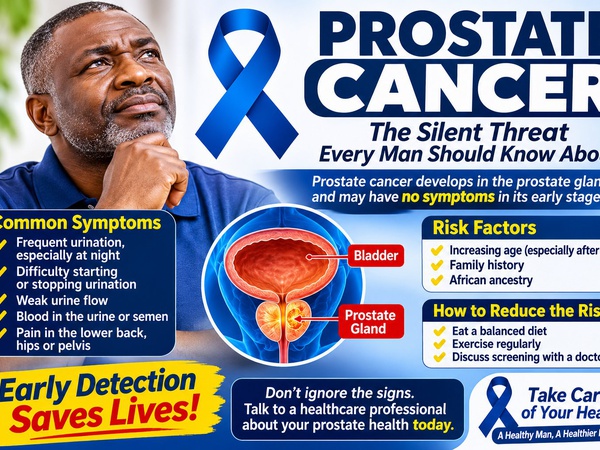
Prostate cancer is one of the major health challenges affecting men around the world. It develops in the prostate gland, a small gland found in men, located just below the bladder and surrounding the upper part of the urethra.
The prostate gland plays an important role in male reproductive health because it produces fluid that forms part of semen.
Prostate cancer occurs when abnormal cells in the prostate begin to grow uncontrollably. One worrying thing about this disease is that it may develop silently without noticeable symptoms in its early stages.
Who is at risk?
Although prostate cancer can affect men of different ages, the risk increases significantly as men grow older, particularly after the age of 50. Other risk factors include family history, inherited genetic factors and African ancestry.
What are the warning signs?
Some common symptoms include:
- Frequent urination, especially at night.
- Difficulty starting or stopping urination.
- Weak urine flow.
- Blood in the urine or semen.
- Pain in the lower back, hips or pelvis, particularly in advanced cases.
However, experiencing these symptoms does not automatically mean someone has prostate cancer. Medical examination is necessary.
Can prostate cancer be detected early?
Yes! Early detection is possible through medical assessments such as the Prostate-Specific Antigen (PSA) blood test and Digital Rectal Examination (DRE). Men should discuss the benefits and limitations of screening with a healthcare professional.
The message is simple:
Men should stop ignoring their health because of fear, embarrassment or the belief that seeking medical attention makes them weak.
Prostate cancer is treatable, especially when discovered early. Let's encourage our fathers, brothers, husbands, uncles and friends to take their prostate health seriously.
Remember, early detection saves lives. Don't wait until it is too late! 💙
Score |
2


Speed Eze
 Student @ Unicross
Prostate Cancer: The Silent Threat Every Man Should Know About


 2


Other insights from Speed Eze










Contributor Points

Points-to-Coupons

Referral Earning

Insights for you.
















ROSES
Roses are redLike our eyesAnd skiesBirds without feathersNor fathersWe're flocklessFlyi...
252 views
16 upvotes
12 comments

































