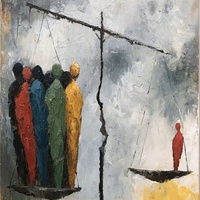



They say he who lives in a glass house should not throw stones. Or that a kettle should refrain from calling a pot black, lest they both discover that hypocrisy is, in fact, a very dark shade.
I understand these dispositions. I agree with them, even. There is something profoundly embarrassing about a person who has made a home out of imperfection and yet insists on conducting inspections in other people's houses.
The Bible, too, has something to say about it. Remove the log from your own eye before attempting to extract the speck from your brother's. Which, if you ask me, is a rather dramatic way of telling people to mind their business until they can see properly.
I have seen a little out of life, and what I can say is that whoever came up with these sayings ate. They ate very well, in fact. Because the older I get, the more I suspect that our opinions of other people's lives are not always born out of wisdom, discernment, or even genuine concern. Sometimes, they are born out of an overestimation of ourselves.
We look at another person's decisions and wonder how they could possibly be so foolish. We look at their mistakes and find ourselves strangely qualified to explain what they ought to have done. We look at their circumstances, often from the comfort of our own entirely different circumstances, and proceed to issue verdicts as though we have been appointed to the Supreme Court of Human Existence.
And the audacity is almost admirable.
There is a peculiar flaw in the eyes of an observer who has forgotten that they, too, are being observed. A tendency to look at another person's life without grace, without context, without the slightest curiosity about what it must have cost them to arrive where they are. Just a keen appetite for judgment and an inflated sense of one's own moral competence.
We are, after all, remarkably generous with advice concerning situations we have never survived.
There is an arrogance that comes with having never done a thing before. A very deep arrogance. The arrogance of the person who has never been desperate enough to make a desperate decision. Of the person who has never had to choose between two terrible options and is therefore convinced that the correct option must have been obvious. Of the person who has never been tested in a particular way and consequently believes that their character is a permanent achievement rather than an untested hypothesis.
It is easy to have principles when life has not yet presented you with an invoice for them.
It is easy to preach patience when you have never been made to wait for something that mattered. To condemn compromise when you have never been cornered. To question why someone stayed, why someone left, why someone forgave, why someone did not, why someone fell apart, why someone picked themselves up in such an unflattering manner.
We have a talent for imagining ourselves as the exception to every human weakness. In other people's stories, we are always the sensible ones. We would have left sooner. We would have spoken up. We would never have tolerated that. We would have known better. We would have done better.
But there is a difference between knowing what a person should do and possessing the courage, resources, clarity, or emotional capacity to actually do it. The distance between the two is where a great many people live. And it is a distance that judgment rarely cares to travel.
I am not suggesting that we abandon discernment, excuse every wrongdoing, or develop an absurd commitment to pretending that every decision is equally defensible. There are things worth condemning. There are patterns worth confronting. There are people who ought to be held accountable.
The truth is, some of us have not been good simply because we have never been tempted in the right direction. Some of us have not been brave because we have never been sufficiently afraid. Some of us have not made terrible decisions because life has, thus far, been kind enough not to offer us terrible choices.
And some of us are walking around with immaculate reputations that have never been exposed to the conditions necessary to ruin them.
I think there is wisdom in being careful with the stones we throw. Not necessarily because the person standing before us is innocent, but because we have not yet established the full extent of our own innocence.
Life has a rather inconvenient habit of changing the roles in a story. The person you once pitied may become the person you envy. The person you condemned may become the person whose circumstances you suddenly understand. And the moral high ground, as it turns out, is not always a permanent residence. Sometimes it is merely a place you have been standing because the flood has not reached your side of the street.
So before we begin our next public trial of somebody else's life, we ought to ask ourselves a few questions. Not to silence ourselves, but to humble ourselves. What do I know? What have I never had to endure? What circumstances might make my convictions difficult to keep? And am I judging this person, or am I simply congratulating myself for not yet having been them?
It is a sobering thought that the difference between a person we admire and a person we ridicule may, in some instances, be nothing more than the circumstances we have yet to encounter.
And if that is the case, we should be a little less eager to throw stones.
Glass houses, after all, have a rather poor reputation for surviving the enthusiasm of self-righteous people.
And most of us, whether we admit it or not, are living in one.


 23