Score |
83


Sam Daniel
 Students @ Adekunle Ajasin University of Akungba. Ondo State
Students @ Adekunle Ajasin University of Akungba. Ondo State



The Fall of the Naira: How Did We Get Here?The Fall of the Naira: How Did We Get Here?
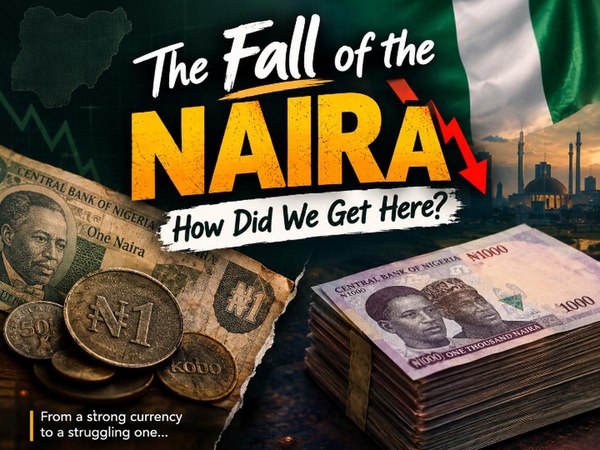
<p>Have you ever wondered how the Nigerian naira went from being a relatively strong currency to one that now requires hundreds or even thousands of naira to buy one US dollar?</p><p><br/></p><p>The fall of the naira did not happen in one day. It has been a long process involving changes in Nigeria's economy, oil prices, foreign exchange policies, inflation, government finances and the supply of foreign currency.</p><p><br/></p><p>When Nigeria introduced the naira in 1973, it replaced the old pounds, shillings and pence system. At that time, ₦1 was equal to 10 shillings, making the naira a significant currency in the Nigerian economy. </p><p><br/></p><p>During the 1970s, Nigeria was benefiting greatly from the oil boom. However, things began to change in the early 1980s. Falling oil prices and increasing demand for foreign exchange created pressure on Nigeria's external finances. By 1982, the country was experiencing a foreign-exchange crisis, and a parallel market began to develop. </p><p><br/></p><p>Then came one of the major turning points.</p><p><br/></p><p>In 1985, during the government of General Ibrahim Babangida, the average exchange rate was about ₦0.89 to US$1. By 1986, the average had fallen to about ₦2.02 to US$1. </p><p><br/></p><p>Why did this happen?</p><p><br/></p><p>In 1986, Nigeria introduced the Structural Adjustment Programme (SAP), which included major foreign-exchange reforms. The government moved away from the previous controlled exchange-rate system toward a more market-determined system. The first foreign-exchange auction in September 1986 resulted in a very large devaluation of the naira. </p><p><br/></p><p>The decline continued through the following decades.</p><p><br/></p><p>By 1989, the naira had fallen to about ₦7.39 per US$1, compared with about ₦0.76 per dollar in 1984. The World Bank described this as roughly a 90% reduction in the naira's value against the dollar over that period. </p><p><br/></p><p>By 1999, the average exchange rate was around ₦92.34 per US$1. By 2000, it had reached about ₦100.12 per US$1. </p><p><br/></p><p>Another important period came in the 2010s. In 2015, under President Muhammadu Buhari, the official/interbank exchange rate ended the year at about ₦197 per US$1, while the Bureau de Change rate was about ₦267 per US$1. </p><p><br/></p><p>The situation became even more complicated in the years that followed. Nigeria faced problems including limited foreign-exchange supply, dependence on oil revenues, inflation, fiscal pressures and multiple exchange rates. The World Bank has also identified declining foreign-exchange inflows, including from oil exports and foreign investors, as contributing to depreciation pressures. </p><p><br/></p><p>In 2023, President Bola Ahmed Tinubu's administration introduced major economic reforms, including ending the petrol subsidy and changing the foreign-exchange system toward a unified, more market-reflective rate. These reforms themselves led to a significant adjustment in the naira's official value. The World Bank reported that by December 2023, the naira had depreciated by approximately 41% in the official market and about 30% in the parallel market since the reforms began. </p><p><br/></p><p>Looking back at this history, one thing becomes clear: the fall of the naira has been a gradual story with several different turning points, rather than the result of one single event or one single government.</p><p><br/></p><p>From less than ₦1 to $1 in the 1970s and 1980s, to over ₦90 in 1999, and then to hundreds and eventually much higher exchange rates in later years, the journey of the naira reflects many changes in Nigeria's economy and foreign-exchange system. </p><p><br/></p><p>And now I want to hear from you. 👇🏽</p><p><br/></p><p>If you could go back to any period in Nigeria's history, which era of the naira would you choose to experience—and why?</p><p><br/></p><p>Or, for those who know the history:</p><p><br/></p><p>What do you think was the biggest turning point in the fall of the naira? 🇳🇬💴</p><p><br/></p><p>Drop your thoughts in the comments. Let's learn from each other's perspectives. 👇❤️</p>


 47
47


Other insights from Sam Daniel









Contributor Points

Points-to-Coupons

Referral Earning

Insights for you.


Igbo Kwenu!!!
Today, I refuse to be humble Not when I speak about my tribe...Cha Cha Cha Cha Cha,Igbo...
805 views
51 upvotes
45 comments


Confessions of a Nearly-Native
My name is Idara. I am Annang from Akwa Ibom. And I cannot speak my language.My mother ...
415 views
32 upvotes
37 comments


Cradle
Who sat and watched my infant head, When sleeping on my cradle bed, And tears of sweet ...
159 views
29 upvotes
31 comments


ÈMI NI ÌLÙ (I Am the Drum)
Mò fẹ́ kí ara mi gbọ́ mi.Before the world gives me a name,let my own soul remember mine.B...
198 views
24 upvotes
27 comments
Agbada and Other Silences
They said it with authority no one questioned.... “Àgbà kì í wà l’ọ́jà, kí orí ọmọ tuntu...
385 views
22 upvotes
29 comments


ÌLÚ MI, ILÉ MI
Modakeke Akoraye omo ogunteludo omo akinkanju loju ogun. Maybe because of you my father...
379 views
18 upvotes
25 comments








165 views
20 upvotes
19 comments