Score |
119






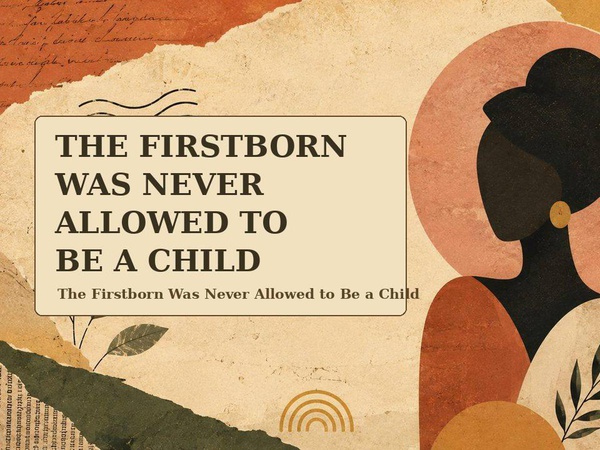
The Firstborn Was Never Allowed to Be a Child
<p>Adaeze cannot remember when she stopped being a daughter and became something closer to staff. Somewhere between the age of eight and the age of twelve, she became the one who answered for her younger ones. If they broke something, she was asked why she didn't stop them. If they failed a test, she was asked why she didn't help them read. If they were rude to a guest, the correction landed on her, not them because she was older, and older meant responsible for everyone's behavior except her own feelings about carrying it.</p><p><br/></p><p>Nobody called it what it was. They called it training. They called it discipline. But what Adaeze learned, underneath the vocabulary, was that she had no right to her own childhood. She was the maid before she was ever paid to be one cleaning up messes she didn't make, absorbing corrections for faults that weren't hers, holding a house together with her silence while everyone else got to be young and wrong and forgiven.</p><p><br/></p><p>So she stopped talking. Not all at once it built, the way resentment does when it has nowhere honest to go. Every time she tried to speak up for herself, to say this isn't fair, I am not their mother, she was met with the same answer: you're the oldest, act like it. Eventually she understood that her opinion had no seat at that table. So she withdrew it. She stopped correcting her siblings, stopped offering thoughts on family matters, stopped opening up at home altogether.</p><p><br/></p><p>Her family read this as rejection. They said she didn't love them anymore, that she was cold, that she didn't want to be around them. What they never asked was what it cost her to be trained into silence in the first place that the very muteness they were now offended by was the exact shape they'd built her into. They wanted the correction and control of a firstborn, but not the tiredness that comes with it. They wanted her voice only when it served them, and her silence read as betrayal the moment it served her instead.</p><p><br/></p><p>Reyna carried a version of this into her own marriage without realizing the pattern was following her. Growing up, she learned to keep her opinions small at home. When she married, she expected that season to end a new house, a new chance to be heard. Instead, she found the same arithmetic waiting for her in her husband's family. When she spoke, her opinion was treated as irrelevant, easily overruled, because in that house she was still new, still a stranger who had "just come" into their son's life. Her voice did not carry the weight of belonging yet. So Reyna did what she'd always done she went quiet. And true to form, the quiet was not read as peace either. It was read as pride. She's acting like she's too important. She thinks she's above us.</p><p><br/></p><p>This is the cruelty in it, a woman raised to believe her opinion doesn't matter will often carry that training into every room she enters afterward, and every room will still find a way to punish her for it whether she speaks or whether she doesn't. Nobody stops to ask where the silence came from. They only notice that it's there, and decide it means she thinks too highly of herself, when the truth is the opposite. She was taught, over and over, across different houses, that she was not high enough to be heard at all.</p><p><br/></p><p> Subscribe </p><p><br/></p><p>If you were the firstborn, or the "stranger" in someone else's family when did you first notice your silence was being misread, and what did it actually mean?</p>


 21
21


Other insights from Whispered Faith Letters









Referral Earning

Points-to-Coupons

Insights for you.


Gen Z, Are We.... Hungry?
If aliens were to read our texts, they'd think Gen Z are in a perpetual state of starva...
520 views
49 upvotes
56 comments


In Her Likeness.
I hail from the southwestern part of Nigeria, and oftentimes, when I walk through the n...
110 views
46 upvotes
53 comments



Dear Dad
Dear dad,It's been 7 years, 3 months and 1 day and your name still echoes in my brain.W...
214 views
44 upvotes
37 comments


Curiosity or Clout?
Omooo I have a bad habit. 😭Whenever something starts trending in Nigeria, I click on it...
147 views
32 upvotes
42 comments

I Think We Broke Gen Alpha
I think we broke Gen Alpha...Yesterday I opened TikTok.A child who couldn't have been o...
246 views
35 upvotes
37 comments




Insufficient!
I met a young man this evening in a shared ride, first it was Arsenal that got us talki...
539 views
31 upvotes
39 comments

GOD IS A GIRL DAD.
Fathers and daughters, a match made in heaven.Literally.They say a girl's first love is...
414 views
27 upvotes
28 comments