THE IRONY OF HUMAN WISDOM
— A rather questionable observation by Blanç.
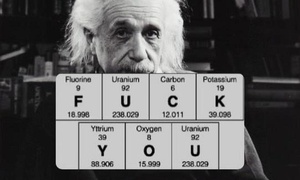
Fawwwk. 🫠
I believe we've all experienced that moment in class. The teacher introduces an entirely unfamiliar subject, throws out a question, and before the rest of us can even process the arrangement of words, some bright chap at the front raises his hand and delivers a rather impressive answer.
And suddenly, your competitive spirit awakens.
Damn. He's smart. I want to be like him.
Ah, yes. The beginning of another unnecessary academic rivalry. Congratulations, you've found your new nemesis. 😭
But that, dear brothers and sisters, is where my little observation begins: the distinction between being smart and being wise.
Because a person can be remarkably intelligent and still make remarkably foolish decisions. One can memorise the entire periodic table and somehow lack the sense to manage a simple disagreement. Fawwk, even a calculator knows how to arrive at an answer; that doesn't mean it understands the question.
Being smart does not automatically make one wise.
And yet, how exactly are we taught to recognise intelligence?
Most of us pass through carefully structured educational systems that measure our intellectual abilities through examinations, grades, and our capacity to remember information. Somewhere along the line, we begin to confuse the ability to reproduce knowledge with the ability to understand, question, and apply it.
As my great-grandfather once said:
“Imagination is more important than knowledge.”
— Albert Einstein.
Yes, my great-grandfather was apparently a rather accomplished physicist. 👀
But there's a point worth considering here.
We've become accustomed to measuring intellectual worth through a narrow definition of academic success. Whoever scores highest gets celebrated, whoever remembers the most gets praised, and whoever struggles to perform within that structure is quietly made to feel inadequate.
And what happens to the student whose greatest strength isn't memorising information, but applying it?
What happens to the creative thinker, the problem-solver, the inventor, or the person who can see possibilities where everyone else sees a wall?
Do we simply tell them to try harder at memorising the wall?
There's a rather popular saying:
“If you judge a fish by its ability to climb a tree, it will spend its entire life believing it is stupid.”
And honestly, I think that captures the problem rather beautifully.
The tragedy isn't that some people struggle academically. It's that we've created an environment where struggling with one particular measure of intelligence can make someone question their entire worth.
I have friends who could contribute wonderfully to the world, people with ideas, practical abilities, creativity, and perspectives worth listening to. Yet, because they cannot cram and regurgitate information quite as efficiently as others, they've somehow been conditioned to believe they're less capable.
And that is a rather unfortunate joke.
The irony of human wisdom isn't necessarily our inability to recognise intelligence. It's our insistence on defining it so narrowly that we overlook everything else.
School is supposed to expand the mind, not convince it that there's only one acceptable way to use it.
And before anyone starts sharpening their pitchforks, no, I'm not suggesting that examinations are useless or that academic discipline should be thrown into the nearest dustbin. Knowledge matters. Education matters. But so do imagination, curiosity, practical reasoning, creativity, and the ability to think beyond what we've been told.
Perhaps wisdom begins when we stop assuming that the person with the highest score must have the greatest understanding.
Because being able to answer every question on a test is impressive.
Knowing which questions are worth asking?
Now that's something else entirely.
FAWWWWWWK. 🤧😭
Perhaps the world doesn't lack intelligent people. Perhaps we've simply become too obsessed with measuring them to notice what they can actually do.
— Blanç.


 11