Score |
145






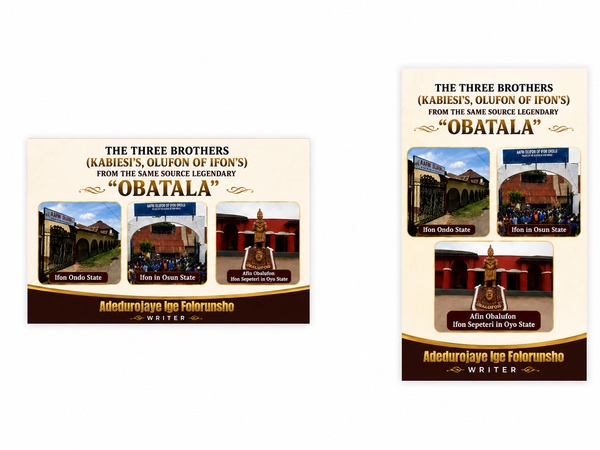
THE STORY OF THE THREE BROTHERS FROM THE SAME SOURCE (IFON OMIMA, IFON OROLU AND IFON SEPETERI).
<p>A BRIEF HISTORY OF IFON OMIMA KINGDOM IN ONDO STATE.</p><p><br/></p><p>We the people of Ifon Omima in Ondo State can trace our ancestral lineage to Ile-Ife, the revered cradle of Yoruba civilisation, and is associated with the ancient lineage of Obatala, one of the foremost figures in Yoruba traditional history.</p><p><br/></p><p>It was from Ile-Ife, according to the tradition, that Olaosa Aladikun, otherwise known as Akogun Erujeje Adugbo, led the ancestral people who would eventually establish the community now known as Ifon Omima.</p><p><br/></p><p>Olaosa Aladikun was said to have received the instruction (Ifa Oracle consultation) to journey forth from Ile-Ife and establish a settlement upon encountering a virgin territory where mushrooms and palm birds were found in remarkable abundance. In Yoruba, mushrooms are known as “olu,” while the palm bird is traditionally referred to as “ẹyẹ ẹga.” The expression “ibi tí olu àti ẹyẹ ẹga fọn sí,” signifying the place where mushrooms and palm birds abound, is therefore preserved in the tradition as the etymological foundation from which the name Ifon emerged.</p><p><br/></p><p>THE FIRST SUCCESSION CRISIS AND THE GREAT MIGRATION.</p><p><br/></p><p>Following the death of the reigning Olufon, the question of succession became a matter of profound importance to the people. Although arrangements had reportedly been concluded for the installation of the deceased monarch's eldest son, Oludagba as his successor, the proposed succession encountered opposition from his younger brother.</p><p><br/></p><p>The younger brother whose name was Osayomi, having secured the allegiance of a substantial portion of the people, resisted the intended installation of the elder brother. The disagreement consequently generated considerable tension and ultimately produced a division within the community. With the greater support of the people apparently resting on his side, the younger brother was eventually crowned king.</p><p><br/></p><p>The development was deeply resented by the elder brother. Aggrieved by the circumstances surrounding the succession, he resolved to abandon the settlement together with his numerous supporters.</p><p><br/></p><p>His departure marked the commencement of another significant chapter in the migratory history of the people. From the vicinity of Osogbo, where they had initially settled, the group journeyed eastward across unfamiliar terrain until they eventually arrived at a small settlement known as Ikin, in the vicinity of present-day Ikare-Akoko.</p><p><br/></p><p>SEPETERI AND THE JOURNEY AWAY FROM IFON.</p><p><br/></p><p>The newly installed Olufon Oba Osayomi Arapaledoye, concerned by the departure of his elder brother and his followers, reportedly became apprehensive about their intentions. Uncertain whether the departing group might eventually return with the purpose of challenging his authority, he dispatched one of his brothers, Sepeteri, to follow them and ascertain their movements.</p><p><br/></p><p>Sepeteri, who was a hunter, embarked upon the assignment. However, during the course of his journey, he reconsidered the mission entrusted to him by the Olufon. He subsequently abandoned the assignment and proceeded towards what is now Oyo State, where, according to tradition, he established a settlement that bears his name to this day.</p><p><br/></p><p>THE SOJOURN AT IKIN AND THE MIGRATION TO ATARE.</p><p><br/></p><p>After spending some considerable time at Ikin, the people of Ifon Omima were reportedly confronted by another grave challenge. Their children became frequent victims of kidnapping, creating an atmosphere of insecurity and apprehension within the settlement.</p><p><br/></p><p>Faced with the necessity of protecting their families and preserving the continuity of their community, the people resolved to abandon Ikin and continue their search for a safer and more suitable habitation.</p><p><br/></p><p>Their subsequent journey took them through forests, jungles, and several settlements. After a prolonged period of movement, they arrived at a location which appeared favourable for habitation. The settlement was named Atare, and the people remained there for some time.</p><p><br/></p><p>Yet, once again, circumstances would compel them to move.</p><p><br/></p><p>THE MYSTERIOUS AFFLICTION AT IMESE ATARE.</p><p><br/></p><p>According to the traditional account, the people soon discovered an extraordinary and disturbing phenomenon at their new settlement. Words spoken casually, particularly expressions of curses uttered in jest or anger, were believed to manifest with immediate and fatal consequences.</p><p><br/></p><p>An expression such as “Tú wà kú,” meaning “May you die,” was traditionally believed to result in the immediate death of the person to whom it was directed.</p><p><br/></p><p>The community consequently experienced considerable loss of life. The phenomenon became a source of profound fear and distress, and the settlement of Imese Atare became associated in the oral tradition with this period of extraordinary misfortune.</p><p><br/></p><p>Confronted by circumstances that appeared increasingly hostile to their continued habitation, the king resolved that another search for a more suitable settlement must be undertaken.</p><p><br/></p><p><br/></p><p>ASIKAN ALAWINI AND THE DISCOVERY OF OJU OGWAMOYE.</p><p><br/></p><p>The king therefore commissioned a group of hunters, under the leadership of Asikan Alawini (whose status is erected at the roundabout of Ifon Omima in Ondo State), to embark upon a search for a new and more favourable place of settlement.</p><p><br/></p><p>Asikan and his fellow hunters travelled a considerable distance, traversing the wilderness in search of a suitable location. After a prolonged journey, they eventually arrived at a place which appeared promising. There, they constructed a small hut and remained at the location rather than returning immediately to Imese Atare.</p><p><br/></p><p>As the hunters failed to return, the king became concerned and subsequently dispatched two men to ascertain their whereabouts.</p><p><br/></p><p>The search party eventually located Asikan and the other hunters in the small hut they had constructed. The place was thereafter named Oju Ogwamoye, traditionally interpreted as “the spot of wisdom.”</p><p><br/></p><p>The discovery proved decisive in the history of Ifon Omima. The people subsequently returned to Imese Atare, gathered their families and possessions, and migrated to Oju Ogwamoye.</p><p><br/></p><p>The settlement established at Oju Ogwamoye became the permanent home of the people and is identified in the traditional history of Ifon Omima as the Origin and location upon which present day Ifon Omima stands.</p><p><br/></p><p>THE ASIKAN QUESTION AND THE BENIN INTERVENTION.</p><p><br/></p><p>The establishment of the new settlement, however, did not immediately bring an end to disputes over authority.</p><p><br/></p><p>Having led the hunters who discovered the new habitation, Asikan reportedly laid claim to the kingship of Ifon, maintaining that his role in discovering the settlement entitled him to assume leadership of the community.</p><p><br/></p><p>His claim precipitated another period of tension and division. The community consequently became divided between supporters of the reigning king and those who supported Asikan.</p><p><br/></p><p>Seeking an authoritative resolution to the dispute, the king and Asikan Olawini/Alawini, accompanied by some of their respective supporters, travelled to Ado, now known as Benin City in English interpretation, to seek the intervention of the Oba of Benin (Ado).</p><p><br/></p><p>At the time, according to the traditional account, the Oba of Benin was held in exceptionally high esteem by the people of Ifon and it envrion, and his judgment was regarded as carrying considerable authority.</p><p><br/></p><p>The Oba of Benin consequently intervened in the dispute and appealed to Asikan to relinquish his claim to the throne.</p><p><br/></p><p>Asikan Alawini accepted the decision.</p><p><br/></p><p>Nevertheless, in recognition of his contribution to the discovery of the new settlement and his importance within the community, he was entrusted with a distinctive traditional responsibility: the determination of appropriate and favourable dates for the celebration of the Obaloro Festival.</p><p><br/></p><p>The settlement of the dispute consequently gave rise to a tradition that has endured across generations. According to the established custom, a person who occupies the chieftaincy of Asikan does not kneel before the Olufon. Instead, the Asikan traditionally renders his greeting to the monarch by raising his right arm and right leg three times.</p><p><br/></p><p>This custom has remained an important symbol of the historical status and traditional significance of the Asikan chieftaincy within Ifon.</p><p><br/></p><p>THE ORIGIN OF THE EBILEADO ROYAL DYNASTY/QUAUTER.</p><p><br/></p><p>Upon returning to Ifon, Asikan Olawini reportedly informed his followers that the Oba of Ado (Benin) had adjudicated the dispute.</p><p><br/></p><p>In the course of recounting the matter, he referred to the king as “Eri Ado,” a phrase traditionally interpreted as signifying the testimony, confirmation, or pronunciation of Ado.</p><p><br/></p><p>Over time, this expression became associated with the royal household known as Ule Eri Ado. Through successive generations and the evolution of oral pronunciation, the name became rendered as Ebi Ule Eriado or Ebileriado, traditionally understood as the family of the testimony or witness of Ado.</p><p><br/></p><p>With the dispute finally resolved, peace and stability were restored to the community.</p><p><br/></p><p>Oba Oludagba Iradodi Odo, then titled as Eriado of Ifon before it was changed to Oloja of Ifon during the reign of Oba Iremokun and finally later reversed as Olufon of Ifon during the reign of Oba Oyinbomukenwa Mabogunje, consequently emerged as the first traditional ruler of Ifon thereby inaugurating a new chapter in the traditional history of the kingdom.</p><p><br/></p><p>LIST OF THE OLUFON OF of IFON OMIMA IN ONDO STATE FROM INCEPTION.</p><p><br/></p><p>The Era of Eriado.</p><p><br/></p><p>1. Oba Iradodi Odo Oludagba.</p><p>2. Oba Iradolugba Ajibuwa.</p><p>3. Oba Iradokenrin Alaghon.</p><p>4. Oba Iradoakeghenre Itanfo.</p><p>5. Oba Iradolugbon Olugha.</p><p><br/></p><p>Following the reign of Oba Iradolugbon, the royal title was changed from Eriado to Oloja.</p><p><br/></p><p>The Era of Oloja.</p><p><br/></p><p>6. Oba Iremokun.</p><p>7. Oba Odeguri (3 months in 1854).</p><p>8. Oba Erunogbe (1854-1887, 33years).</p><p>9. Oba Ogenuwa (1887-1891, 4years).</p><p>10. Oba Ogwadogbon (1891-1896, 5years).</p><p>11. Oba Idaniken Ugbarugba (1896- 1900, 4years).</p><p>12. Oba Mabogunje (1900-1913, 13years).</p><p>13. Oba Agun (1913-1925, 12years).</p><p>14. Oba Isijola Egwange (1925-1932, 7years and was dethroned).</p><p><br/></p><p>At a later stage in the historical development of the monarchy, the royal designation was once again altered, this time from Oloja to Olufon, which has remained the established title of the traditional ruler of Ifon Omima till this present date.</p><p><br/></p><p>The Era of Olufon.</p><p><br/></p><p>15. Oba Oyinbomukenwa Mabogunje (1935-1963, 28years).</p><p>16. Oba Adegbera Odogiyan (1969-1996, 28years)</p><p>17. Oba Israel Adegoke Adeusi (1997-2020, 23years).</p><p><br/></p><p>A BRIEF HISTORY OF IFON OROLU TOWN IN OSUN STATE. </p><p>Orolu is another name for the ancient city of Ifon in Osun State. The name OROLU is interchangeably used for Ifon in Osun State, meaning "our towns tradition" and what led to the incident was when the founder, Oba Aladikun went to war leaving his wives around. The youngest one who was the king favourite was being maltreated when his husband was away and whenever she asked the senior wives, they would say "Oro ilu wa ni meaning our towns tradition. </p><p><br/></p><p>How the town began?</p><p><br/></p><p>Upon the demise of OBATALA, some of his sons contested for the position of Olufe (Now Ooni of Ife) and among this contestant, Obalufon Alayemore emerge as the successor of Obatala.</p><p><br/></p><p>Olaosa Oladikun, who was the son of Obatala consulted an ifa Oracle for prophecy of his Exodus, he was directed to establish a kingdom wherever he was plenty weavers birds/palm fronds/palm birds on a tree and mushrooms underneath which is couch in Yoruba language " Ibi olu ati eye ega fon si" meaning where mushrooms and palm fronds spread in large numbers. Thus, which is now the name of the town " Ifon" meaning "Spread". I.e Olufon of Ifon Omima, Olufon of Ifon Orolu, Obalufon of Sepeteri. Lastly again, Ifon can be interpreted as Spread. </p><p><br/></p><p>The term Olu (mushrooms) though a weak and fragile plant signifies prominence, achievement and when used as a prefix to a noun, it signifies first among equals. Thus, Olu of Ibadan (Olubadan) means king of Ibadan, Olu Omo means the best out of the children Etc. Thus, Olufon (Ruler of Ifon Omima and Ifon Orolu) has traditionally prominence over and above all other Oba's in Yorubaland.</p><p><br/></p><p>Olufon is a crown king. One being in possession of both Ade Are (Are crowns) and Ade sesesfun (White beaded crown), Olufon of Ifon Orolu in Osun State was reputed to have crown the Alaafin of Oyo with Ade Are (Are crown) to elevate Alaafin's status to that of Oba against Baale (a mere distinct head), that's why Olufon has always been a permanent members of the Council of chiefs since the period of colonial government and this oral statement can also be traced back to the Olufon Panegyric/Eulogy (Oriki).</p><p><br/></p><p>LIST OF THE OLUFON OF IFON OROLU FROM INCEPTION.</p><p><br/></p><p>Rulers at Ifọn Eega.</p><p><br/></p><p>1. Oba Olaosa Aladikun Akogun Ẹrujẹjẹ Àdúgbò — 12th Century.</p><p>2. Oba Oyefimihan Onilare Ilofo — 12th Century.</p><p>3. Oba Abiose Osagidigbi — 12th Century.</p><p>4. Oba Laniyonu Akande — 13th Century.</p><p>5. Oba Igbo Olugbile Agajolu — 13th Century.</p><p><br/></p><p>Rulers at Ifọn Ere.</p><p><br/></p><p>6. Oba Oosagbemi Akinsigbin — 13th Century.</p><p>7. Oba Olumorin Adubi — 13th Century.</p><p>8. Oba Olugbonse Jejearalose — 13th Century.</p><p>9. Oba Otolorin Okòó — 13th Century.</p><p>10. Oba Akinseeko Onilosin — 13th Century.</p><p>11. Oba Osatayo Onakunsola — 13th Century.</p><p>12. Oba Orisayomi Omoribikolasi — 14th Century.</p><p>13. Oba Osawuyi Olumoyekun — 14th Century.</p><p>14. Oba Merolasa Adewure — 14th Century.</p><p>15. Oba Arinola Osatokun — 14th Century.</p><p>16. Oba Osayomi Arapaledoye — 14th Century.</p><p><br/></p><p>According to the traditional account, Oba Osayomi Arapaledoye was the younger brother of Arẹmọ Oludagba, who migrated with his people and established Ifọn Omima in present-day Ondo State after being denied the throne.</p><p><br/></p><p>Rulers at Ifọn Bale.</p><p><br/></p><p>17. Oba Akinrefon Abewela — c. 1398–1447</p><p>18. Oba Odunolu — 1450–1484</p><p>19. Oba Olumoyekun — 1488–1521</p><p>20. Oba Emiolu Olumogbe — 1524–1576</p><p>21. Oba Ilori Ajagboye — 1635–1672 (after a long interregnum)</p><p>22. Oba Ajayi Ogidiolu, also known as Nage or Onagegbesumi — 1680–1691</p><p>23. Oba Orisafimihande Onilare — 1693–1748</p><p>24. Oba Olaojo Osatolu — 1748–1780</p><p><br/></p><p>Rulers at Ifọn-Ile.</p><p><br/></p><p>Ifọn-Osun / Present-Day Ifọn Orolu</p><p><br/></p><p>25. Oba Oluyeyin Kerejegbe (ascended the throne at a tender age) — 1780–1833</p><p>26. Oba Moronfolu Okunoye — 1834–1844</p><p>27. Oba Orisatoyinbo Alesinloye — 1845–1900</p><p>28. Oba Oyeku Arowogbadamun — 1901–1910</p><p>29. Oba Osadare Oluyeyin — 1910–1912</p><p>30. Oba Bamikeesa Atanda Akinyooye I — 1912–1944</p><p>31. Oba Salawu Oyelade — 1945–1968</p><p>32. Oba James Olagunju Akinyooye II — 1971–1985</p><p>33. Oba Ilufoye Olatoye Orisatoyinbo II — 1 May 1990–20 August 2007</p><p>34. Oba Al-Maroof Adekunle Magbagbeola, Olumoyero II — 20 February 2008–April 2021</p><p>35. His Royal Majesty, Oba Peter Oluwole Ipadeola Ilufemiloye Akinyooye III — February 2024–Present.</p>


 162
162


Other insights from Adedurojaye Ige Folorunsho-Akintulubo






Contributor Points

Points-to-Coupons

Referral Earning

Insights for you.


Let's Forikori
Honestly, I have been hearing "Olodo Uprising" for the longest time, and I think it's h...
241 views
36 upvotes
30 comments


My journey:From the Gates of UniAbuja...
The dust of Gwagwalada hung in the air, a familiar yet distinct scent that marked the b...
458 views
27 upvotes
39 comments


HOW PETTY THEY CAN BE
I've always enjoyed Spotify and other streaming services, I mean if nothing I get to co...
714 views
35 upvotes
25 comments

I won guys
I won English guys. I had done all the typing and guess what I lost it. Don't worry I'm...
145 views
24 upvotes
25 comments


The Final Stretch
Burning Candles, Sweaty Eyes and a Packed Brain. 😭A packed brain that has refused to ac...
85 views
26 upvotes
28 comments


LIFE OF A FUTURE DIPLOMAT (I GUESS) T...
Okay, hi.My name is Nomshu, but most people here know me as Grace, and I’m a student of...
420 views
25 upvotes
88 comments


A WORD IS ENOUGH FOR THE WISE
There is something extremely powerful about words, they hold power most never pay atten...
2337 views
17 upvotes
21 comments

I am Olodo
Insult me however you like, but don't think you are insulting me when you call me **Olo...
161 views
19 upvotes
22 comments

School is a scam
The concept of education has been debated for centuries, and its true meaning has been ...
770 views
19 upvotes
23 comments


The Bridge to Adulthood
I remember when I was in secondary school, my classmates and I had great dreams and pla...
1351 views
17 upvotes
22 comments