Score |
64


Goodluck Onyeka
 tailor @ lagos, nigeria



The World Is Becoming More Connected, but Are We Becoming Less Human?
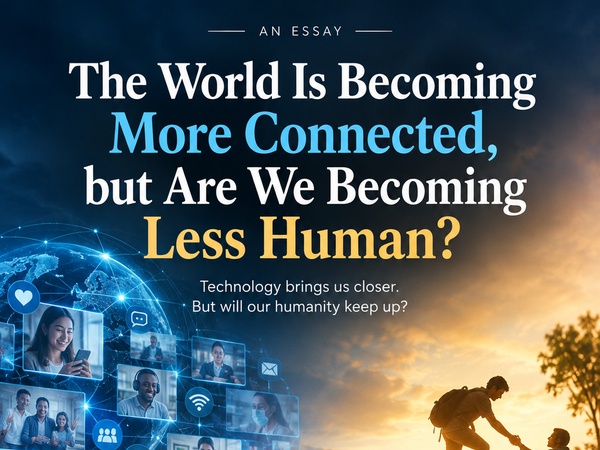
<p><br/></p><p><br/></p><p>We have built a world where a message can cross an ocean in less than a second, yet a cry for help can remain unheard in the same room. We can recognise strangers thousands of kilometres away while overlooking the struggles of people sitting beside us. Never before have human beings possessed so many tools for connection. Yet an uncomfortable question remains: are we using our progress to bring humanity closer together, or are we merely making distance easier to hide?</p><p><br/></p><p>The problem is not that the world has become connected. It is that connection and compassion are not the same thing.</p><p><br/></p><p>Technology has expanded the boundaries of human possibility. A student in Nigeria can attend a virtual lesson taught abroad. Families separated by migration can maintain relationships through video calls. Medical professionals can exchange knowledge across borders, while small businesses can reach customers they might never encounter physically. These achievements demonstrate that technology can overcome distance, expand opportunity, and improve lives.</p><p><br/></p><p>Yet the ability to communicate is not necessarily the ability to understand. We can exchange hundreds of messages without having one meaningful conversation. We can accumulate thousands of online followers without developing a single relationship in which we feel genuinely understood. We can witness suffering through a screen, express sympathy, and continue scrolling without considering whether we could help.</p><p><br/></p><p>When did witnessing another person's pain become an acceptable substitute for responding to it?</p><p><br/></p><p>This question is more than a philosophical concern. The World Health Organization reported in June 2025 that approximately one in six people worldwide experienced loneliness, based on estimates covering 2014–2023. Adolescents aged 13–17 had the highest estimated prevalence, at 20.9%. These figures do not prove that technology causes loneliness. They reveal something more fundamental: despite unprecedented opportunities to communicate, meaningful human connection remains a significant global challenge. <Cite refs={["turn563383search0","turn563383search1"]}/></p><p><br/></p><p>Consider a student who enters the classroom every morning wearing a smile. Behind that smile may be financial hardship, family difficulties, or the fear of disappointing everyone who believes in them. Their classmates may admire their photographs, react to their posts, and describe them as happy. Yet nobody may notice their silence or ask whether they are truly okay.</p><p><br/></p><p>The student is visible to many people but understood by very few.</p><p><br/></p><p>This is the difference between being noticed and being known. Visibility allows others to see our lives; understanding requires them to look beyond appearances. A photograph cannot explain an entire human experience, a follower count cannot measure genuine friendship, and a cheerful status cannot reveal everything a person feels.</p><p><br/></p><p>The contradiction extends beyond the classroom. Families may occupy the same room while paying more attention to separate screens than to one another. Online discussions can transform disagreements into personal attacks, making humiliation seem more important than understanding. During an emergency, someone may become preoccupied with recording an event instead of considering how to respond responsibly. In each case, the problem is not simply the presence of technology. It is the possibility that convenience and attention have begun to compete with empathy and responsibility.</p><p><br/></p><p>However, intellectual honesty requires us to examine the opposite argument. Human beings experienced loneliness, prejudice, selfishness, and indifference long before the internet existed. To blame technology for every failure of compassion would be to confuse a tool with the person using it.</p><p><br/></p><p>Digital platforms can reunite families, provide educational opportunities, expose injustice, and connect people with communities that understand their experiences. Technology can help people with disabilities communicate, enable emergency responders to coordinate assistance, and make valuable information available to communities previously excluded from it. Even artificial intelligence can support learning and problem-solving when developed and used responsibly.</p><p><br/></p><p>Technology, therefore, is neither automatically humane nor inevitably harmful. Its effects depend partly on how it is designed, who controls it, and what people choose to do with it.</p><p><br/></p><p>This leads to a deeper problem: we have become remarkably skilled at advancing our capabilities, but we have not automatically advanced our character.</p><p><br/></p><p>A society may possess sophisticated machines while neglecting vulnerable citizens. It may celebrate economic growth while overlooking people who cannot afford basic necessities. It may provide unlimited access to information without teaching its citizens to evaluate evidence, recognise manipulation, or respect those who disagree with them. Greater knowledge does not guarantee wisdom, just as greater connectivity does not guarantee compassion.</p><p><br/></p><p>Progress becomes incomplete when we measure what humanity can produce but ignore how humanity treats people.</p><p><br/></p><p>What, then, should a genuinely connected world look like?</p><p><br/></p><p>First, we must make empathy a daily practice rather than a slogan. This means listening without immediately judging, checking on friends beyond their online appearances, and refusing to participate in digital cruelty. It means recognising that a person does not need to make their suffering public before deserving support. Small acts of attention may appear insignificant, but they can help create relationships in which people feel seen, heard, and respected.</p><p><br/></p><p>Second, schools and families must teach responsible connection alongside technological competence. Students should learn not only how to use digital tools but also how to protect privacy, question misinformation, disagree respectfully, and recognise the human consequences of their online behaviour. Families can create opportunities for undistracted conversations, while communities can support activities that bring people together beyond their screens.</p><p><br/></p><p>Third, technology companies and public institutions must recognise that human well-being is part of technological responsibility. Digital platforms should take harmful interactions seriously, protect users' privacy, and avoid treating attention as the only measure of success. Governments and communities should also invest in accessible libraries, recreational spaces, youth programmes, and support services where meaningful relationships can develop. Connection requires both individual effort and environments that make connection possible.</p><p><br/></p><p>These solutions do not demand that we abandon innovation. They demand that innovation serve human dignity.</p><p><br/></p><p>Imagine a future in which machines become better at translating languages, analysing information, and solving complex problems. Such achievements would be extraordinary. Yet they would remain incomplete if people continued to dismiss suffering, judge worth through popularity, or mistake winning an argument for understanding another human being.</p><p><br/></p><p>The next great measure of civilisation should not be how many people we can reach in a second, but how many we are willing to understand when listening requires patience. It should not be how much information we possess, but how wisely we use it. And it should not be how advanced our inventions become, but whether their benefits reach people whose needs are too often overlooked.</p><p><br/></p><p>We have already learned how to connect the world. Now we must learn how to make that connection meaningful.</p><p><br/></p><p>Because the ultimate test of progress is not simply whether humanity can do more. It is whether, as our capabilities expand, our concern for one another grows with them.</p><p><br/></p><p>A connected world is an achievement of technology. A compassionate world must be an achievement of humanity.</p>


 6


Other insights from Goodluck Onyeka












Contributor Points

Points-to-Coupons

Referral Earning

Insights for you.
















ROSES
Roses are redLike our eyesAnd skiesBirds without feathersNor fathersWe're flocklessFlyi...
229 views
16 upvotes
12 comments


Pharaohs and Medicine
Imhotep and Hippocrates: A Look at Ancient Egyptian and Greek MedicineAncient Egyp...
1801 views
13 upvotes
10 comments

































