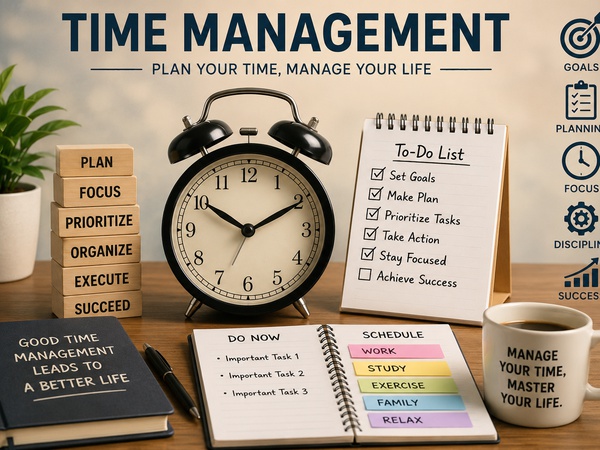
Time Management: The Silent Weapon Behind Every Successful Life
Time is the one thing every human being receives equally.
Rich or poor. Young or old. Famous or unknown.
Everyone wakes up with the same twenty-four hours.
Yet somehow, one person builds a future, while another spends years watching life pass by.
The difference is not luck.
It is not talent alone.
It is not even intelligence.
The difference is time management.
What Time Management Really Means
Many people think time management simply means creating timetables or waking up early. That is only the surface.
Time management is the ability to control how your hours are spent so your life moves in the direction you truly want.
It is the discipline of choosing what deserves your energy and refusing what destroys your focus.
In reality, time management is not about managing clocks.
It is about managing yourself.
Because time keeps moving whether you are prepared or not.
Why Time Is More Valuable Than Money
Money lost can return.
A failed exam can sometimes be rewritten.
A broken phone can be replaced.
But one wasted hour is gone forever.
Every second becomes history immediately after it passes.
That is why people who understand time deeply treat it like treasure. They know procrastination is expensive. They know distractions slowly steal dreams.
Many young people today do not fail because they are incapable.
They fail because their attention is constantly being consumed.
Hours disappear scrolling through social media, watching videos, gossiping, sleeping excessively, or postponing responsibilities until pressure becomes unbearable.
The danger of wasting time is that it rarely feels dangerous in the moment.
Five minutes becomes one hour.
One hour becomes one day.
One day becomes one year.
And suddenly, people begin asking themselves: “Where did all the time go?”
The Brutal Truth About Procrastination
Procrastination is one of the greatest enemies of progress.
It convinces people that there will always be another chance later.
Later to study.
Later to improve.
Later to start the business.
Later to read the book.
Later to become serious about life.
But “later” is one of the most dangerous lies people tell themselves.
The future is built by what is done consistently today.
Most successful people are not magically motivated every single day. They simply learned how to act even when they do not feel like it.
That is real discipline.
The Relationship Between Time and Success
Behind every excellent student is disciplined use of time.
Behind every successful athlete is disciplined use of time.
Behind every millionaire, artist, doctor, entrepreneur, or leader is disciplined use of time.
Success is rarely sudden.
It is usually the result of small actions repeated daily:
reading instead of endlessly scrolling,
practicing instead of complaining,
preparing instead of delaying,
focusing instead of drifting.
Time management transforms ordinary effort into extraordinary results.
Even one focused hour daily can completely change a person’s future over time.
The Biggest Time Wasters
One of the first steps toward effective time management is recognizing what destroys productivity.
1. Social Media Addiction
Apps are designed to capture attention for as long as possible. Endless scrolling weakens concentration and steals valuable hours without people realizing it.
2. Lack of Priorities
When everything feels important, nothing truly gets done. People become busy without actually being productive.
3. Poor Planning
Starting the day without direction often leads to confusion and wasted effort.
4. Fear of Failure
Some people delay tasks because they are afraid of not being perfect. Ironically, delay creates even more failure.
5. Laziness and Comfort
Comfort is attractive, but growth usually requires discomfort. Great futures are rarely built inside comfort zones.
How to Manage Time Effectively
Set Clear Goals
A person without goals wastes more time because they have no direction. Goals create focus.
Ask yourself:
What kind of life do I want?
What do I want to achieve this year?
What habits must change?
Clear goals make decisions easier.
Create a Daily Plan
Successful days rarely happen accidentally.
Write down:
what must be completed,
what can wait,
and what should be avoided completely.
Planning reduces confusion and increases control.
Prioritize Important Tasks
Not every task carries equal value.
Focus first on activities that improve your future:
studying,
learning skills,
exercising,
building discipline,
resting properly.
Do not spend most of your energy on meaningless distractions.
Learn to Say No
Sometimes poor time management comes from trying to please everyone.
Protecting your time is necessary.
Not every invitation deserves acceptance.
Not every conversation deserves hours.
Avoid Multitasking
Doing many things at once often reduces quality and concentration.
Focus deeply on one task at a time.
Deep focus produces stronger results faster.
Rest Wisely
Good time management is not about working endlessly until exhaustion.
Rest matters. Sleep matters. Mental health matters.
But rest should refresh you, not consume your entire day.
Time Management and Students
For students especially, time management can determine academic success or failure.
Many students are intelligent but inconsistent. They wait until exams are close before opening their books. This creates stress, panic, and poor performance.
Studying a little every day is more powerful than cramming everything overnight.
Consistency beats pressure.
A student who studies two focused hours daily for months often performs better than someone who studies ten hours only before exams.
The Emotional Side of Time Management
Poor time management affects more than grades or productivity.
It creates:
stress,
anxiety,
guilt,
low self-esteem,
and feelings of being lost.
When people constantly delay important responsibilities, they begin feeling disappointed in themselves.
On the other hand, managing time well builds confidence.
Completing tasks creates momentum.
Momentum creates motivation.
Motivation strengthens discipline.
Discipline: The Real Secret
People often search for motivation, but motivation changes constantly.
Discipline is stronger.
Discipline means:
reading even when tired,
studying even when distracted,
waking up when comfort says sleep,
choosing long-term success over short-term pleasure.
Time management without discipline cannot survive.
Conclusion
Time is life itself.
How a person spends their hours eventually becomes how they spend their years.
Every dream requires time.
Every achievement demands sacrifice.
Every successful future is built from daily choices.
The painful truth is that wasted time rarely announces itself while it is happening. Its consequences appear later — in missed opportunities, regrets, unfinished goals, and unrealized potential.
But the beautiful truth tis this:
It is never too late to take control.
One decision today can change the direction of an entire future.
A person who learns to master time gains something powerful: control over their destiny.
And in a world full of distractions, that power is rare.


 288