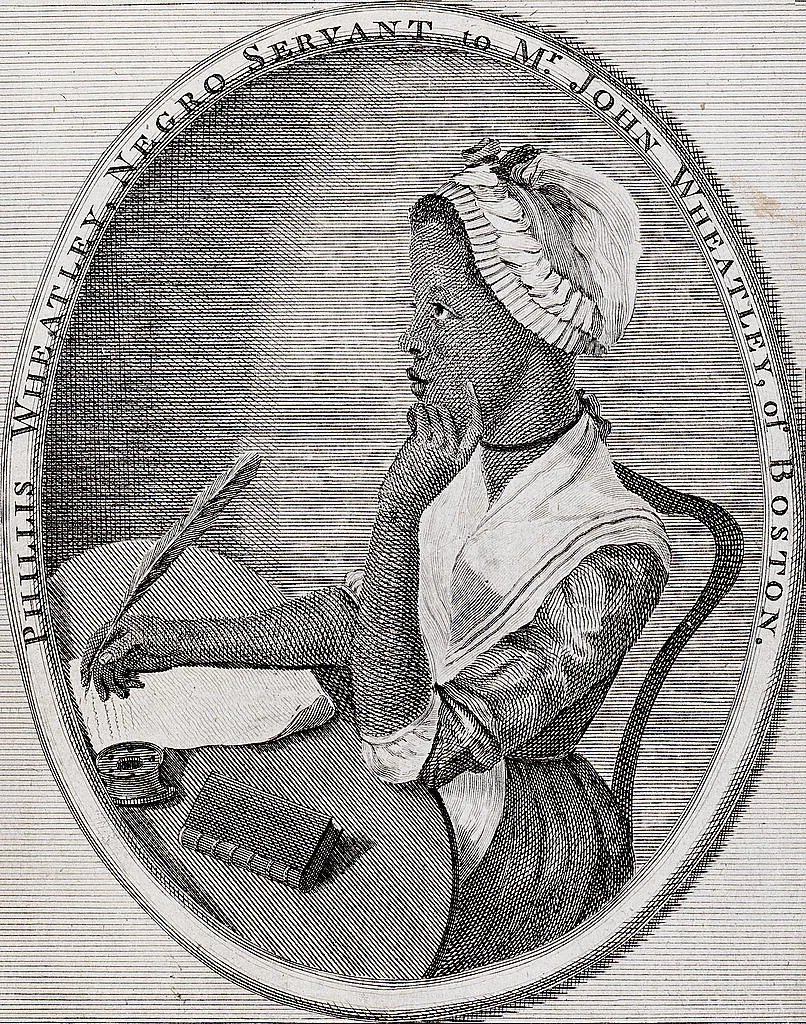
Frontispiece to Phillis Wheatley poems on various subjects, 1773
In October 1772, Phillis Wheatley was a young woman born in West Africa and enslaved in Boston. Eighteen prominent men signed an attestation that she had written her poems herself and the signers included Governor Thomas Hutchinson and John Hancock. Her book was published in London in September 1773, carrying that certificate in its front pages. Historians disagree about how formal the “examination” was. Some argue she was probably never interrogated in person and that the attestation worked partly as a marketing tool. Either way, a Black woman's authorship needed white witnesses. To me, that's utter nonsense. Even that did not settle it, Thomas Jefferson wrote in Notes on the State of Virginia that religion had produced a Phillis Wheatley but could not produce a poet and that her poems fell below the dignity of criticism. The evidence of originality was on the front page of her work and he still refused it. The doubt was also systematic. In an essay he revised in 1753–54, David Hume added a footnote suspecting that Black people were naturally inferior to whites. In the same note, he dismissed a learned man in Jamaica as admired for slender accomplishments, “...as one admires a parrot”. A parrot is a creature that is supposed to imitate and never to think. This is the oldest charge against the African voice: That we can only repeat not create
Sometimes the proof could be held in the hand and it was still doubted. In 1910, the German ethnologist Leo Frobenius saw the Ife heads. He could not accept that Africans had made them and he invented a theory that survivors of Atlantis had brought Greek civilization to Yorubaland. By 1948, archaeologists accepted that Yoruba artisans had made the heads. Herein, we see the willingness not to believe in the authenticity of the African voice has remained consistent and unchanging. Our own originality has been policed by our own critics too. When Amos Tutuola's The Palm-wine drinkard appeared in 1952, Dylan Thomas praised it as "young English"but as Eustace Palmer recorded, the first reaction of Nigerians and other Africans was almost uniformly hostile, objecting to his English and his originality. Praise from outside and shame from inside both treated Tutuola's voice as an accident even though it was an outstanding craft. Chimamanda Adichie describes the same suspicion in her talk The danger of a single story. An American roommate asked where she had learned to speak English so well and was confused to hear that English is Nigeria's official language. A professor told her that her novel was not “authentically African”. Notice the trap? We are doubted for sounding too foreign and doubted again for not sounding foreign enough.
Here comes the not so new trial wherein the accuser has been changing. Africa's writers have been cross-examined unfairly long before any algorithm existed and the advent of AI just gave the already biased court a new instrument. This is where AI enters and where I think the unfairness is sharpest. I believe a voice is truly yours because of what stands behind it rather than the unpredictability of a machine trained with human writings, produces its own results and then is used to detect AI writings which were written based on the writings of humans. In 2023 Stanford researchers tested seven AI-writing detectors, they falsely flagged an average of over 61% of essays by non-native English speakers as AI-generated while the same detectors were near-perfect on essays by US-born eighth graders. The detectors reward predictable, plain prose whose writer has English as their first language but a writer who learned English formally in a second or third language is the one most likely to be punished for correct and careful sentences. The “delve” controversy has the same shape. The Guardian's Alex Hern pointed out that “delve” is far more common in Nigerian business English than in British or American english and suggested that this may trace back to the outsourced African workers who helped train ChatGPT. That is a theory though and not a proven fact but a 2026 academic study found mixed results: one post-trained model moved toward Nigerian English while another moved away from it. Even so, the practical effect is plain; Careful Nigerian english now risks being read as machine english and the people who helped shape these systems are the ones suspected of being them.
AI-generated writing is real and plagiarism takes credit from people who do the work. Communities like ours are right to want protection. A detector score is not evidence of authorship but a statistical guess about style and the Stanford numbers show whom that guess punishes. Suspicion built on how an African sounds is the same method as Jefferson's but this time, it wears a modern face.
A voice is yours when you can answer for it, that means you know where its words come from, you can defend its choices and you can write it again, differently, in front of someone. It lives in the proverb your grandmother used at the right moment, in the rhythm Pidgin gives a joke that no formal register can carry and in the Yoruba or Igbo or Swahili thought that arrives before the English sentence does. These are examples of native intelligence. Africa has thousands of languages and accents, so no single sound can stand for all of them and “sounding African enough” is itself a single story. It is a lived inheritance and a model can imitate its surface but cannot hold it hence, communities that want to protect originality should ask for process and not for purity. They can ask for drafts, for conversation about the work and for revision in front of an editor. They should presume authorship and weigh evidence, not letting a score settle the question. Wheatley needed eighteen signatures to be believed. We should not build a world in which every African writer needs a certificate from a machine.
References
Academy of American Poets. (n.d.). Poems on various subjects, religious and moral [Web page]. Retrieved from https://poets.org/book/poems-various-subjects-religious-and-moral
Adichie, C. N. (2009). The danger of a single story [Transcript of TEDGlobal talk]. Retrieved from https://www.oerproject.com/-/media/WHP/PDF/Transcripts/TED_Danger_of_a_Single_Story_Chimamanda_Adichie.pdf
Chooi, J. (2026). Stylistic transfer from annotator communities to large language models. In Proceedings of SIGHUM 2026 (pp. 135–145). Association for Computational Linguistics. Retrieved from https://preview.aclanthology.org/ingest-eacl/2026.latechclfl-1.13.pdf.
Eze, E. C. (2000). Hume, race, and human nature. Journal of the History of Ideas, 61(4), 691–698. doi:10.1353/jhi.2000.0039
Hern, A. (2024, April 16). TechScape: How cheap, outsourced labour in Africa is shaping AI English. The Guardian. Retrieved from https://www.pressreader.com/usa/the-guardian-usa/20240417/282050512110374
Mark, J. J. (n.d.). Poems of Phillis Wheatley and Jefferson's criticism. World History Encyclopedia. Retrieved from https://www.worldhistory.org/article/2684
Myers, A. (2023, May 15). AI-detectors biased against non-native English writers. Stanford HAI. Retrieved from https://hai.stanford.edu/news/ai-detectors-biased-against-non-native-english-writers
Nigeria's ancient royal portraits challenged European biases toward African art. (n.d.). National Geographic. Retrieved from https://www.nationalgeographic.com/history/history-magazine/article/nigerian-treasures-ife-heads-bronze
Palmer, E. (1978). Twenty-five years of Amos Tutuola. The International Fiction Review, 5(1). Retrieved from https://journals.lib.unb.ca/index.php/IFR/article/download/13280/14363/17988
The Palm-Wine Drinkard. (n.d.). In Wikipedia. Retrieved November 19, 2026, from https://en.wikipedia.org/wiki/The_Palm-Wine_Drinkard
Poems on various subjects, religious and moral. (n.d.). In Wikipedia. Retrieved November 19, 2026, from https://en.wikipedia.org/wiki/Poems_on_Various_Subjects,_Religious_and_Moral



 11