Score |
13


The Uncomfortable Pen
 Studying animal science @ Student
Studying animal science @ Student



When Illness Meets Responsibility
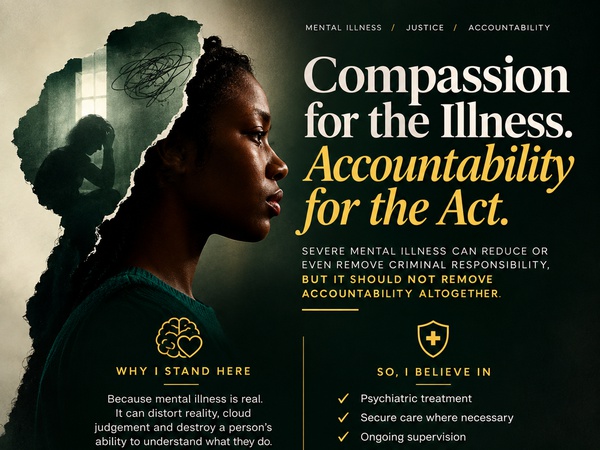
<p><strong>T</strong>here is something deeply uncomfortable about the Lindsay Clancy case because it forces us to hold two truths in our hands at the same time.</p><p><br/></p><p>A mother killed her three children. That fact is devastating.</p><p>But that same mother was also experiencing severe mental illness, and the question of what was happening inside her mind cannot simply be pushed aside because the outcome was horrific.</p><p>That is where the conversation becomes difficult.</p><p>I believe severe mental illness should reduce or, in some circumstances, remove criminal responsibility, but it should not remove accountability altogether.</p><p>Those two things are not necessarily the same.</p><p>When we hear the word “accountability,” we often immediately think of prison, punishment and suffering imposed by the state. But accountability can also mean recognising what happened, protecting society, receiving compulsory treatment and ensuring that a person remains under appropriate supervision for as long as necessary.</p><p><br/></p><p>This distinction matters in cases involving conditions such as postpartum psychosis.</p><p>Postpartum psychosis is not simply a mother being overwhelmed, tired or depressed. It can involve hallucinations, delusions, paranoia and a severely distorted perception of reality. In Clancy’s case, defence experts argued that she was suffering from postpartum psychosis and was unable to understand the wrongfulness of what she was doing. Prosecutors presented a different interpretation of her mental state and argued that she understood her actions.</p><p><br/></p><p>That disagreement is precisely why I am uncomfortable with the idea that either “she was mentally ill, so she is innocent” or “three children died, so she must be punished.”</p><p><br/></p><p>Neither statement adequately addresses the complexity of the situation.</p><p><br/></p><p>If a person genuinely cannot distinguish right from wrong because they are experiencing a severe psychotic disorder, placing them in an ordinary prison does not magically make them responsible. It may satisfy our desire to see consequences, but it does not necessarily deliver justice.</p><p><br/></p><p>At the same time, declaring someone completely free from responsibility can feel deeply inadequate when innocent lives have been taken.</p><p><br/></p><p>The answer, therefore, should not be to pretend mental illness did not exist. Nor should it be to treat mental illness as a universal escape route from criminal responsibility.</p><p><br/></p><p>There should be a serious legal distinction between “she did not do it” and “she did it, but her mental state fundamentally affected her responsibility.”</p><p><br/></p><p>The first denies the act.</p><p><br/></p><p>The second acknowledges both the act and the illness.</p><p><br/></p><p>That distinction is important for the families left behind. The children who died do not become less valuable because their mother was ill. Their lives deserve to be acknowledged without turning their deaths into an argument against treating mental illness seriously.</p><p><br/></p><p>It is also important for other mothers.</p><p><br/></p><p>If we make women afraid that admitting frightening thoughts will automatically lead to criminal punishment, some may remain silent when they desperately need help. And silence is dangerous.</p><p><br/></p><p>A mother experiencing postpartum psychosis should be able to say, “I am having thoughts that scare me,” without immediately believing that asking for help will destroy her family or her freedom.</p><p><br/></p><p>We should be building a system where that confession triggers urgent intervention, not shame.</p><p><br/></p><p>But intervention must also mean something.</p><p><br/></p><p>When there are clear warning signs, society cannot simply say, “We did not know.” Families, healthcare providers and institutions need systems capable of recognising escalating risk and responding appropriately.</p><p><br/></p><p>That is one of the uncomfortable lessons from cases like Clancy’s: sometimes tragedy is not just about one person. It also exposes weaknesses in the systems surrounding that person.</p><p><br/></p><p>What stayed with me most about this case is how uncomfortable it made me feel. At first, it is easy to look at the deaths of three children and think, “She should be punished.” That was honestly my first instinct too. But the more I learned about severe postpartum mental illness, the harder that answer became for me. I kept asking myself: if someone’s mind is so seriously disturbed that they genuinely cannot understand what they are doing, are we really achieving justice by treating them exactly like someone who made the same choice with a clear mind?</p><p>At the same time, I cannot ignore the children. They had no choice in any of this. Their lives ended, and their family has to live with that loss. That is why I don't believe mental illness should make the tragedy disappear from the conversation. For me, justice has to make room for both realities: compassion for someone who was seriously ill and accountability for the lives that were lost.</p><p><br/></p><p>Ultimately, I do not think justice should be measured only by how much suffering we inflict on the person who committed the crime.</p><p><br/></p><p>Justice should ask harder questions.</p><p>What happened?</p><p>What was happening in that person's mind?</p><p>Could they understand what they were doing?</p><p>Could the tragedy have been prevented?</p><p>How do we protect the public now?</p><p>And what does society owe the victims and their families?</p><p><br/></p><p>If severe mental illness genuinely destroys a person's ability to understand the nature or wrongfulness of their actions, I do not believe ordinary criminal punishment is necessarily justice.</p><p><br/></p><p>But I also do not believe “not criminally responsible” should mean “nothing happened.”</p><p><br/></p><p>There should still be accountability through psychiatric care, secure confinement where necessary, continued assessment, supervision and a legal process that takes the victims seriously.</p><p>Because compassion for the mentally ill should never require us to forget the dead.</p><p>And demanding justice for the dead should never require us to pretend that severe mental illness is simply an excuse.</p><p><br/></p><p>Perhaps the hardest form of justice is the one that refuses to choose between compassion and responsibility.</p><p>It says: We can acknowledge that someone was profoundly ill without pretending that three lives did not end.</p><p>And that, to me, is where the conversation about Lindsay Clancy and about mental illness and criminal responsibility generally should begin.</p>



 36
36


Other insights from The Uncomfortable Pen












Contributor Points

Points-to-Coupons

Referral Earning

Insights for you.



Silence: The things we don't say.🥺
I walked out of my house, shutting the door behind me, and moved to the terrace.I neede...
254 views
60 upvotes
64 comments
Suicide: The Permanent Solution.
“Did you regret it?”“You know…”I hesitated.“What happened?”A heavy sigh was the first r...
269 views
51 upvotes
54 comments

Suicide: The Nigerian perspective.
As we all know, this month, September is Suicide Prevention Month.Today, I'll be talkin...
167 views
46 upvotes
66 comments


2 a.m.
Maybe it's all the nights I spent not sleepingOr all the days I sat thinkingOf how I've...
270 views
52 upvotes
50 comments

Yours in the Empty
Losing a father is one thing,Losing a best friend is another.Losing the "head" is one t...
418 views
60 upvotes
44 comments

I’m Skinny, and So What?
What if I told you that I have cried more over my own arms than over any guy who has ev...
237 views
49 upvotes
51 comments


Shocking Generosity.
Dear Mr. Smith,Good afternoon, sir. I hope this letter meets you well.I write to profus...
136 views
46 upvotes
43 comments


After Alhaji
"Kai, yarinyar nan ta yi sa'a ƙwarai.""Wallahi. Alhaji Ibrahim da kansa zai aura ta.""T...
292 views
37 upvotes
44 comments


One step forward, Three steps back
I'm tired...But not for the reason you're thinking How much more must life take?How muc...
448 views
51 upvotes
41 comments