Score |
223



Chefor Eugene
 Economics/management @ Student
Economics/management @ Student



When One Tongue Drowns Another
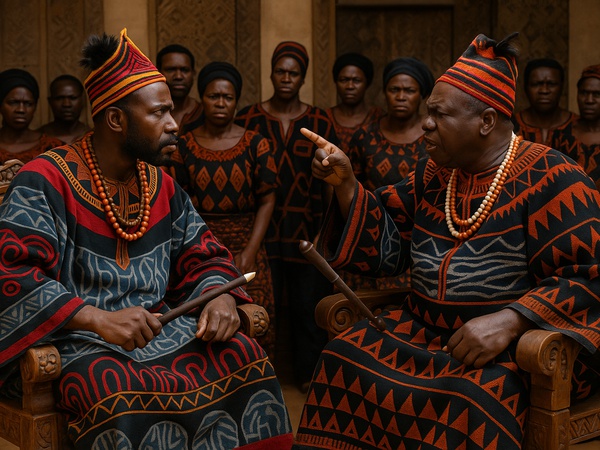
<p><strong>When One Tongue Drowns Another</strong></p><p>Long ago, in the heart of the green valleys of Etana, a proud and peaceful people lived. They were known for their hospitality, strong traditions, and their native language, Leti, which they spoke with pride. Leti wasn’t just a means of communication. It was a way of life, a channel for their songs, prayers, market deals, and ancestral wisdom.</p><p>One season, a migrating tribe called the Ngoma arrived in Etana after fleeing conflict in their homeland. The Etana villagers, true to their customs of brotherhood, welcomed the strangers with open arms. They offered them land, food, and a place in the community. Grateful, the Ngoma settled peacefully and began to grow in number.</p><p>At first, communication between the two tribes was managed in Leti, the host language, with a bit of English for complex matters. But as the Ngoma population grew, their leaders began to suggest that English be used more often. They said it was more “modern” and could bridge the cultural gap. Slowly, meetings, church announcements, and school lessons transitioned to English.</p><p>Years passed, and the Ngoma tribe became the majority. Then came another proposal, one that would shake Etana’s cultural foundation. The Ngoma elders suggested that their own native language, Ngorati, be used alongside or even instead of Leti in public gatherings. They argued that their population outnumbered that of the Etana people, and so it was only fair that information be shared in a language their people fully understood.</p><p>The Etana villagers were stunned. Their language, once the heartbeat of the land, was now considered less practical. Some younger Etana children could no longer speak Leti fluently, having grown up hearing mostly English and Ngorati in schools and churches. The market songs, the proverbs of the elders, and the storytelling nights became rare. Elders wept in silence as they watched their words fade into history.</p><p>However, not all hope was lost. A few brave Etana youth, both from the host and Ngoma tribes, began to question this direction. They believed that true diversity meant respecting all cultures, not replacing one with another. Together, they formed language clubs, hosted cultural days, and insisted on bilingual announcements. A new spirit of unity through diversity began to rise.</p><p>Still, deep scars remained. The loss of full fluency in Leti among the younger generation meant that a part of Etana’s soul had been wounded. Meanwhile, Ngorati and English flourished, creating a complex mix of identities.</p><p><strong>Reflection:</strong></p><p>This story raises important questions about language, power, and coexistence. While the Ngoma tribe did not intend to destroy Etana’s culture, their influence, powered by numbers and subtle persuasion led to the erosion of a once-vibrant heritage. It shows how language can either unite or divide, preserve or erase.</p><p><strong>Here’s a question for you</strong></p><p>If your community were the village of Etana, how would you protect your language and culture while still welcoming and coexisting with others?</p><p>Let me know your thoughts in the comments section </p>


When One Tongue Drowns Another
By
 Chefor Eugene
•
11 plays
Chefor Eugene
•
11 plays
Chefor Eugene
•
11 plays
0:00 /
0:00


 702
702


Other insights from Chefor Eugene









Contributor Points

Points-to-Coupons

Referral Earning
Insights for you.


Igbo Kwenu!!!
Today, I refuse to be humble Not when I speak about my tribe...Cha Cha Cha Cha Cha,Igbo...
818 views
51 upvotes
45 comments


Confessions of a Nearly-Native
My name is Idara. I am Annang from Akwa Ibom. And I cannot speak my language.My mother ...
430 views
32 upvotes
37 comments


Cradle
Who sat and watched my infant head, When sleeping on my cradle bed, And tears of sweet ...
181 views
29 upvotes
31 comments

ÈMI NI ÌLÙ (I Am the Drum)
Mò fẹ́ kí ara mi gbọ́ mi.Before the world gives me a name,let my own soul remember mine.B...
219 views
24 upvotes
27 comments
Agbada and Other Silences
They said it with authority no one questioned.... “Àgbà kì í wà l’ọ́jà, kí orí ọmọ tuntu...
400 views
22 upvotes
29 comments


ÌLÚ MI, ILÉ MI
Modakeke Akoraye omo ogunteludo omo akinkanju loju ogun. Maybe because of you my father...
392 views
18 upvotes
25 comments







190 views
20 upvotes
19 comments