Score |
118






When the Roof Falls Part One: The Boys Who Had to Become It
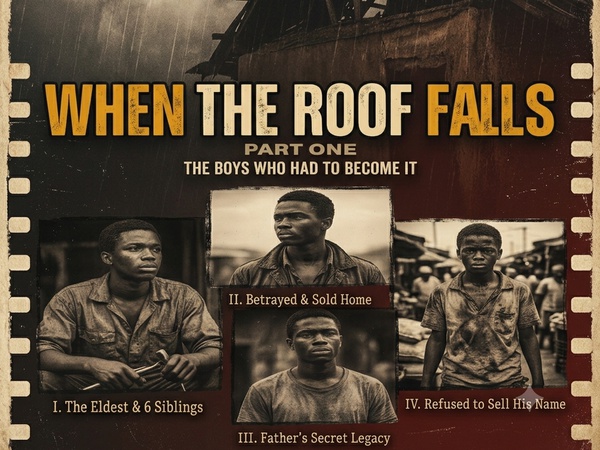
<p>When the Roof Falls</p><p> Part One:</p><p> The Boys Who Had to Become It</p><p><br/></p><p>A house doesn't fall when the walls crack. It falls when the roof goes.</p><p><br/></p><p>That is an unwritten reality nobody talks about. You can survive cracked walls, patch them, lean around them, learn to live with the gap. But the roof is the thing that was never supposed to move. The roof is what makes everything under it safe enough to call home. </p><p>And for a lot of us, our father was the roof. Not because he was perfect. Because he was the one thing we built our whole understanding of shelter around, without ever once considering what happens to a house the day the roof simply isn't there anymore.</p><p>I've been sitting with four stories like that. Four boys who lost the roof and, in the same breath, without transition, without warning, without anyone asking if they were ready became one. I'm going to tell you all four. Reflect on these stories. Because what happens after the roof falls is what it actually costs a child to become one that's a conversation too big for one letter alone.</p><p><br/></p><p>I.</p><p><br/></p><p>He had his whole life memorized before he'd even lived it. Mechanical engineering. Same as his father. He used to watch the man come home in his work clothes, hands still faintly smelling of grease and metal, and think that. I want to be like that. Not because anyone forced the dream on him, but because it felt like the safest dream a boy could have,” a life with a blueprint already tested, already proven, already walked by someone who loved him enough to make it look possible.”</p><p>Then, in one season, his father died. And before the compound had even finished smelling like the wreaths from the burial, before his mother had taken off the black clothes of mourning, she died too. Just followed him. The way people sometimes do when grief is heavier than the body carrying it.</p><p>He was the eldest of six.</p><p>He was somebody's son a few weeks ago. He had homework. He had a curfew. He had a dream that belonged only to him. And then, overnight, five other faces started looking at him the way children look to a parent for food, for permission, for the simple reassurance that things were still going to be okay. He didn't get to choose the promotion. Grief promoted him. One day he was the first-born trying to make his father proud, and the next he was the only roof five children had left, and there was no one to teach him how to be one. He had to learn it the way you learn to swim when someone throws you into the water by not drowning, because drowning wasn't an option anyone had left him.</p><p>The mechanical engineering degree is still somewhere in the wreckage of a boy who used to have a future picked out. Some days I wonder if he even remembers he once wanted it. He was too busy becoming the blueprint himself.</p><p><br/></p><p>II.</p><p><br/></p><p>The second one lost the roof and then watched someone he trusted sell the walls too.</p><p>His father died, and in the natural order of things the order every child is raised to believe in the elder brother was supposed to step into the space their father left. That's the unspoken rule in a lot of our homes the first son inherits not just property, but responsibility. He becomes the next roof. That's the deal. That's what the culture teaches a boy to expect the moment his father's casket is lowered.</p><p>Instead, his brother sold the house.</p><p>Not "struggled to provide." Not "wasn't ready for the weight." He looked at the one shelter his mother and younger sibling had left in the world, the physical proof that their father had existed, had built something, had tried and he sold it. Took the money. Left.</p><p>The grief of realizing loss doesn't automatically make people better. Sometimes it reveals exactly who they always were, and it's someone who, faced with a family that needed holding, decided to hold only himself. This boy couldn't finish school after that. Not because he lacked the brain for it. Because school fees require an address to send the results to, a roof to sleep under while you study, a family behind you steady enough that your mind isn't constantly doing the arithmetic of where you'll sleep next month. He wasn't failed by his own ability. He was failed by the one person who was supposed to be the roof after the roof, and instead became one more thing collapsing on top of him.</p><p><br/></p><p>III.</p><p><br/></p><p>The third story starts with a love so careful it becomes a trap.</p><p>He was the only boy among nine girls, the long-awaited son in a house full of daughters, born to a father who was a politician, a provider, a man whose love language was protection. And I mean that literally he protected his wife from ever having to work. Never let her lift a finger toward providing, never let her near the family's finances, never let her carry anything heavier than raising nine children, because in his mind, that was what loving a woman looked like. Shield her. Handle everything yourself. Let her never have to know how hard things really are.</p><p>It sounds sweet, doesn't it? Until you understand what it actually was, a man who was so certain of his own permanence that he never once built a version of the family that could survive without him. He never told his wife what he owned, what he'd invested in, where the money was, what to do if he wasn't there one day. Not out of malice. Out of a kind of dangerous certainty that he would always be the roof, so nobody else needed to learn how to hold one up.</p><p>Then he died. And the secrecy died with him except it didn't die, it detonated. There was no account she could access. No investment anyone could locate. No instructions, no plan, no map for the after. A man who spent his whole life making sure his wife never had to work a day in her life accidentally made sure that the day he died, she had absolutely nothing to work with.</p><p>Their son went off to university not long after, carrying grief he hadn't even had time to feel yet, and less than a hundred naira to his name. Freshers walking around with new provisions, new bedsheets, pocket money from home, and him doing the math on whether he could afford one meal a day. He hadn't even finished his first year when he made the decision that would reroute the rest of his twenties when he went home. Back to the village. Back to a mother in her fifties who had never once in her life had to budget, had never sold anything, had never negotiated a price, and now had to learn all of it at once, in mourning, with ten children still needing to be fed and schooled. Back to become, at nineteen or twenty, to the very thing his father spent a lifetime insisting he'd never have to be.</p><p>He didn't get to grieve his father like a son. He had to grieve him like a replacement.</p><p><br/></p><p>IV.</p><p><br/></p><p>The fourth one didn't even get the mercy of a father dying whole. His father was already gone and what was left behind was a mother whose body simply wasn't strong enough to carry what needed carrying. Not lazy. Not unwilling. “Chronically sick” doesn't announce itself with a funeral but empties a house just as completely.</p><p>He was fourteen.</p><p>Read that number again, because I think we skip past ages too fast in stories like this. Fourteen is supposed to be the age of exam timetables and arguments about curfew, not the age you start trading in the market to feed five younger siblings and a mother too weak to stand at a stove for long. But that's what he did. He started hustling small trade, small margins, whatever a fourteen-year-old's hands could turn into food because the alternative was watching five other children go hungry while waiting for a system that was never coming to save them.</p><p>None of them could go to school. Not because they didn't want to. Because wanting doesn't pay fees, and there was no one left whose job it was to make wanting possible. So he did what a child in that position is taught to do when the walls start closing in and he reached out to one relative who might still count as roof. He called his uncle.</p><p>And his uncle said yes. Said he'd love to help. Said he'd sponsor his education, train him properly, give him the one thing every fourteen-year-old boy carrying a family on his back was desperate for a way out. There was just one condition. He wanted the boy to drop his father's name and take his instead. Answer to him. Be, on paper and in every room he ever walked into, his son, not his nephew.</p><p>I want you to imagine standing in that moment. Fourteen years old, exhausted, hungry, responsible for five other lives, being handed the exact rope you need to pull yourself and your siblings out of the water and the only price is erasing your father. Not honoring his memory while accepting help. Erasing him. Trading the one thing he had left of a man he'd already lost his name for a future that would only be real if that man had never existed at all.</p><p>He refused.</p><p>And that refusal is where the real suffering started. Not trading at fourteen. Not the siblings out of school. Those were already hard. But turning down the one open door because walking through it meant unbecoming his father's son. That's the decision that cost him the most, and it's also the one I think about the longest. He chose to keep carrying his siblings, keep hustling in the market, keep being the roof with no training and no safety net, rather than let anyone rename the man whose absence he was already grieving. He didn't get applauded for it. Nobody threw him a parade for choosing dignity over relief. He just went back to being fourteen and exhausted and responsible, except now also quietly aware of exactly how much his family's survival was worth to the people who were supposed to help hold it up.</p><p>Four boys. Four different roofs. Four different ways of falling into a life nobody prepared them for.</p><p>But here's what I haven't told you yet what none of these stories answer on their own what does carrying that weight actually do to a person, years later? What happens to the dream that got buried, the childhood that got skipped, the grief that never got its turn? What does it cost a person to become the roof, and does that cost ever get paid off or do you just keep living inside a house you built out of your own unlived life?</p><p>That's Part Two. Because these boys didn't just survive the falling. They had to keep standing under what they became. And that part of the story deserves its own letter.</p><p>Part Two continues next the cost of becoming the roof, and what it means to finally set the weight down.</p><p><br/></p>


 11
11


Other insights from Whispered Faith Letters










Referral Earning

Points-to-Coupons

Insights for you.


Gen Z, Are We.... Hungry?
If aliens were to read our texts, they'd think Gen Z are in a perpetual state of starva...
514 views
48 upvotes
53 comments



In Her Likeness.
I hail from the southwestern part of Nigeria, and oftentimes, when I walk through the n...
103 views
43 upvotes
49 comments


Dear Dad
Dear dad,It's been 7 years, 3 months and 1 day and your name still echoes in my brain.W...
213 views
44 upvotes
35 comments


Curiosity or Clout?
Omooo I have a bad habit. 😭Whenever something starts trending in Nigeria, I click on it...
143 views
32 upvotes
41 comments

I Think We Broke Gen Alpha
I think we broke Gen Alpha...Yesterday I opened TikTok.A child who couldn't have been o...
240 views
35 upvotes
36 comments


GOD IS A GIRL DAD.
Fathers and daughters, a match made in heaven.Literally.They say a girl's first love is...
411 views
26 upvotes
28 comments


Insufficient!
I met a young man this evening in a shared ride, first it was Arsenal that got us talki...
535 views
30 upvotes
38 comments