




You read a piece by an African writer. The English is clean. The argument is sharp. The sentences land well. And the first thing that comes to your mind is not, this person can write. The first thing is, this person used AI.
Why?
Why does intelligence become suspicious when it comes from a person you did not expect it from? I am not talking about every reader. Some people have real concerns about originality, and that is fair. I am talking about a pattern. A pattern where the same piece gets called brilliant with one name on it, and gets questioned with another name on it. A pattern where an African name makes people check twice.
That is not about AI. That is about what you already believed before you opened the page.
This is not a new problem. It just has a new name now.
Chimamanda Ngozi Adichie talked about this in her TED talk, The Danger of a Single Story. She wrote a novel. A professor read it and told her it was not authentically African. His reason was simple. Her characters were too much like him. They were educated. They drove cars. They had conversations that did not fit the village suffering he had in his head.
He was not reading her book. He was checking her book against a picture he already had. And when her book did not match that picture, he said her book was fake.
Today people do the same thing with AI. They have a picture in their head of how an African should write. When the writing goes past that picture, they say it cannot be human. They say a machine must have helped. The word changed from "not authentic" to "AI generated." The thinking behind it did not change at all.
And that thinking is based on one lie. That there is only one African voice.
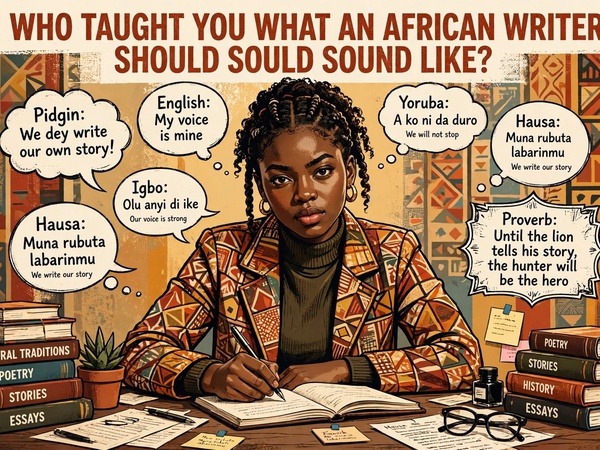
Look at Nigeria alone and that lie falls apart. We have people who grew up speaking Igbo at home and learned English in school. We have people who grew up speaking Hausa and Yoruba and still speak English like water. We have people who speak Pidgin from morning till night and can explain a whole life story in Pidgin without missing one detail. We have people who speak English at home because that is what their parents spoke.
Which one of them is the real African?
Must I drop a proverb in every paragraph to prove I am from here? Must I write my English broken so you will believe me? Must I make my characters poor and hopeless so you will feel comfortable calling my work African? That is not authenticity. That is performance. And we are tired of performing for people who do not know us.
And there is something else about language that people miss. Sometimes a thought comes to you first in your mother tongue. It is original and real. It has feeling. It has the exact word your grandmother would use. Then you try to put it in English. The words may be correct, but the feeling shifts or changes. Something gets lost in the translation. That does not mean the English is fake. It means you are carrying two worlds in one head, and you are trying to make both of them make sense on paper. That is not cheating. That is work.
Our intelligence did not start with AI. It did not start with the internet. It did not start with any app.
Before any of this technology existed, our people were already thinkers. Our grandmothers could tell a story at night and hold a full compound quiet. Not because they had a degree. Because they knew how to use words. Our fathers knew family history from five generations back without writing one thing down. Our market women can settle a fight with words and make both sides go home happy.
But native intelligence is not only in the past. And it is not only in stories. It is in science. It is in business. It is in philosophy. It is in mathematics. It is in young Nigerians building apps, doing research, starting businesses, experimenting with new ideas, asking hard questions. It is alive today. It did not need a machine to create it, and it did not stop when machines arrived.
So when an African writer writes well today, why are you shocked? Did you think we just started thinking now?
Now, let me be honest about the other side. AI misuse is real. Some people do copy and paste. Some people do let a machine write a whole essay and then put their name on it. That is laziness.That is dishonesty. And it makes life hard for writers who actually sat down, thought hard, and wrote from their own head.
But you cannot call a person a cheat just because their English is good. You cannot call a person a cheat just because their work flows well. Big vocabulary is not proof... Good structure is not proof... And Fluency is not proof.
If you want to accuse someone, bring real proof. Show where they copied from. Show the work. Do not just say, this does not sound like you. Do not just say, this is too good. Too good for who? Too good for what you expected from me?
That is the real question here. This article is not about whether Africans can write good English. Because We can. We have been doing it. Some of us write good English. Some of us write good Pidgin. Some of us write in our mother tongue. All of that is African.
This article is about freedom. The freedom to express your intelligence without your identity becoming the reason people doubt you. The freedom to write the way you write and be read for what you wrote, not for what people assumed about you before they read what you wrote.
So I will ask it again.
Who taught you what an African writer should sound like? Who gave you that rule? And why should an African writer have to defend her intelligence before you even agree to listen to her story?
Read the work first...Judge the work... Leave the suspicion at the door. And let African writers keep thriving with their knowledge.



 31