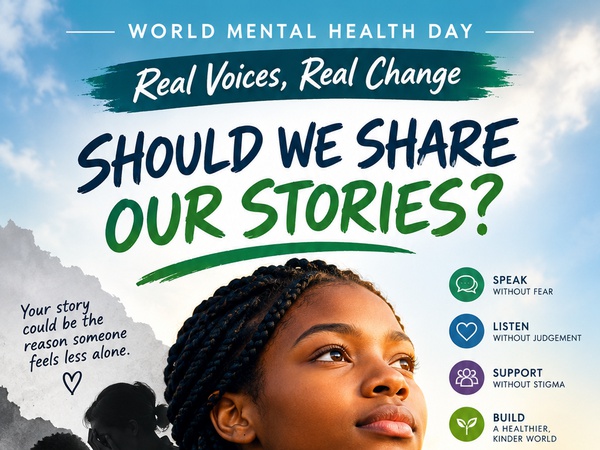
World Mental Health Day 2026: Real Voices, Real Change — Should We Share Our Stories?
By Onyeka Joseph
5 October 2026
A story is more than just words—it’s a bridge. It connects one person’s pain to another’s understanding. Often, the very words we hesitate to speak aloud are exactly what someone else needs to hear. But when sharing our stories means exposing our most vulnerable moments to the world, a vital question arises: should we share our stories? I believe we should—but not because anyone owes the world an explanation of their struggles. We share because honest stories, told safely and willingly, have the power to break silence, dismantle stigma, and remind us all that we are not alone. Isn’t it true that “a problem shared is a problem halved”? Why keep silent when our stories can be the light in someone else’s darkness?
According to the World Health Organization (WHO), approximately 1 in 8 people worldwide—about 970 million—were living with a mental disorder in 2019, a number that has likely increased since then. Depression alone affects more than 280 million people globally, making it a leading cause of disability. Despite this, only about 1 in 3 people with mental health conditions receive any form of treatment, highlighting the pervasive stigma and lack of access to care. Historically, mental health was shrouded in misunderstanding and fear. For centuries, mental illness was often attributed to supernatural causes or moral failings, leading to isolation, mistreatment, and institutionalization. It was only in the 20th century that mental health began to be recognized as a medical and social issue deserving compassion and scientific study. The establishment of the World Federation for Mental Health in 1948 and the first World Mental Health Day in 1992 marked critical milestones in global efforts to raise awareness. Over decades, advocacy and research have shifted public perception from fear and shame toward understanding and support, though stigma remains a significant barrier. As the African proverb says, “Wisdom does not come overnight.” Our collective understanding of mental health has grown slowly but steadily, and sharing stories is part of that wisdom.
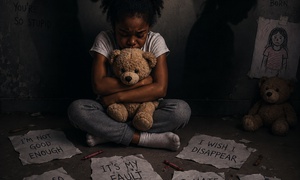
Mental health challenges are often invisible. Someone can smile with friends, attend school or work, and appear perfectly fine while quietly carrying a heavy burden. Because these struggles are hidden, misunderstanding and judgment can easily take root. People may be unfairly labeled as “weak,” “dramatic,” or “seeking attention” when what they truly need is empathy and support. How can we judge what we cannot see? If a tree falls in a forest and no one hears it, does it make a sound? Similarly, if someone suffers silently, does their pain matter less? Studies show that stigma and discrimination are among the biggest obstacles preventing people from seeking help globally. In many countries, cultural beliefs still discourage open discussion of mental health, with some regions reporting that up to 70% of people with mental illness do not seek treatment due to fear of social repercussions. The economic cost of untreated mental illness is staggering, estimated at over $1 trillion annually worldwide in lost productivity.
This is where authentic voices matter. When individuals courageously share their experiences, they replace stereotypes with real human stories. Statistics tell us millions face mental health challenges, but personal stories make those numbers tangible and relatable. They invite those unfamiliar with mental health struggles to look beyond assumptions and see the person behind the experience. For someone suffering in silence, hearing another say, “You are not alone,” can be profoundly healing. While a story cannot solve every problem, it can open a door. It can make asking for help feel less daunting. It can spark conversations that might never have happened otherwise. As Brené Brown wisely said, “Vulnerability is not winning or losing; it’s having the courage to show up and be seen when we have no control over the outcome.”
Yet, sharing stories is not inherently beneficial. We must guard against turning pain into spectacle. Social media often rewards dramatic stories with likes and shares, pressuring people to reveal more than they are comfortable with. Personal experiences can be misunderstood, mimicked, mocked, or permanently tied to one’s digital identity. That is why choice is crucial. No one should feel compelled to share their story just to inspire others. Silence is not failure. Privacy is not shame. Everyone has the right to decide what to share, when, and with whom. And when someone chooses to speak, listeners must respond with respect—not judgment. “The right to be heard does not automatically include the right to be taken seriously,” but it does demand respect and empathy.
It’s also important to remember that stories are not a substitute for professional help. Sharing can foster connection, but serious mental health issues often require support from trusted adults, counselors, psychologists, or medical professionals. Telling someone to “just stay positive” or “be strong” is rarely enough. Real change demands communities that encourage open dialogue and systems ready to listen and act. Internationally, mental health advocacy has gained momentum. The United Nations’ Sustainable Development Goals (SDGs) include mental health as a key component of health and well-being. Countries worldwide are increasingly integrating mental health into primary healthcare, recognizing it as essential to overall health. Global campaigns like Time to Change, Beyond Blue, and Heads Together have demonstrated the power of storytelling combined with systemic action. “If you want to go fast, go alone. If you want to go far, go together.” This African proverb reminds us that collective effort and shared stories build stronger, more compassionate communities.
Perhaps the greatest gift of sharing stories is not just that people speak—but that others learn to listen. A society can mark World Mental Health Day with posts and profile picture changes, but if people are still mocked for seeking help, ignored when they speak, or judged for experiences others don’t understand, then awareness has not translated into meaningful change. True change begins when a story is met with compassion.
So, should we share our stories? Yes—but on our own terms. We should share when we are ready, in safe spaces that honor our dignity, and with the understanding that our experiences belong to us alone. We should listen without turning vulnerability into entertainment, and build communities where no one has to reach a breaking point before being taken seriously. On this World Mental Health Day, perhaps the goal should not be to make everyone speak. Perhaps it should be to ensure that when someone finally finds the courage to speak, there is someone ready to listen. Because a real voice can start a conversation. A conversation can change attitudes. And changed attitudes can save lives. As Maya Angelou said, “There is no greater agony than bearing an untold story inside you.”


 83