Score |
126


Goodyboy/Joe
 tailor @ lagos, nigeria
tailor @ lagos, nigeria



World Mental Health Day 2026: Real Voices, Real Change — Should We Share Our Stories?
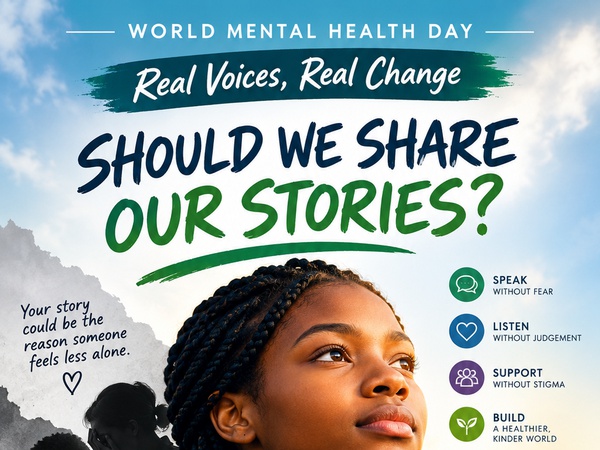
<p>World Mental Health Day 2026: Real Voices, Real Change — Should We Share Our Stories?</p><p>By Onyeka Joseph</p><p>5 October 2026</p><p><br/></p><p>A story is more than just words—it’s a bridge. It connects one person’s pain to another’s understanding. Often, the very words we hesitate to speak aloud are exactly what someone else needs to hear. But when sharing our stories means exposing our most vulnerable moments to the world, a vital question arises: Should we share our stories?</p><p><br/></p><p>I believe we should—but not because anyone owes the world an explanation of their struggles. We share because honest stories, told safely and willingly, have the power to break silence, dismantle stigma, and remind us all that we are not alone.</p><p><br/></p><p>Mental health challenges are often invisible. Someone can smile with friends, attend school or work, and appear perfectly fine while quietly carrying a heavy burden. Because these struggles are hidden, misunderstanding and judgment can easily take root. People may be unfairly labeled as “weak,” “dramatic,” or “seeking attention” when what they truly need is empathy and support.</p><p><br/></p><p>This is where authentic voices matter.</p><p><br/></p><p>When individuals courageously share their experiences, they replace stereotypes with real human stories. Statistics tell us millions face mental health challenges, but personal stories make those numbers tangible and relatable. They invite those unfamiliar with mental health struggles to look beyond assumptions and see the person behind the experience.</p><p><br/></p><p>For someone suffering in silence, hearing another say, “You are not alone,” can be profoundly healing. While a story cannot solve every problem, it can open a door. It can make asking for help feel less daunting. It can spark conversations that might never have happened otherwise.</p><p><br/></p><p>Yet, sharing stories is not inherently beneficial.</p><p><br/></p><p>We must guard against turning pain into spectacle. Social media often rewards dramatic stories with likes and shares, pressuring people to reveal more than they are comfortable with. Personal experiences can be misunderstood, mimicked, mocked, or permanently tied to one’s digital identity.</p><p><br/></p><p>That is why choice is crucial.</p><p><br/></p><p>No one should feel compelled to share their story just to inspire others. Silence is not failure. Privacy is not shame. Everyone has the right to decide what to share, when, and with whom. And when someone chooses to speak, listeners must respond with respect—not judgment.</p><p><br/></p><p>It’s also important to remember that stories are not a substitute for professional help. Sharing can foster connection, but serious mental health issues often require support from trusted adults, counselors, psychologists, or medical professionals. Telling someone to “just stay positive” or “be strong” is rarely enough. Real change demands communities that encourage open dialogue and systems ready to listen and act.</p><p><br/></p><p>Perhaps the greatest gift of sharing stories is not just that people speak—but that others learn to listen.</p><p><br/></p><p>A society can mark World Mental Health Day with posts and profile picture changes, but if people are still mocked for seeking help, ignored when they speak, or judged for experiences others don’t understand, then awareness has not translated into meaningful change.</p><p><br/></p><p>True change begins when a story is met with compassion.</p><p><br/></p><p>So, should we share our stories?</p><p><br/></p><p>Yes—but on our own terms. We should share when we are ready, in safe spaces that honor our dignity, and with the understanding that our experiences belong to us alone. We should listen without turning vulnerability into entertainment, and build communities where no one has to reach a breaking point before being taken seriously.</p><p><br/></p><p>On this World Mental Health Day, perhaps the goal should not be to make everyone speak.</p><p><br/></p><p>Perhaps it should be to ensure that when someone finally finds the courage to speak, there is someone ready to listen.</p><p><br/></p><p>Because a real voice can start a conversation.</p><p><br/></p><p>A conversation can change attitudes.</p><p><br/></p><p>And changed attitudes can save lives.</p>
Competition entry
|
WORLD MENTAL HEALTH DAY: REAL VOICES, REAL CHANGE - SHOULD WE SHARE OUR STORIES?


 17
17


Other insights from Goodyboy/Joe








Contributor Points

Points-to-Coupons

Referral Earning
Insights for you.











ROSES
Roses are redLike our eyesAnd skiesBirds without feathersNor fathersWe're flocklessFlyi...
219 views
16 upvotes
12 comments


Pharaohs and Medicine
Imhotep and Hippocrates: A Look at Ancient Egyptian and Greek MedicineAncient Egyp...
1779 views
13 upvotes
10 comments