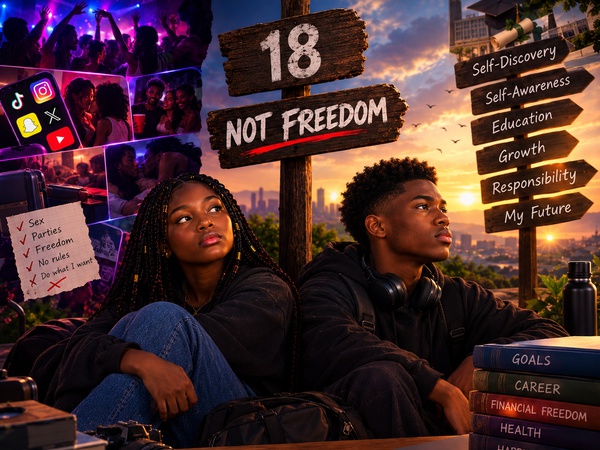
18 Is Not Freedom
For many teenagers, turning 18 feels like crossing a finish line.
You count down to the day. You imagine what it will feel like to finally say, “I'm 18.” Suddenly, you believe you are old enough to make your own decisions, live by your own rules, and do whatever you want.
Eighteen feels like freedom.
At least, that is what many of us are made to believe.
We grow up hearing that 18 is the age when everything changes. The age when childhood is finally behind us. The age when we become “big girls” and “big boys.” And because of that, some of us begin to associate 18 with doing whatever we feel like—sexually, emotionally, mentally, physically, and socially.
But have we ever stopped to ask ourselves where this idea of freedom really comes from?
Perhaps it comes from the conversations we have with our friends, the things we watch on social media, or the way society presents adulthood to us. We see young people celebrating their independence, making their own choices, and living life on their own terms. We hear people say, “You're 18 now; you're an adult. You can do whatever you want.”
Gradually, we begin to believe that turning 18 means we no longer need guidance, correction, or advice from anyone.
And sometimes, when our parents or older people try to correct us, we see it as an attempt to control us rather than an opportunity to learn.
But is that really what freedom means?
Of course, the world is changing. Young people today have access to information, opportunities, and experiences that may not have been available to previous generations. We have new ways of thinking, new ambitions, and different perspectives on life.
However, does growing up in a changing world mean that everything the older generation teaches us is irrelevant?
Not necessarily.
Sometimes, the experiences of older people can offer lessons we have not yet encountered ourselves. Their advice may not always be perfect, and not every traditional belief applies to the world we live in today. Nevertheless, there is a difference between questioning advice to understand it better and rejecting it simply because we believe we are old enough to know everything.
The challenge is learning to think for ourselves without assuming that we have nothing left to learn from others.
But then you turn 18.
And somewhere between the excitement and the reality, you begin to understand something:
18 is not freedom.
It is a new beginning.
It is the beginning of a phase where you are expected to understand yourself better. You begin asking questions you never thought about as a child.
Who am I? What do I really want? What kind of person am I becoming? What do I want my future to look like?
Eighteen does not suddenly make you mature. It does not erase your mistakes. It does not give you all the answers.
It simply opens the door to a stage where you have to start finding those answers for yourself.
And that is where many people get it wrong.
They see the number 18 and think it means they have finally become adults in every sense. But age and maturity are not the same thing.
Society may recognise you as an adult, but you are still learning about life. You may have the freedom to make certain decisions, but you must also learn to live with their consequences.
Some 18-year-olds are discovering themselves. Some are building their futures. Some are still figuring out who they are. And that is okay.
There is no single path to maturity, and nobody has to have everything figured out simply because they have reached a particular age.
Because being 18 is not about having everything figured out.
It is about becoming more self-aware.
It is about learning that every decision has consequences. It is about understanding that freedom without responsibility can easily become a trap.
It is also about learning when to listen, when to question, when to stand your ground, and when to admit that you still have something to learn.
The truth is, turning 18 may give you more independence, but it also demands more responsibility.
You are no longer simply asking, “What can I do?”
You begin to ask, “What should I do?”
You begin to understand that not every opportunity is worth taking, not every trend is worth following, and not every decision that feels good in the moment will be good for your future.
You learn that growing up is not about proving to everyone that you are independent. Sometimes, it is about having the wisdom to recognise when you need guidance.
And perhaps that is the real meaning of 18.
Not freedom.
Self-discovery. Self-awareness. Growth.
Eighteen is not the moment you suddenly become a completely different person.
It is the beginning of discovering the person you want to become.


 22