Score |
57


Galton
 Student @ University of Lagos
Student @ University of Lagos



AI Is Changing the Work. But Are We Getting Better at It?
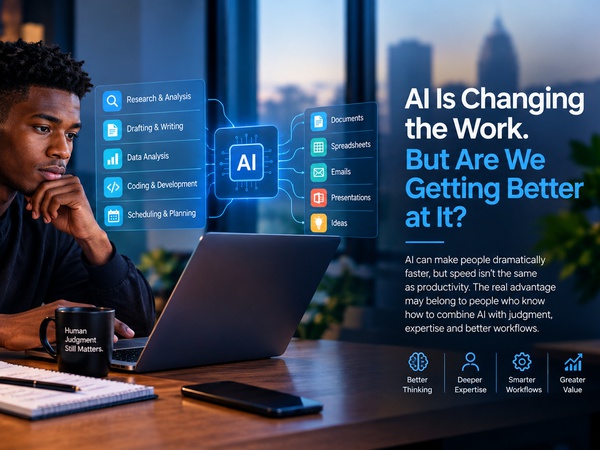
<p><strong>AI can make people dramatically faster, but speed isn't the same as productivity. The real advantage may belong to people who know how to combine AI with judgment, expertise and better workflows.</strong></p><p><br/></p><p>For a while, the promise of artificial intelligence sounded straightforward:</p><p><br/></p><p>Give AI a task.</p><p><br/></p><p>Get the result faster.</p><p><br/></p><p>Do more.</p><p><br/></p><p>It is an attractive proposition. If an AI assistant can write the first draft, analyse the spreadsheet, summarise the meeting and generate the presentation, why wouldn't productivity rise?</p><p><br/></p><p>But there is a question that is becoming harder to ignore:</p><p><br/></p><p>Are we actually producing better work, or are we simply producing more of it?</p><p><br/></p><p>That distinction could become one of the most important questions of the AI era.</p><p><br/></p><p>Faster is not automatically better</p><p><br/></p><p>Imagine two employees.</p><p><br/></p><p>The first takes four hours to produce a report.</p><p><br/></p><p>The second uses AI and produces one in 30 minutes.</p><p><br/></p><p>The second employee appears to be eight times more productive.</p><p><br/></p><p>But what if the first report contains three important errors and the second contains six?</p><p><br/></p><p>The technology has increased speed without increasing quality.</p><p><br/></p><p>This is the uncomfortable part of AI productivity.</p><p><br/></p><p>It is relatively easy to measure how quickly something was produced.</p><p><br/></p><p>It is much harder to measure whether it was correct, useful, original, well-reasoned or appropriate for the situation.</p><p><br/></p><p>And that is where human judgment becomes more important.</p><p><br/></p><p>Microsoft's 2026 Work Trend Index found that 58% of AI users surveyed said they are producing work they could not have produced a year earlier.</p><p><br/></p><p>But when those workers were asked which human skills become more important as AI takes on more work, the top answers were quality control of AI output (50%) and critical thinking (46%).</p><p><br/></p><p>That tells us something important.</p><p><br/></p><p><strong>AI isn't simply removing work from humans.</strong></p><p><br/></p><p>It is changing which parts of the work humans need to be good at.</p><p><br/></p><p>The disappearing skill may not be the one you expect</p><p><br/></p><p>There is a popular assumption that the most valuable skill in the AI economy will be knowing how to operate AI.</p><p><br/></p><p>That is only part of the picture.</p><p><br/></p><p>The International Labour Organization published a 2026 report examining how AI is changing workplace skills. Its conclusion is particularly interesting: AI literacy is becoming important, but workers also need cognitive, digital and socio-emotional capabilities, including adaptability, critical thinking and human agency.</p><p><br/></p><p>The ILO also notes that AI and machine-learning skills remain a relatively small portion of overall job requirements. In several countries examined, they represented roughly 1% or less of skills requested in online vacancies.</p><p><br/></p><p>In other words, most people will not need to become AI engineers.</p><p><br/></p><p>They will need to become better professionals who know how to work with AI.</p><p><br/></p><p>That is a very different proposition.</p><p><br/></p><p>AI doesn't replace expertise. It changes how expertise is used.</p><p><br/></p><p>Consider a graphic designer.</p><p><br/></p><p>AI can generate an image in seconds.</p><p><br/></p><p>But the difficult questions remain:</p><p><br/></p><p>What should the image communicate?</p><p><br/></p><p>Who is the audience?</p><p><br/></p><p>Which visual hierarchy works?</p><p><br/></p><p>What feels trustworthy?</p><p><br/></p><p>What should be removed?</p><p><br/></p><p>Does the final design actually solve the client's problem?</p><p><br/></p><p>The same applies to an engineer.</p><p><br/></p><p>AI might help analyse data, generate calculations, explain a circuit or produce documentation.</p><p><br/></p><p>But someone still needs to understand whether the result makes engineering sense.</p><p><br/></p><p>A lawyer can use AI to review documents.</p><p><br/></p><p>A doctor can use AI to organise information.</p><p><br/></p><p>A journalist can use AI to research and structure material.</p><p><br/></p><p>A programmer can use AI to generate code.</p><p><br/></p><p>In every case, the person with genuine domain knowledge has an advantage because they can recognise when the AI is wrong.</p><p><br/></p><p>Expertise becomes the filter through which AI output gains value.</p><p><br/></p><p>The AI advantage may belong to the reviewer</p><p><br/></p><p>This creates an interesting reversal.</p><p><br/></p><p>For years, productivity often meant becoming faster at producing something.</p><p><br/></p><p>With AI, production is becoming increasingly cheap.</p><p><br/></p><p>Drafts are cheap.</p><p><br/></p><p>Code is cheap.</p><p><br/></p><p>Images are cheap.</p><p><br/></p><p>Summaries are cheap.</p><p><br/></p><p>Ideas are cheap.</p><p><br/></p><p>The scarce resource may increasingly become good judgment.</p><p><br/></p><p>If AI can generate 20 possible solutions, the valuable person may be the one who can quickly identify the two worth pursuing.</p><p><br/></p><p>If AI can produce 10 versions of an article, the valuable editor may be the one who knows which claims need verification.</p><p><br/></p><p>If AI can generate thousands of lines of code, the valuable developer may be the one who understands the architecture well enough to identify what shouldn't be shipped.</p><p><br/></p><p>This doesn't make creation irrelevant.</p><p><br/></p><p>It makes selection, verification and refinement more important.</p><p><br/></p><p>The productivity gap could become a skill gap</p><p><br/></p><p>There is another problem.</p><p><br/></p><p>Not everyone is benefiting from AI equally.</p><p><br/></p><p>The OECD's 2026 research found that AI adoption among firms in OECD countries increased from around 7% in 2021 to 20% in 2025.</p><p><br/></p><p>But the same research identifies skills shortages as a major barrier to adoption. It also found that workers increasingly need the ability to use, analyse and interpret data, alongside problem-solving, creativity and innovation.</p><p><br/></p><p>That means simply giving people access to an AI tool isn't enough.</p><p><br/></p><p>Two people can have access to exactly the same AI system and get dramatically different results.</p><p><br/></p><p>One person may know how to frame the problem, provide useful context, challenge the output, verify the answer and integrate it into a larger workflow.</p><p><br/></p><p>The other may simply type:</p><p><br/></p><p>«"Do this for me."»</p><p><br/></p><p>The technology is identical.</p><p><br/></p><p>The capability isn't.</p><p><br/></p><p>This is why AI literacy matters</p><p><br/></p><p>AI literacy is sometimes treated as knowing how to write good prompts.</p><p><br/></p><p>That is too narrow.</p><p><br/></p><p>A genuinely AI-literate worker should be able to:</p><p><br/></p><p>Understand:</p><p>Know what the system can and cannot reliably do.</p><p><br/></p><p>Direct:</p><p>Give it a clear objective and useful context.</p><p><br/></p><p>Evaluate:</p><p>Check whether the output is accurate and appropriate.</p><p><br/></p><p>Correct:</p><p>Recognise mistakes and improve the result.</p><p><br/></p><p>Integrate:</p><p>Know where AI fits into the wider workflow.</p><p><br/></p><p>Decide:</p><p>Know when not to use AI at all.</p><p><br/></p><p>That last one may become increasingly important.</p><p><br/></p><p>Because the best use of AI is not necessarily to put AI into every task.</p><p><br/></p><p>Sometimes the fastest way to produce a good result is to do the task yourself.</p><p><br/></p><p>Don't automate a bad process</p><p><br/></p><p>This connects directly to our first article.</p><p><br/></p><p>We argued that people shouldn't collect AI tools simply because they exist.</p><p><br/></p><p>The same principle applies to workflows.</p><p><br/></p><p>Suppose a company has a terrible process for handling customer complaints.</p><p><br/></p><p>Adding an AI chatbot might make the company process complaints faster.</p><p><br/></p><p>But it hasn't necessarily solved the underlying problem.</p><p><br/></p><p>It may simply have automated inefficiency.</p><p><br/></p><p>The same thing can happen to individuals.</p><p><br/></p><p>If your research process is disorganised, AI can help you produce more disorganised research.</p><p><br/></p><p>If you don't know what you're trying to achieve, AI can generate more things you don't need.</p><p><br/></p><p>If you can't distinguish a good answer from a bad one, a faster answer doesn't solve the problem.</p><p><br/></p><p>AI works best when it is attached to a good process.</p><p><br/></p><p>The people who benefit most may not be the people who use AI the most</p><p><br/></p><p>This is perhaps the most important distinction.</p><p><br/></p><p>Imagine two workers using AI for eight hours a day.</p><p><br/></p><p>Worker A uses AI to generate everything.</p><p><br/></p><p>Worker B uses AI selectively: research, first drafts, repetitive analysis and routine tasks.</p><p><br/></p><p>But Worker B spends significant time checking, thinking, refining and making decisions.</p><p><br/></p><p>Worker A may produce more material.</p><p><br/></p><p>Worker B may produce more value.</p><p><br/></p><p>The difference is subtle, but enormous.</p><p><br/></p><p>AI should not become a machine for maximising output.</p><p><br/></p><p>It should become a tool for increasing the value of human effort.</p><p><br/></p><p>What should you actually improve?</p><p><br/></p><p>If you're a student, professional, entrepreneur or creator trying to prepare for an AI-heavy workplace, learning another 50 AI tools probably isn't the answer.</p><p><br/></p><p>Build these instead:</p><p><br/></p><p>1. Domain expertise</p><p><br/></p><p>Know your field well enough to recognise good and bad AI output.</p><p><br/></p><p>2. Critical thinking</p><p><br/></p><p>Don't accept an answer simply because it sounds confident.</p><p><br/></p><p>3. Communication</p><p><br/></p><p>The better you can explain a problem, the better you can direct AI toward solving it.</p><p><br/></p><p>4. Data literacy</p><p><br/></p><p>Learn how to understand, analyse and interpret information.</p><p><br/></p><p>5. AI literacy</p><p><br/></p><p>Understand the strengths, weaknesses and appropriate uses of the systems you're working with.</p><p><br/></p><p>6. Quality control</p><p><br/></p><p>Make verification part of the workflow rather than something you do only after something goes wrong.</p><p><br/></p><p>7. Adaptability</p><p><br/></p><p>The tools will change.</p><p><br/></p><p>The underlying ability to learn will matter longer than any individual AI product.</p><p><br/></p><p>The real productivity question</p><p><br/></p><p>The AI era is creating a strange situation.</p><p><br/></p><p>We can now produce more content, more code, more images, more analysis and more drafts than ever.</p><p><br/></p><p>But abundance creates its own problem.</p><p><br/></p><p>When producing something becomes cheap, deciding what deserves to exist becomes more valuable.</p><p><br/></p><p>That is why the future of work may not belong simply to people who know how to get AI to produce more.</p><p><br/></p><p>It may belong to people who know:</p><p><br/></p><p>What to ask.</p><p><br/></p><p>What to accept.</p><p><br/></p><p>What to reject.</p><p><br/></p><p>What to verify.</p><p><br/></p><p>What to improve.</p><p><br/></p><p>And perhaps most importantly:</p><p><br/></p><p>What is worth doing in the first place.</p><p><br/></p><p>AI is changing the work.</p><p><br/></p><p>But becoming faster isn't the finish line.</p><p><br/></p><p>The real advantage will come when we learn to use AI to make human work better, not merely bigger.</p>


 7
7


Other insights from Galton






Contributor Points

Points-to-Coupons

Referral Earning

Insights for you.


My Unpopular opinions of Social Media.
I Really Hate Social MediaWait, hear me out.I'm not saying this from a place of pride o...
217 views
33 upvotes
40 comments


Meet Amina the AI
Well yes, the image attached to this post was created with DALLE. After some interestin...
1456 views
19 upvotes
12 comments


If You Can’t Beat Them, Join Them
I didn’t experience the “before.” Before landlines, before phones, before mobile money—...
308 views
27 upvotes
25 comments


Grandpa lied (A little)
"Grandpa said, farming pays and not even your AI can take that away" that was my cousin...
313 views
25 upvotes
26 comments


Social Media vs Reality – Let’s Be Fo...
Let’s talk. Be honest, have you ever looked at someone’s Instagram story and immediatel...
432 views
15 upvotes
15 comments

Are we becoming who we are, or who we...
We are shaped long before we realize itby things we do not question,by voices we do not...
291 views
19 upvotes
20 comments


Over sharing with a bot : it's not th...
Lately I’ve realized my most stable relationship might actually be with ChatGPT. 😭 I co...
457 views
16 upvotes
16 comments

The Impact Of Social Media vs Books: ...
A social media personality emerged on the internet months ago and a basic small toy tha...
358 views
19 upvotes
15 comments


Tech is the New White Collar Job
Tech is the New White Collar Job
Tech is the new currency; with tech, you can say cr...
1053 views
17 upvotes
11 comments

Three (3) reasons why AI is losing to...
This article explains how Google's new policy affects AI-written content and flagging g...
810 views
17 upvotes
17 comments