Score |
52


Galton
 Student @ University of Lagos
Student @ University of Lagos



AI Is Learning to Act. Are We Ready to Let It?
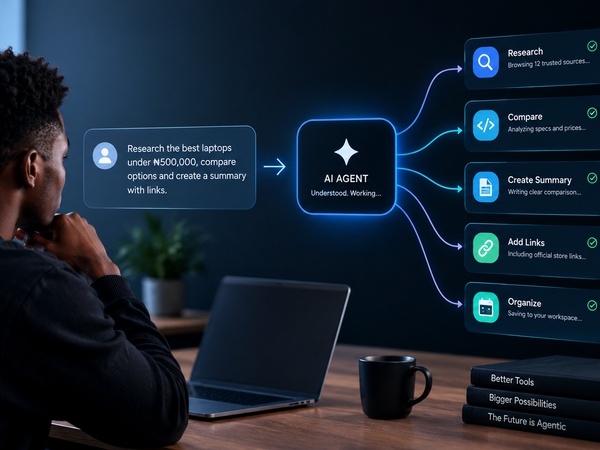
<p>AI Is Learning to Act. Are We Ready to Let It?</p><p><br/></p><p>AI agents are moving beyond chatbots and into real-world tasks—from coding and research to shopping and business workflows. Here’s what is changing, and what you should understand before handing them control.</p><p><br/></p><p>For the past few years, using AI has mostly meant asking a question and getting an answer.</p><p><br/></p><p>You type a prompt.</p><p>The AI responds.</p><p>You decide what to do next.</p><p><br/></p><p>That model is beginning to change.</p><p><br/></p><p>The next phase of AI is increasingly about agents—systems that can take a goal, break it into steps, use tools, make decisions along the way and carry out parts of the task with less human intervention.</p><p><br/></p><p>Instead of asking an AI to explain how to complete a task, you may increasingly be able to ask it to complete the task itself.</p><p><br/></p><p>And this shift is happening faster than many people realize.</p><p><br/></p><p>AI agents are no longer just an experiment</p><p><br/></p><p>Microsoft's 2026 Work Trend Index found that the number of active agents in the Microsoft 365 ecosystem had grown 15 times year over year, with an even larger increase in large enterprises. Microsoft's research covered 20,000 AI-using knowledge workers across 10 countries and analyzed large amounts of anonymized Microsoft 365 activity.</p><p><br/></p><p>McKinsey's 2026 global AI survey points in the same direction.</p><p><br/></p><p>Among organizations with more than $1 billion in annual revenue, 40% of respondents said their organizations were scaling AI agents, compared with 27% the previous year. Among smaller organizations, the figure was 22%.</p><p><br/></p><p>Those numbers don't mean that AI agents have taken over the workplace.</p><p><br/></p><p>In fact, Stanford's 2026 AI Index paints a more cautious picture: across most business functions, the majority of surveyed organizations reported no agent use, and scaled deployment remained in the single digits for most functions.</p><p><br/></p><p>That's an important distinction.</p><p><br/></p><p>AI agents are growing rapidly, but we're still relatively early.</p><p><br/></p><p>So what exactly is an AI agent?</p><p><br/></p><p>Think about the difference between an AI assistant and an AI agent.</p><p><br/></p><p>An assistant might help you write an email.</p><p><br/></p><p>An agent could potentially:</p><p><br/></p><p>1. Read the relevant information.</p><p>2. Determine what needs to be done.</p><p>3. Draft the email.</p><p>4. Check your calendar or other connected information.</p><p>5. Send or schedule it according to the rules you've given it.</p><p><br/></p><p>The important difference isn't simply intelligence.</p><p><br/></p><p>It's agency.</p><p><br/></p><p>A conventional chatbot mostly waits for your next instruction.</p><p><br/></p><p>An agent can operate through a sequence of actions toward a goal.</p><p><br/></p><p>That could mean researching a topic, writing and testing code, processing information, managing a workflow, updating software systems or, increasingly, interacting with services on your behalf.</p><p><br/></p><p>The biggest change isn't that AI can answer better</p><p><br/></p><p>It's that AI can potentially do more between your instructions.</p><p><br/></p><p>This changes the relationship between humans and software.</p><p><br/></p><p>For decades, software has largely required people to learn how to operate it.</p><p><br/></p><p>You open an application.</p><p><br/></p><p>You find the right menu.</p><p><br/></p><p>You enter information.</p><p><br/></p><p>You click through several steps.</p><p><br/></p><p>AI agents introduce another possibility:</p><p><br/></p><p>Tell the system what outcome you want, and let it figure out some of the steps.</p><p><br/></p><p>That could make complicated software more accessible.</p><p><br/></p><p>It could also create a new problem.</p><p><br/></p><p>If an AI system is allowed to take actions, mistakes are no longer limited to producing a bad paragraph on a screen.</p><p><br/></p><p>A mistake could mean sending the wrong message, changing the wrong record, purchasing the wrong product or making an incorrect decision.</p><p><br/></p><p>The cost of an error can increase with the agent's level of access.</p><p><br/></p><p>That's where things get interesting</p><p><br/></p><p>Consider AI shopping agents.</p><p><br/></p><p>Instead of searching through dozens of websites yourself, an agent could potentially compare products, evaluate options and help complete a purchase.</p><p><br/></p><p>Sounds convenient.</p><p><br/></p><p>But who is responsible if it chooses incorrectly?</p><p><br/></p><p>What happens if an agent is manipulated by information on a website?</p><p><br/></p><p>What if it uses your payment information incorrectly?</p><p><br/></p><p>And how do you know exactly why it made a particular choice?</p><p><br/></p><p>Those aren't purely theoretical questions anymore.</p><p><br/></p><p>On September 22, 2026, a group of major banks warned about risks surrounding AI-powered shopping agents, including fraud, scams, incorrect purchases and data privacy. They called for greater transparency around when AI is participating in transactions and stronger safeguards for consumer data.</p><p><br/></p><p>The more capable AI becomes, the more important these questions become.</p><p><br/></p><p>The real challenge may be trust</p><p><br/></p><p>The technology has to be capable enough to perform useful tasks.</p><p><br/></p><p>But capability alone isn't enough.</p><p><br/></p><p>Imagine giving an AI agent access to your:</p><p><br/></p><p>- Email</p><p>- Calendar</p><p>- Documents</p><p>- Company systems</p><p>- Bank or payment information</p><p>- Customer database</p><p>- Social media accounts</p><p><br/></p><p>Suddenly, the question isn't:</p><p><br/></p><p>“Is this AI smart?”</p><p><br/></p><p>The more important questions become:</p><p><br/></p><p>“What can it access?”</p><p><br/></p><p>“What can it change?”</p><p><br/></p><p>“What happens when it gets something wrong?”</p><p><br/></p><p>“Can I see what it did?”</p><p><br/></p><p>“Can I stop it?”</p><p><br/></p><p>Those questions will become increasingly important as agents move from experimentation into everyday workflows.</p><p><br/></p><p>Humans aren't disappearing from the equation</p><p><br/></p><p>There is an interesting finding in Microsoft's 2026 research.</p><p><br/></p><p>Among the AI users surveyed, 66% said AI had allowed them to spend more time on high-value work, while 58% said AI enabled them to produce work they couldn't have produced a year earlier.</p><p><br/></p><p>The implication isn't necessarily that humans become irrelevant.</p><p><br/></p><p>It may be the opposite.</p><p><br/></p><p>As AI takes on more execution, humans may spend more time deciding what should be done, why it matters and whether the result is acceptable.</p><p><br/></p><p>That makes judgment increasingly valuable.</p><p><br/></p><p>An agent can execute a workflow.</p><p><br/></p><p>Someone still needs to decide whether that workflow is worth executing in the first place.</p><p><br/></p><p>Don't automate a bad process</p><p><br/></p><p>This may be the most important lesson for individuals and businesses considering AI agents.</p><p><br/></p><p>If your existing process is confusing, inefficient or poorly designed, giving it to an AI agent doesn't automatically fix it.</p><p><br/></p><p>It can simply make the bad process run faster.</p><p><br/></p><p>Deloitte's 2026 research found that only 5% of surveyed organizations said their business processes were highly prepared for AI agents, while 74% of surveyed leaders expected nearly half of their business processes to be redesigned or rebuilt around AI agents within four years.</p><p><br/></p><p>That suggests the biggest opportunity isn't simply installing agents.</p><p><br/></p><p>It is rethinking the work first.</p><p><br/></p><p>What should you do now?</p><p><br/></p><p>You don't need to start building an army of AI agents tomorrow.</p><p><br/></p><p>Instead, start by looking at your own repetitive work.</p><p><br/></p><p>Ask:</p><p><br/></p><p>What do I repeatedly do that follows a predictable process?</p><p><br/></p><p>Maybe it's:</p><p><br/></p><p>- Sorting information</p><p>- Researching competitors</p><p>- Preparing reports</p><p>- Responding to routine messages</p><p>- Organizing documents</p><p>- Monitoring information</p><p>- Writing code</p><p>- Managing customer enquiries</p><p><br/></p><p>Then ask another question:</p><p><br/></p><p>Does this task actually require my judgment at every step?</p><p><br/></p><p>If the answer is no, it may be a candidate for automation.</p><p><br/></p><p>But don't give an AI unrestricted access simply because it can perform a task.</p><p><br/></p><p>Start with limited permissions.</p><p><br/></p><p>Test it.</p><p><br/></p><p>Review its output.</p><p><br/></p><p>Measure the results.</p><p><br/></p><p>Then expand its responsibilities gradually.</p><p><br/></p><p>The age of AI agents is beginning—but it isn't finished</p><p><br/></p><p>There is a tendency to talk about new AI technology as if the future has already arrived.</p><p><br/></p><p>It hasn't.</p><p><br/></p><p>The evidence shows rapid growth in agent deployment, but it also shows that widespread, fully scaled adoption remains relatively limited.</p><p><br/></p><p>We're somewhere in between experimentation and transformation.</p><p><br/></p><p>That may actually be the most important moment to pay attention.</p><p><br/></p><p>Because the decisions made now—about access, privacy, accountability, human oversight and how work is redesigned—will influence how useful these systems become.</p><p><br/></p><p>The biggest question isn't whether AI agents will become more capable.</p><p><br/></p><p>They almost certainly will.</p><p><br/></p><p>The bigger question is:</p><p><br/></p><p>How much control are we willing to give them—and how intelligently will we use that control?</p><p><br/></p><p>The next generation of AI won't just answer our questions.</p><p><br/></p><p>It will increasingly take action on our behalf.</p><p><br/></p><p>And that changes everything.</p>


 28
28


Other insights from Galton












Contributor Points

Points-to-Coupons

Referral Earning

Insights for you.


My Unpopular opinions of Social Media.
I Really Hate Social MediaWait, hear me out.I'm not saying this from a place of pride o...
243 views
33 upvotes
40 comments


Meet Amina the AI
Well yes, the image attached to this post was created with DALLE. After some interestin...
1478 views
20 upvotes
12 comments


If You Can’t Beat Them, Join Them
I didn’t experience the “before.” Before landlines, before phones, before mobile money—...
323 views
28 upvotes
25 comments


Grandpa lied (A little)
"Grandpa said, farming pays and not even your AI can take that away" that was my cousin...
338 views
25 upvotes
26 comments


Social Media vs Reality – Let’s Be Fo...
Let’s talk. Be honest, have you ever looked at someone’s Instagram story and immediatel...
443 views
15 upvotes
15 comments

Are we becoming who we are, or who we...
We are shaped long before we realize itby things we do not question,by voices we do not...
308 views
19 upvotes
20 comments


Three (3) reasons why AI is losing to...
This article explains how Google's new policy affects AI-written content and flagging g...
847 views
18 upvotes
18 comments


Over sharing with a bot : it's not th...
Lately I’ve realized my most stable relationship might actually be with ChatGPT. 😭 I co...
467 views
16 upvotes
16 comments


The Impact Of Social Media vs Books: ...
A social media personality emerged on the internet months ago and a basic small toy tha...
392 views
19 upvotes
15 comments

Tech is the New White Collar Job
Tech is the New White Collar Job
Tech is the new currency; with tech, you can say cr...
1069 views
17 upvotes
11 comments