Score |
128


Galton
 Student @ University of Lagos
Student @ University of Lagos



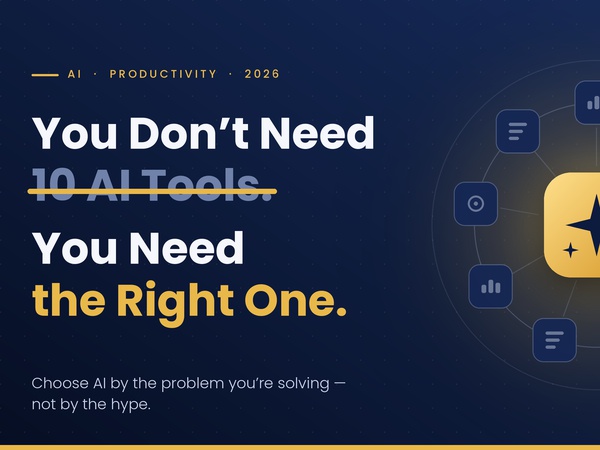
You Don't Need 10 AI Tools. You Need the Right One. From research and writing to coding, presentations and automation, here's how to choose AI based on the problem you're actually trying to solve.
<p>There is a strange problem with artificial intelligence in 2026.</p><p><br/></p><p>There is too much of it.</p><p><br/></p><p>Every week, another AI tool appears. One promises better writing. Another claims to be better at research. Another creates presentations. Another writes code. Another generates images and video. Others can search the web, analyze documents, summarize meetings or automate business processes.</p><p><br/></p><p>And then there are AI agents — systems designed to do more than answer a question. They can plan and execute multiple steps toward a goal.</p><p><br/></p><p>With all of this happening at once, it is easy to mistake collecting AI tools for becoming productive with AI.</p><p><br/></p><p>It isn't.</p><p><br/></p><p>The real question is much simpler:</p><p><br/></p><p>What problem are you trying to solve?</p><p><br/></p><p>The AI tool trap</p><p><br/></p><p>Imagine you have a research assignment.</p><p><br/></p><p>You could spend an hour comparing ChatGPT, Claude, Gemini, Perplexity, NotebookLM and several other tools.</p><p><br/></p><p>You could watch reviews.</p><p><br/></p><p>You could read “10 best AI tools for students” articles.</p><p><br/></p><p>You could test five different prompts in five different applications.</p><p><br/></p><p>And after all that, you still have an assignment to complete.</p><p><br/></p><p>This is the trap.</p><p><br/></p><p>AI is supposed to reduce friction. But if choosing and switching between tools becomes a task of its own, some of that benefit disappears.</p><p><br/></p><p>The growing number of AI products makes this increasingly relevant. Current AI research shows that people are using AI across many different kinds of work, from finding information and producing content to analysis and problem-solving.</p><p><br/></p><p>The goal, therefore, shouldn't be to have the largest AI toolkit.</p><p><br/></p><p>It should be to build a useful workflow.</p><p><br/></p><p>Start with the job</p><p><br/></p><p>Instead of asking:</p><p><br/></p><p>“Which AI tool is the best?”</p><p><br/></p><p>Start with:</p><p><br/></p><p>“What am I trying to accomplish?”</p><p><br/></p><p>The answer changes everything.</p><p><br/></p><p>If you need to understand a difficult engineering concept, your priority is explanation and reasoning.</p><p><br/></p><p>If you need to investigate a subject, you need research and source verification.</p><p><br/></p><p>If you need to turn your ideas into slides, you need presentation and design capabilities.</p><p><br/></p><p>If you are writing software, you may need an AI coding assistant.</p><p><br/></p><p>If you repeatedly perform the same digital process, automation may be more valuable than another chatbot.</p><p><br/></p><p>The tool comes after the problem.</p><p><br/></p><p>One problem can require several AI capabilities</p><p><br/></p><p>Consider a small business trying to improve its customer service.</p><p><br/></p><p>The owner might need to:</p><p><br/></p><p>- answer common customer questions;</p><p>- organize incoming enquiries;</p><p>- identify serious leads;</p><p>- create follow-up messages;</p><p>- record customer information;</p><p>- remind staff to follow up.</p><p><br/></p><p>There isn't necessarily one magical application that solves everything.</p><p><br/></p><p>Instead, the business can design a workflow in which different AI capabilities handle different parts of the process.</p><p><br/></p><p>That is a much more useful way of thinking about AI.</p><p><br/></p><p>Don't ask which tool can do everything. Ask which part of the process needs help.</p><p><br/></p><p>AI is moving beyond the chatbot</p><p><br/></p><p>This is where the story gets more interesting.</p><p><br/></p><p>For the past few years, much of our interaction with AI has looked like this:</p><p><br/></p><p>You → prompt → AI → answer</p><p><br/></p><p>You ask a question and the system responds.</p><p><br/></p><p>But AI agents are beginning to change that model.</p><p><br/></p><p>The emerging approach looks more like:</p><p><br/></p><p>You → goal → AI plans → AI uses tools → AI completes tasks → you review the result</p><p><br/></p><p>Google describes AI agents as systems that can understand a goal, develop a multi-step plan and take actions under human guidance and oversight.</p><p><br/></p><p>Microsoft's 2026 Work Trend Index also reports that active agents in the Microsoft 365 ecosystem increased 15-fold year over year, while its survey of 20,000 AI-using knowledge workers across 10 countries found that 66% said AI allowed them to spend more time on higher-value work.</p><p><br/></p><p>That doesn't mean everyone suddenly needs an AI agent.</p><p><br/></p><p>It means the definition of an “AI tool” is changing.</p><p><br/></p><p>The next generation of AI is increasingly about doing, not simply answering.</p><p><br/></p><p>So what should your AI stack look like?</p><p><br/></p><p>For most people, it doesn't need to be complicated.</p><p><br/></p><p>Think in terms of capabilities rather than brands.</p><p><br/></p><p>1. A general AI assistant</p><p><br/></p><p>You need something that can help you think, explain concepts, brainstorm, draft, analyze and work through problems.</p><p><br/></p><p>This is your general-purpose layer.</p><p><br/></p><p>2. A research layer</p><p><br/></p><p>When accuracy and source discovery matter, you need tools and workflows designed around research.</p><p><br/></p><p>But never confuse an AI-generated answer with verified evidence.</p><p><br/></p><p>For important information, check the underlying sources.</p><p><br/></p><p>3. A creation layer</p><p><br/></p><p>Depending on what you do, this might mean tools for:</p><p><br/></p><p>- writing;</p><p>- presentations;</p><p>- images;</p><p>- video;</p><p>- design;</p><p>- documents.</p><p><br/></p><p>You don't need all of them.</p><p><br/></p><p>You need the ones connected to the work you actually do.</p><p><br/></p><p>4. An automation layer</p><p><br/></p><p>This is where AI starts becoming genuinely useful for repetitive work.</p><p><br/></p><p>Suppose you receive a customer enquiry.</p><p><br/></p><p>Instead of manually copying the information into several places, an automated workflow could capture the enquiry, organize the information, notify you and create a follow-up task.</p><p><br/></p><p>The value isn't that AI wrote something impressive.</p><p><br/></p><p>The value is that a repetitive process became simpler.</p><p><br/></p><p>5. Agents — when the problem justifies them</p><p><br/></p><p>Agents are potentially powerful because they can handle longer, multi-step tasks.</p><p><br/></p><p>But more autonomy also means more responsibility.</p><p><br/></p><p>An agent connected to your email, files, calendar, financial accounts or business systems has access to things a simple chatbot may never need to see.</p><p><br/></p><p>So the more an AI system can do, the more important permissions, verification and human oversight become.</p><p><br/></p><p>The “best AI tool” doesn't exist</p><p><br/></p><p>There is no universal best AI tool.</p><p><br/></p><p>There is only the tool that is appropriate for a particular job.</p><p><br/></p><p>A researcher and a video editor may need completely different AI systems.</p><p><br/></p><p>A student and an electrical engineer may have different workflows.</p><p><br/></p><p>A small business owner and a software developer may use AI in completely different ways.</p><p><br/></p><p>Even within the same profession, two people can have different needs.</p><p><br/></p><p>This is why “best AI tool” lists can be useful starting points but poor substitutes for understanding your own workflow.</p><p><br/></p><p>Don't automate a bad process</p><p><br/></p><p>There is another important lesson here.</p><p><br/></p><p>AI cannot automatically turn a badly designed process into a good one.</p><p><br/></p><p>If your workflow is confusing, automating it may simply allow you to perform the wrong process faster.</p><p><br/></p><p>Research into workplace AI adoption increasingly points toward the importance of redesigning workflows rather than simply adding AI on top of existing processes. Microsoft's 2026 research, for example, emphasizes that organizations need to rethink how work is divided between people and AI rather than treating AI as another standalone software package.</p><p><br/></p><p>So before automating something, ask:</p><p><br/></p><p>Why are we doing it this way in the first place?</p><p><br/></p><p>Then ask:</p><p><br/></p><p>Which part actually needs AI?</p><p><br/></p><p>A better way to choose an AI tool</p><p><br/></p><p>The next time you see a new AI tool trending online, don't immediately sign up.</p><p><br/></p><p>Ask five questions:</p><p><br/></p><p>1. What problem does it solve?</p><p><br/></p><p>If you cannot identify the problem, you probably don't need the tool.</p><p><br/></p><p>2. How often do I have that problem?</p><p><br/></p><p>A tool that saves five minutes once a month may not matter.</p><p><br/></p><p>A tool that saves 30 minutes every day is different.</p><p><br/></p><p>3. What does it replace or improve?</p><p><br/></p><p>Does it remove repetitive work? Improve quality? Reduce errors? Save time?</p><p><br/></p><p>4. What does it need access to?</p><p><br/></p><p>Consider your data, privacy and permissions before connecting AI to sensitive information.</p><p><br/></p><p>5. Can I measure the benefit?</p><p><br/></p><p>If you cannot tell whether the tool improved your workflow, you may simply be adding another piece of software.</p><p><br/></p><p>The future isn't about having more AI</p><p><br/></p><p>The AI industry will probably continue producing new tools at a remarkable pace.</p><p><br/></p><p>Some will disappear.</p><p><br/></p><p>Some will become features inside larger products.</p><p><br/></p><p>Some will become essential parts of everyday software.</p><p><br/></p><p>And some will completely change how certain tasks are performed.</p><p><br/></p><p>But the people who benefit most won't necessarily be the people who know the names of the most AI applications.</p><p><br/></p><p>They will be the people who understand how to turn AI into useful work.</p><p><br/></p><p>That means knowing the problem, designing the workflow, choosing the right tools and keeping human judgment where it matters.</p><p><br/></p><p>So the next time you see another article promising the “10 AI tools you absolutely need,” pause before opening ten new tabs.</p><p><br/></p><p>You probably don't need ten.</p><p><br/></p><p>You need the right.</p>


 44
44


Other insights from Galton













Contributor Points

Points-to-Coupons

Referral Earning

Insights for you.


My Unpopular opinions of Social Media.
I Really Hate Social MediaWait, hear me out.I'm not saying this from a place of pride o...
243 views
33 upvotes
40 comments


Meet Amina the AI
Well yes, the image attached to this post was created with DALLE. After some interestin...
1478 views
20 upvotes
12 comments


If You Can’t Beat Them, Join Them
I didn’t experience the “before.” Before landlines, before phones, before mobile money—...
323 views
28 upvotes
25 comments


Grandpa lied (A little)
"Grandpa said, farming pays and not even your AI can take that away" that was my cousin...
338 views
25 upvotes
26 comments


Social Media vs Reality – Let’s Be Fo...
Let’s talk. Be honest, have you ever looked at someone’s Instagram story and immediatel...
443 views
15 upvotes
15 comments

Are we becoming who we are, or who we...
We are shaped long before we realize itby things we do not question,by voices we do not...
308 views
19 upvotes
20 comments


Three (3) reasons why AI is losing to...
This article explains how Google's new policy affects AI-written content and flagging g...
847 views
18 upvotes
18 comments


Over sharing with a bot : it's not th...
Lately I’ve realized my most stable relationship might actually be with ChatGPT. 😭 I co...
467 views
16 upvotes
16 comments


The Impact Of Social Media vs Books: ...
A social media personality emerged on the internet months ago and a basic small toy tha...
392 views
19 upvotes
15 comments

Tech is the New White Collar Job
Tech is the New White Collar Job
Tech is the new currency; with tech, you can say cr...
1069 views
17 upvotes
11 comments