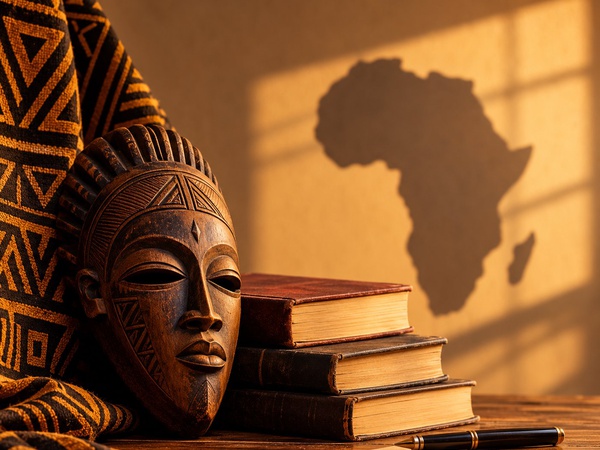
This is not the beginning of a plot, but the continuation of one; a pattern that has followed African writers even before we learnt the white man's tongue. For centuries, African creativity has wrestled with Western perceptions that diminish our works while building structures that sustain those perceptions.
In 1898, C. H. Read and O. M. Dalton, writing about the Benin artworks, expressed their astonishment at finding “so highly developed an art among a race so entirely barbarous.” They recognised the sophistication of the artwork but struggled to reconcile it with their perception of its creators. The art was acknowledged, but the people behind it were not given the same recognition. When minds like these helped shape how our history was understood, how do we expect those perceptions to disappear overnight?
Yet Africans continued to unleash their native intelligence: the freedom to think African, see Africa and write about Africa, unafraid and intentional. Wole Soyinka did it. Chinua Achebe did it. Amos Tutuola did it. Many others followed, each refusing to be confined to a single idea of African expression.
Like an orchestra, African writers breathe life into different tones, rhythms, rhymes and echoes of their lands. Africa does not have one single voice; it has a roar. Our stories carry the proverbs of our elders, the memories of our communities and the languages that give our experiences their particular meaning. But what happens when our writing moves beyond what the world has come to recognise as African? Amos Tutuola's The Palm-Wine Drinkard (1952), for instance, drew on Yoruba oral storytelling and was criticised by some for its unusual English and supposedly primitive style. In 2026, Zimbabwean writer Simbarashe Kundizeza faced accusations of using AI to write his story The Blue Fighter. A detector flagged almost the entire story, although the Caine Prize later cleared him after examining evidence of its creation. Different generations, different accusations, but the same troubling question: who gets to decide what an African writer is capable of producing?
This is why the African voice is being unfairly put on trial in the age of AI. The suspicion is not new; only the instrument has changed. Artificial intelligence can imitate human language, ideas and literary patterns, but its ability to produce convincing writing does not make every sophisticated human work machine-generated. Nor should a detector's suspicion become a verdict against an author.
Writing communities must protect originality, but banning every form of AI assistance is not the only answer. They need clear rules on acceptable AI use, transparent declarations, and fair verification processes. Writers should be able to present drafts, version histories and explanations of their creative decisions. Detection tools may raise questions, but they should never deliver the final judgment. The burden should be on a fair investigation, not an automatic accusation.
So, what makes a voice truly yours? It is the perspective through which you see the world, the experiences you carry, the memories you inherit and the imagination with which you give them life. A story can speak of your father's struggles, your children's hopes or a place you have never left. What matters is the human thought and intention that shape it.
Our voices matter. As African writers, we must tell our stories and those of our fathers and children, through our own eyes, minds and hands. We should not have to sound familiar to be believed, or sound different to be questioned. The African voice has been true all along. Perhaps it is time the world learnt to listen.
---
References
Read, C. H., & Dalton, O. M. (1898). Works of Art from Benin City. Journal of the Anthropological Institute of Great Britain and Ireland, 27, 362–382. Available at: https://africabib.org/rec.php?RID=P00047856 (Accessed: 19 November 2026).
Hart, C. (2009). In search of African literary aesthetics: Production and reception of the texts of Amos Tutuola and Yvonne Vera. Journal of African Cultural Studies, 21(2), 177–195. https://doi.org/10.1080/13696810903259400 (Accessed: 19 November 2026).
The Caine Prize for African Writing. (2026). Caine Prize confirms 2026 winner following suggestion of AI use. Available at: https://www.caineprize.com/press (Accessed: 19 November 2026).
Hadra, M., Cambridge, K., & Mesbah, M. (2026). Evaluating the accuracy and reliability of AI content detectors in academic contexts. International Journal for Educational Integrity, 22, Article 4. https://doi.org/10.1007/s40979-026-00213-1 (Accessed: 19 November 2026).


 16