Score |
585


Bolaji
 A Tutor And A Student @ Lagos State University
A Tutor And A Student @ Lagos State University



Can Nigeria Learn from Burkina Faso: Rethinking Africa’s Future
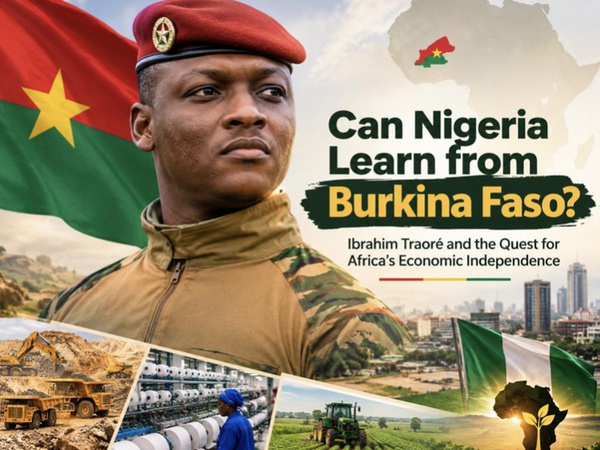
<p>Can Nigeria Learn from Burkina Faso: Rethinking Africa’s Future</p><p><br/></p><p>Can Nigeria still get better? Do we still have the potential to become the giant of Africa we have always claimed to be? Can African countries compete with European nations in economic growth, industrial production, social welfare, and national development?</p><p><br/></p><p>These are questions frequently asked by Nigerians and other Africans who have become increasingly concerned about the future of our continent. Africa is blessed with abundant natural resources, fertile land, and human potential capable of transforming it into one of the world's leading economic powers. Yet, many African countries continue to struggle with poverty, unemployment, insecurity, and economic instability.</p><p><br/></p><p>Our present challenges are partly rooted in the consequences of colonialism, our continued dependence on foreign manufactured goods, and the poor decisions of successive or past African leaders. For decades, many African countries have exported raw materials only to import finished products made from those same resources. This dependence has weakened local industries and limited our economic independence. Consequently, many Africans have lost hope in the possibility of meaningful development, particularly in Nigeria, where corruption, insecurity, and economic hardship continue to discourage young people.</p><p><br/></p><p>However, the developments in Burkina Faso under Captain Ibrahim Traore have renewed discussions about African self-reliance. Since coming to power in 2022, his government has pursued policies aimed at increasing national control over mineral resources, improving agriculture, and encouraging domestic production such as textile industry. </p><p><br/></p><p>In 2025, Burkina Faso took control of two gold mines through a state-owned mining company. It was currently reported that a big textile industry was launched in September 2026 to limit the rate of importing clothes and textile materials from abroad . His administration has also promoted agricultural mechanisation and food production as part of efforts to strengthen the country's economy. According to the World Bank, Burkina Faso's economy grew by an estimated 5.3 per cent in 2025, although insecurity and other economic challenges remain significant.</p><p><br/></p><p>These developments highlight an important lesson: African countries must begin to transform their natural resources into finished products, establish industries, support local businesses, and create employment opportunities for their citizens. Rather than depending excessively on imported goods, we must develop the capacity to produce what we consume. Nevertheless, these reforms must be assessed by their lasting effects on people's living standards, and Burkina Faso's challenges should not be overlooked.</p><p><br/></p><p>Nigeria, in particular, has enormous potential to achieve economic transformation. With its oil, gas, agricultural resources, solid minerals, and youthful population, the country has the foundation needed for sustainable development. If Nigerian leaders prioritise industrialisation, agricultural development, reliable electricity, education, and the fight against corruption, the country can make significant progress. Other African leaders can equally learn from Ibrahim Traore’s policies that promote self-reliance while ensuring good governance and respect for citizens' rights.</p><p><br/></p><p>Be that as it may , Africa's past may explain our challenges, but it must not determine our future. We can restore our glory, but not through hope alone. We must build, produce, innovate, and hold our leaders accountable.</p><p><br/></p><p>Therefore , here is the big question: Do you genuinely believe Nigeria can still become a developed nation and compete with European countries? Can other African leaders learn from Ibrahim Traoré's approach to economic self-reliance, or do you think Africa's challenges go far beyond leadership?</p><p><br/></p><p><br/></p>


 34
34


Other insights from Bolaji







Contributor Points

Points-to-Coupons

Referral Earning
Insights for you.

Happy Birthday Tobi 🤍
It's funny how much I've been built Many characters and scenes are definitely factors B...
145 views
35 upvotes
24 comments

Leadership begins with us
Let us face the truth. We're quick to point fingers at the government, but let's be rea...
865 views
19 upvotes
16 comments


The Work Ahead: What the Intellectual...
A boy sleeps under the Oshodi flyover in Lagos, one of thousands. In most tellings of N...
140 views
15 upvotes
14 comments


In a dilenma of choices, how do you i...
It does not really matter where we were.Neither does it really matter where we are.What...
414 views
12 upvotes
12 comments
Nigeria’s future might depend on our ...
I was scrolling on Twitter recently when a post stopped my thumb mid-swipe. A man was e...
185 views
16 upvotes
12 comments

Give me the Mandate...
“Madam President, what’s the update on the project?”She looked up from her phone.“Which...
113 views
12 upvotes
13 comments


ARE YOU JEALOUS OR IS IT LOW SELF EST...
Why do other people taping from your idea scare you?Is it because you are scared of bei...
515 views
10 upvotes
13 comments

The "As" and the "Like" _Shaping the ...
The "As" and "like" ..... in English Language they carry the same meaning but in a real...
382 views
12 upvotes
13 comments


"In dire need of compassion and chara...
A story was told about a man who was walking near the park and heard a sound from a nea...
1599 views
11 upvotes
11 comments