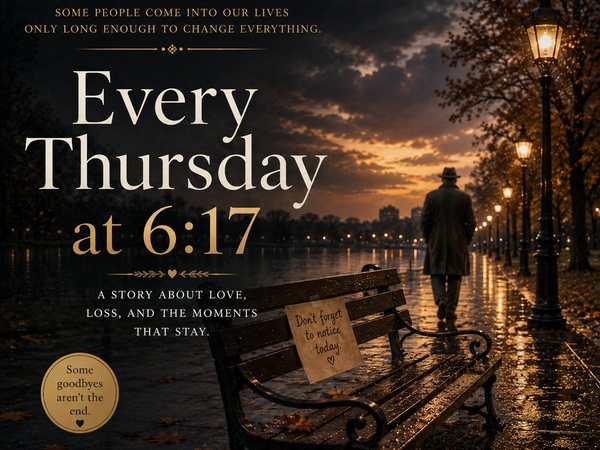
Every Thursday at exactly 6:17 p.m., a stranger sat on the same bench.
He never looked at his phone.
Never wore headphones.
Never read a book.
He simply sat there for one hour, hands folded neatly in his lap, as though he were waiting for someone who was always running late.
I noticed him because I was avoiding my own apartment.
My fiancé had died three months earlier.
Everyone said grief came in waves. Nobody warned me it could also come in routines.
Mine looked like buying coffee I didn't want, walking through the park until sunset, and pretending I wasn't counting all the couples still laughing together.
The man on the bench became part of my routine too.
Week after week, he came.
Same grey coat.
Same polished shoes.
Same distant smile whenever children ran past.
He looked peaceful in a way that almost annoyed me.
One rainy Thursday, curiosity beat good manners.
"Are you waiting for someone?" I asked.
He smiled.
"I was hoping someone would finally ask."
I laughed awkwardly.
"I'm serious."
"So am I."
He moved over, leaving enough space for me.
"My wife died seven years ago."
The sentence landed gently, as if he'd said it so many times it had worn smooth around the edges.
"I'm sorry."
"Don't be," he said. "We had forty-two years together. That's a miracle these days."
I didn't know what to say after that.
He looked toward the empty path ahead.
"She used to finish work at six every Thursday. We'd meet here before going home."
He tapped the bench softly.
"I came the week after her funeral because I didn't know where else to be."
"And you never stopped?"
"No."
"Why?"
He smiled again.
"Because love doesn't disappear just because the person does."
For a while, we watched people pass.
Children chased pigeons.
A teenager fell off a skateboard and laughed before anyone else could.
Life, rude as ever, continued.
"I used to think," he said quietly, "that moving on meant leaving her behind."
"And now?"
"Now I think moving on is taking her with me."
I felt something inside me loosen.
Not heal.
Just loosen.
He stood at exactly 7:17.
As if an invisible bell had rung.
Before leaving, he reached into his coat pocket and handed me a folded piece of paper.
"For next Thursday," he said.
He walked away before I could open it.
Inside were only twelve words.
Don't spend so much time missing yesterday that you forget to notice today.
The following Thursday, I arrived at the bench ten minutes early.
6:17 came.
Then 6:30.
Then 7.
He never came back.
I asked the coffee seller across the road if he knew the old man.
He frowned.
"The gentleman in the grey coat?"
"Yes."
"He stopped coming after his wife died... years ago."
"But I was talking to him last week."
The man looked at me strangely.
"No, miss."
"He passed away last winter."
I still go every Thursday.
Not because I'm waiting for him.
But because sometimes the people who save us only stay long enough to remind us that life is still waiting too.


 109